Unruh & Minkowski Modes: Analytic Extension Explained

Click For Summary

Discussion Overview

The discussion revolves around the analytic extension of Rindler modes and their relationship to Minkowski vacuum states, as presented in Sean Carroll's "Spacetime and Geometry." Participants explore the implications of analytic properties of modes in the context of quantum field theory, specifically addressing the nature of positive and negative frequency modes.

Discussion Character

  • Technical explanation
  • Debate/contested
  • Mathematical reasoning

Main Points Raised

  • One participant questions why the analytic and bounded nature of the extended Rindler modes implies they can be expressed solely in terms of positive-frequency Minkowski modes, specifically asking about the exclusion of negative frequency modes.
  • Another participant explains that positive frequency Minkowski modes are analytic in one half of the complex plane, while negative frequency modes are analytic in the opposite half, suggesting that a function analytic in one half cannot include contributions from modes analytic in the other half.
  • A participant challenges this by asking if left-moving negative frequency modes could be analytic in the same half of the complex plane.
  • Another response reiterates that right-moving waves can only be expanded in terms of right-moving modes, indicating a restriction on superimposing left and right moving modes for a purely right-moving wave.
  • One participant raises a question regarding differing definitions of Unruh modes found in different sources, expressing confusion about how they could be equivalent.
  • Another participant suggests that the discrepancy in definitions may stem from a typo or a different convention used in the other paper.

Areas of Agreement / Disagreement

Participants express differing views on the analytic properties of modes and their implications, indicating that multiple competing perspectives remain unresolved regarding the relationship between Rindler and Minkowski modes.

Contextual Notes

There are unresolved assumptions regarding the definitions and conventions used in the different sources for Unruh modes, which may affect the interpretation of the claims made.

KDPhysics
Messages
73
Reaction score
24
TL;DR
Why do the so-called unruh modes which are extensions of Rindler modes share the same vacuum as the Minkowski modes, as explained in Carroll's Spacetime and geometry?
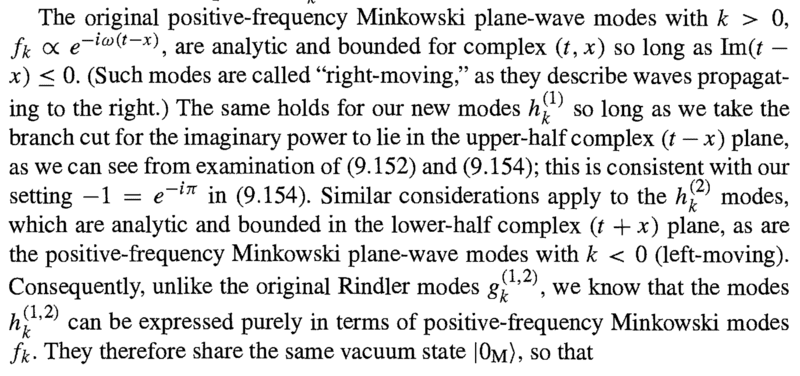
In Carroll "Spacetime and Geometry" I found the following explanation for why the analytically extended rindler modes share the same vacuum state as the Minkowski vacuum state:
Screenshot 2021-10-31 at 23.22.40.png

I can't quite understand why the fact that the extended modes [\tex]h_k^{(1),(2)}[\tex] are analytic and bounded on the same region as the Minkowski modes proves that [\tex]h_k^{(1),(2)}[\tex] can be expressed in terms of positive-frequency Minkowski modes only. Why are negative frequency modes out of the picture?
 
  • Like
Likes   Reactions: Demystifier
Physics news on Phys.org
For simplicity, consider only right-moving modes. (The argument for left-moving ones will be analogous.) Positive frequency Minkowski modes are analytic in one half of the complex plane, while negative frequency Minkowski modes are analytic in the other half. Hence, a function that is analytic in one (and not in the other!) half of the plane must have expansion only in terms of one set of Minkowski modes. Modes which are not analytic in the needed half cannot contribute to a function which is analytic there.
 
Last edited:
  • Like
Likes   Reactions: vanhees71 and KDPhysics
But couldn't the left moving negative frequency modes be analytic in that half of the complex plane?
 
KDPhysics said:
But couldn't the left moving negative frequency modes be analytic in that half of the complex plane?
Right moving wave has an expansion only in terms of right moving modes. You cannot superimpose both left and right moving modes to get a purely right moving wave.
 
Last edited:
  • Like
Likes   Reactions: vanhees71 and KDPhysics
I see, thanks!
 
  • Like
Likes   Reactions: Demystifier
One last question, the Unruh modes as defined in Sean Carroll's "Spacetime and Geometry" are:
$$h_k^{(1)} = \frac{1}{\sqrt{2\sinh(\pi \omega/a)}}\big(e^{\pi \omega/2a} g_k^{(1)} + e^{-\pi \omega/2a} g_{-k}^{(2)}{}^*\big)$$
On the other hand this paper gives a different definition:
$$h_k^{(1)} = \frac{1}{\sqrt{2\sinh(\pi \omega/a)}}\big(e^{\pi \omega/2a} g_k^{(1)} + e^{-\pi \omega/2a} g_{k}^{(2)}{}^*\big)$$
I can't quite understand how these could be the same.
 
The other paper either has a typo or uses a different convention for definition of second modes.
 

Similar threads

  • · Replies 2 ·
Replies
2
Views
2K
  • · Replies 23 ·
Replies
23
Views
3K
  • · Replies 40 ·
2
Replies
40
Views
5K
  • · Replies 8 ·
Replies
8
Views
12K
  • · Replies 1 ·
Replies
1
Views
1K
  • · Replies 12 ·
Replies
12
Views
4K
  • · Replies 7 ·
Replies
7
Views
2K
  • · Replies 5 ·
Replies
5
Views
2K
  • · Replies 5 ·
Replies
5
Views
3K
  • · Replies 2 ·
Replies
2
Views
1K