Unsolvable tension force problem

Click For Summary

Homework Help Overview

The discussion revolves around a tension force problem from a statics class, specifically addressing the equilibrium conditions of a system involving a rope and a ring acting as a pulley. Participants are exploring the implications of the net force being zero and the behavior of tension forces in different components of the system.

Discussion Character

  • Conceptual clarification, Assumption checking

Approaches and Questions Raised

  • Participants are examining the tension forces in the rope segments and questioning whether the components of force must individually equal zero for the system to be in equilibrium. There is also discussion about the role of the ring as a pulley and its impact on the tension forces.

Discussion Status

The conversation is ongoing, with participants expressing confusion about the conditions for equilibrium and the nature of the forces involved. Some have suggested that the problem may be unsolvable as posed, while others are clarifying the definitions and roles of the components in the system.

Contextual Notes

There is a concern regarding the assumptions made about the forces acting in the z direction and whether the system can achieve equilibrium under the given conditions. The original poster notes that the problem was deemed unsolvable by the professor, which adds to the complexity of the discussion.

KABOOM_physics
Messages
5
Reaction score
0
This was a problem on an exam that our professor later discovered was unsolvable THE WAY HE POSED THE QUESTION. First off, it's important to note that this is from a statics class, therefore Fnet = 0 will be true for all problems in our course.

So here's my thoughts on this and I would like to see if anyone else agrees with me or if I'm just completely way off.

If rope EAD has a tension force of 980N, the so should the AD segment of that rope. The z component of AD should have a F = 980cos(1/sqrt(8)) in the positive z direction. Since there are no other forces with components in either z direction, it would imply that the arrangement has not settled and will move. which would imply that Fnet does not = 0. Also I understand that the center ring can act as a pulley (which in this problem has no mass or friction), however it is not a fixed pulley. So wouldn't the Fnet for each component (x,y,z) have to equal 0 individually?

Any help or insight to create a proper response is much appreciated.

Thanks,
Steve
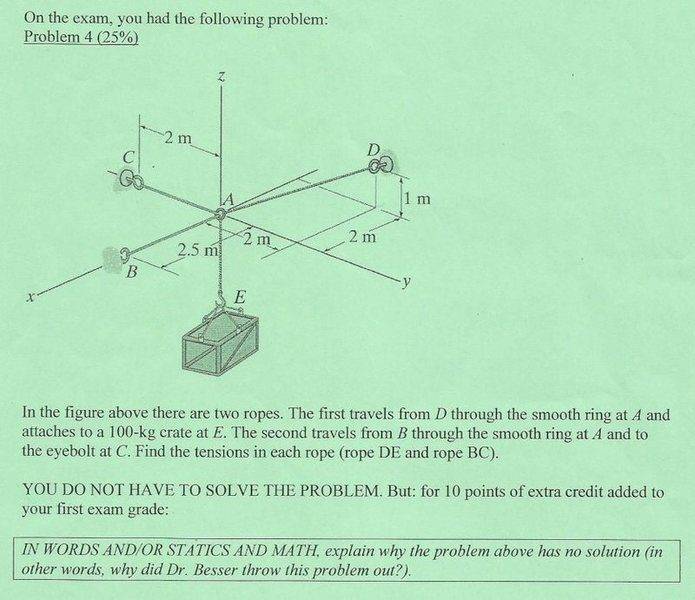
Scan.jpg
 
Physics news on Phys.org
I'm confused when you say "act as a pulley" but if we can ignore this and just go back to your original statement about the z component. If Fnet=0 then the z component has to equal the force in AE doesn't it?
 
  • Like
Likes   Reactions: KABOOM_physics
If you consider pulley systems in physics that we examine to be massless and frictionless then it wouldn't matter if the pulley rotated or not. The function of the pulley is to redirect the rope and thus redirecting the tension force. This basically does the same thing, doesn't it? The only difference is that instead of the "pulley" being fixed on a wedge or table, the "pulley" is free floating. I guess the main thing that has me confused is do the components each individually need to equal zero? Or is it possible for them to have some magnitude but the net force still equals zero?
 
Well I'm not sure about your definition of the function of a pulley but in this case, yes, you are correct the ring is redirecting the tension force.

The components do not need to be anything other than that which is required to maintain equilibrium. But maybe first answer my question above.
 
  • Like
Likes   Reactions: KABOOM_physics
Thats part of the problem though. Yes, the -z component would be EA, but remember that EA is part of the whole rope EAD. If this system were at equilibrium and Fnet = 0, then there should be another +z component of equal magnitude, or a combination of +z components. The section AD would have some +z force component to it, but it couldn't possibly be enough if EAD were all the same force. But if the components of Fnet do not need to equal 0 individually then that doesn't matter, right?
 
Sorry, I don't know what you mean by your last sentence.

You claim that EAD must be the same force. If we assume the ring is frictionless and dimensionless then I think you are correct.
 
  • Like
Likes   Reactions: KABOOM_physics
KABOOM_physics said:
I guess the main thing that has me confused is do the components each individually need to equal zero? Or is it possible for them to have some magnitude but the net force still equals zero?

The only way a vector can be the zero vector is for each of its components to be zero.
 
  • Like
Likes   Reactions: KABOOM_physics
Ok, so then this problem is unsolvable the way it is asked because it is not possible for there to be enough of an opposing force in the +z direction for the system to have an Fnet of 0? Does that sound right?
 
KABOOM_physics said:
Ok, so then this problem is unsolvable the way it is asked because it is not possible for there to be enough of an opposing force in the +z direction for the system to have an Fnet of 0? Does that sound right?
That sounds right to me.
 
  • Like
Likes   Reactions: KABOOM_physics
  • #10
Awesome, thank you!
 

Similar threads

  • · Replies 9 ·
Replies
9
Views
2K
  • · Replies 22 ·
Replies
22
Views
2K
  • · Replies 2 ·
Replies
2
Views
2K
  • · Replies 10 ·
Replies
10
Views
5K
  • · Replies 4 ·
Replies
4
Views
2K
  • · Replies 24 ·
Replies
24
Views
10K
  • · Replies 12 ·
Replies
12
Views
4K
  • · Replies 7 ·
Replies
7
Views
5K
  • · Replies 6 ·
Replies
6
Views
2K
  • · Replies 3 ·
Replies
3
Views
2K