Upper and lower bounds of integral

  • Context: Undergrad 
  • Thread starter Thread starter ddddd28
  • Start date Start date
  • Tags Tags
    Bounds Integral
Click For Summary
SUMMARY

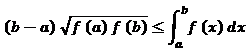
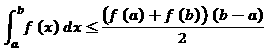
The discussion centers on the validity of the inequality involving definite integrals and functions, specifically the expression (b-a)√(f(a)f(b)) ≤ ∫_a^b f(x) dx. Counterexamples are provided, including f(x) = x and f(x) = cos(x), demonstrating that the inequality does not hold for all functions, particularly polynomial ones. The participants emphasize the necessity of considering absolute values to avoid undefined scenarios, particularly when dealing with negative outputs under square roots.

PREREQUISITES
  • Understanding of definite integrals and their geometric interpretation.
  • Familiarity with polynomial functions and their properties.
  • Basic knowledge of calculus, particularly integration techniques.
  • Concept of absolute values in mathematical expressions.
NEXT STEPS
  • Research the properties of definite integrals and their applications in calculus.
  • Study the implications of absolute values in integral inequalities.
  • Explore counterexamples in calculus to understand the limitations of mathematical inequalities.
  • Learn about the behavior of polynomial functions and their integrals over specified intervals.
USEFUL FOR

Students studying calculus, mathematicians interested in integral inequalities, and educators seeking to explain the nuances of definite integrals and their limitations.

ddddd28
Messages
73
Reaction score
4
Is it always true that:
upload_2016-9-8_20-37-30.png


upload_2016-9-8_20-38-26.png

Noticing that it works for some functions, I wanted to ensure it is true for all of them( at least polynomical), but since I am still in high school, and I don't have deep understanding in calculus( yet), the question is forwarded to you. proof please!
 

Attachments

  • upload_2016-9-8_20-27-29.png
    upload_2016-9-8_20-27-29.png
    414 bytes · Views: 608
  • upload_2016-9-8_20-37-24.png
    upload_2016-9-8_20-37-24.png
    471 bytes · Views: 652
Last edited by a moderator:
Physics news on Phys.org
The first equation is obviously false. Consider: ##f: \mathbb{R} \rightarrow \mathbb{R}: x \mapsto x.##

Then, ##\int\limits_{-1}^1 x dx = 0##, while ##(b-a) \sqrt{f(a) f(b)} = 2 \sqrt{-1} \quad ##is not defined when we only allow real numbers.
 
Last edited by a moderator:
  • Like
Likes   Reactions: zaidalyafey
In order to calculate that area , one needs to divide the parts. Let's assume also that only the absolute values are taken, and then , there will not be any problems with the root output. Thus, the formula is still valid.
 
ddddd28 said:
In order to calculate that area , one needs to divide the parts. Let's assume also that only the absolute values are taken, and then , there will not be any problems with the root output. Thus, the formula is still valid.

I don't see absolute values in the formula itself though.
 
Consider the function

$$f(x) = x(1-x)$$

Then

$$\int^1_0 x(1-x) dx = \frac{x^2}{2}-\frac{x^3}{3} = \frac{1}{6} > \frac{f(1)+f(0)}{2} = 0$$
 
  • Like
Likes   Reactions: member 587159
ok, what about the first part of the formula?
 
Math_QED said:
The first equation is obviously false. Consider: ##f: \mathbb{R} \rightarrow \mathbb{R}: x \mapsto x.##

Then, ##\int\limits_{-1}^1 x dx = 0##, while ##(b-a) \sqrt{f(a) f(b)} = 2 \sqrt{-1} \quad ##is not defined when we only allow real numbers.
ddddd28 said:
In order to calculate that area ,
one needs to divide the parts.
@ddddd28, you posted an inequality that included a definite integral, which can represent an area, but doesn't have to.
The inequality was ##(b - a)\sqrt{f(a)f(b)} \le \int_a^b f(x) dx##
ddddd28 said:
Let's assume also that only the absolute values are taken, and then , there will not be any problems with the root output. Thus, the formula is still valid.
 
For the first equation. Consider the function

$$f (x) = \cos(x), a= 0 , b= 2\pi$$

$$2 \pi \sqrt {1 \times 1} >\int^{2\pi}_0\cos(x ) dx=0$$
 
ddddd28 said:
Is it always true that:
View attachment 105614

View attachment 105615
Noticing that it works for some functions, I wanted to ensure it is true for all of them( at least polynomical), but since I am still in high school, and I don't have deep understanding in calculus( yet), the question is forwarded to you. proof please!
Both false - simple counterexamples:
(1) f(x)=x^2,\ a=-1,\ b=1,\ (2) f(x)=1-x^2,\ a=-1,\ b=1
 
Last edited by a moderator:

Similar threads

  • · Replies 23 ·
Replies
23
Views
4K
  • · Replies 5 ·
Replies
5
Views
2K
  • · Replies 8 ·
Replies
8
Views
3K
Replies
11
Views
2K
  • · Replies 2 ·
Replies
2
Views
2K
  • · Replies 2 ·
Replies
2
Views
2K
  • · Replies 4 ·
Replies
4
Views
2K
  • · Replies 1 ·
Replies
1
Views
2K
  • · Replies 6 ·
Replies
6
Views
2K
Replies
2
Views
2K