Use Excel to find the similarity between functions.

  • Thread starter Thread starter 24forChromium
  • Start date Start date
  • Tags Tags
    Excel Functions
Click For Summary
To quantitatively describe the closeness of the predicted values from a hypothetical relationship to actual experimental readings, several statistical methods can be employed. A χ2 test can assess the goodness of fit between the predicted and actual data. Additionally, calculating the R2 value from the linear regression will provide insight into how well the model explains the variance in the data. Confidence intervals for the slope and intercept of the regression line can also indicate whether the theoretical parameters fall within an acceptable range. Visual inspection of the data suggests potential shortcomings in the theoretical model, which may lead to its statistical rejection.
24forChromium
Messages
155
Reaction score
7
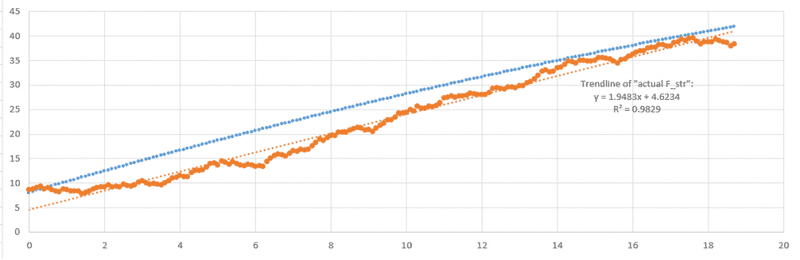
I am writing a paper and I came up with a function that uses a hypothetical relationship to predict the value of one variable at different points in time, I graphed it, and then graphed the actual readings from an experiment. How can quantitatively describe how close the two trends are? In other words, how can I quantitatively describe the amount of support the hypothetical relationship get from the experiment? See image for more ideas, predictive function gives values in blue, actual readings are orange.
Screenshot 2015-09-15 21.39.28.png
 
Computer science news on Phys.org
You could perform a χ2 test. You can also calculate the R2 for your model, since you already have the value for the linear regression.

If you don't know what any of that means, you can start with https://en.wikipedia.org/wiki/Goodness_of_fit
 
You can get the confidence intervals for the slope and intercept of the regression line. For a given confidence level, your theoretical parameters will be in or out of the confidence interval. Just eyeballing the data, the regression line, and your theoretical line, I think there is something missing from your theory. I think it is likely to be statistically rejected.
 
Thread 'ChatGPT Examples, Good and Bad'
I've been experimenting with ChatGPT. Some results are good, some very very bad. I think examples can help expose the properties of this AI. Maybe you can post some of your favorite examples and tell us what they reveal about the properties of this AI. (I had problems with copy/paste of text and formatting, so I'm posting my examples as screen shots. That is a promising start. :smile: But then I provided values V=1, R1=1, R2=2, R3=3 and asked for the value of I. At first, it said...

Similar threads

  • · Replies 1 ·
Replies
1
Views
3K
Replies
10
Views
6K
  • · Replies 5 ·
Replies
5
Views
2K
  • · Replies 4 ·
Replies
4
Views
3K
  • · Replies 2 ·
Replies
2
Views
2K
  • · Replies 61 ·
3
Replies
61
Views
4K
  • · Replies 3 ·
Replies
3
Views
2K
  • · Replies 9 ·
Replies
9
Views
2K
  • · Replies 2 ·
Replies
2
Views
2K
  • · Replies 1 ·
Replies
1
Views
2K