Using continuity to evaluate a limit of a composite function

4 replies · 2K views · last reply
member 731016
Homework Statement
Please see below
Relevant Equations
Please see below
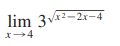
For this problem,
Printed instruction reading: Use continuity to evaluate the limit.

Limit expression: lim as x approaches 4 of 3 raised to the power of the square root of (x^2 - 2x - 4).

The solution is,
Typeset solution text: f(x) = 3 to the power sqrt(x^2 - 2x - 4) is continuous on its domain; domain is {x | x^2 - 2x - 4 >= 0} = {x | (x-1)^2 >= 5} = {x | |x-1| >= sqrt(5)} = (-inf, 1 - sqrt(5)] union [1 + sqrt(5), inf); f(4) = 3^sqrt(16-8-4) = 3^2 = 9.

However, I tried to solve this problem using my Graphics Calculator instead of completing the square. I got the zeros of ##x^2 - 2x - 4## to be ##x_1 = 3.236## and ##x_2 = -1.236##

Therefore ##x_1 ≥ 3.236## and ##x_2 ≥ -1.236##

Since ##x_1 > x_2## then,

Therefore ## (x | x ≥ -1.236 ) ## which is ##~(x | x ≥ 1 - \sqrt{5} )~## (sorry curly brackets were not working), however, my domain restriction excludes some other values shown in the solution. Dose anybody please know a way using my method to get those values?

Many thanks!
 
Last edited by a moderator:
In the process of ##lim_{x\rightarrow 4}## we put x in the region ##(4-\epsilon, 4+\epsilon)## for any small positive number ##\epsilon##, which is in your {x| 3.236<x} but not in {x|x<-1.236}.

For an example of another exercise of ##lim_{x\rightarrow -2}## we put x in the region ##(-2-\epsilon, -2+\epsilon)## for any small positive number ##\epsilon##, which is not in your {x| 3.236<x} but is in {x|x<-1.236}.
 
  • Like
Likes   Reactions: member 731016
anuttarasammyak said:
In the process of ##lim_{x\rightarrow 4}## we put x in the region ##(4-\epsilon, 4+\epsilon)## for any small positive number ##\epsilon##, which is in your {x| 3.236<x} but not in {x|x<-1.236}.

For an example of another exercise of ##lim_{x\rightarrow -2}## we put x in the region ##(-2-\epsilon, -2+\epsilon)## for any small positive number ##\epsilon##, which is not in your {x| 3.236<x} but is in {x|x<-1.236}.
Thank you for your reply @anuttarasammyak !

Sorry, I have not really done by epsilon-delta definition of a limit.

Many thanks!
 
ChiralSuperfields said:
Homework Statement: Please see below
Relevant Equations: Please see below

For this problem,
View attachment 324502
View attachment 324503
The solution is,
View attachment 324504
However, I tried to solve this problem using my Graphics Calculator instead of completing the square. I got the zeros of ##x^2 - 2x - 4## to be ##x_1 = 3.236## and ##x_2 = -1.236##

Therefore ##x_1 ≥ 3.236## and ##x_2 ≥ -1.236##

Since ##x_1 > x_2## then,

Therefore ## (x | x ≥ -1.236 ) ## which is ##~(x | x ≥ 1 - \sqrt{5} )~## (sorry curly brackets were not working), however, my domain restriction excludes some other values shown in the solution. Dose anybody please know a way using my method to get those values?

Many thanks!

For [itex]P(x) = ax^2 + bx + c[/itex]:

If [itex]P[/itex] has only a single real root, or no real roots:
  • If [itex]a > 0[/itex] then [itex]P(x) \geq 0[/itex] everywhere.
  • If [itex]a < 0[/itex] then [itex]P(x) \geq 0[/itex] only at the real root (if any).
If [itex]P[/itex] has two distinct real roots [itex]r_1 < r_2[/itex]:
  • If [itex]a > 0[/itex] then [itex]P(x) \geq 0[/itex] for [itex]x \leq r_1[/itex] or [itex]x \geq r_2[/itex] ("outside the roots").
  • If [itex]a < 0[/itex] then [itex]P(x) \geq 0[/itex] for [itex]r_1 \leq x \leq r_2[/itex] ("between the roots").

All of these results follow from the facts that [itex]P(x)[/itex] is positive for all sufficiently large [itex]|x|[/itex] if [itex]a > 0[/itex] and negative for all sufficiently large [itex]|x|[/itex] if [itex]a < 0[/itex] and that a polynomial only changes sign at a real root of odd multiplicity.

Alternatively, by completing the square you can reduce this to either [itex]|x - p| \leq q[/itex] or [itex]|x - p| \geq q[/itex]. The first has the interpretation that [itex]x[/itex] is at most [itex]q[/itex] units away from [itex]p[/itex], ie. [itex]p - q \leq x \leq p + q[/itex]. The second has the interpretation that [itex]x[/itex] is at least [itex]q[/itex] units away from [itex]p[/itex], ie. [itex]x \leq p -q[/itex] or [itex]x \geq p + q[/itex].
 
Last edited:
  • Informative
Likes   Reactions: member 731016
This seems a case of using continuity implies sequential continuity. ( Though the converse is false).
 
  • Like
Likes   Reactions: member 731016