Sekonda
- 201
- 0
Hey,
My question concerns parts (a), (b) and (c) in the below.
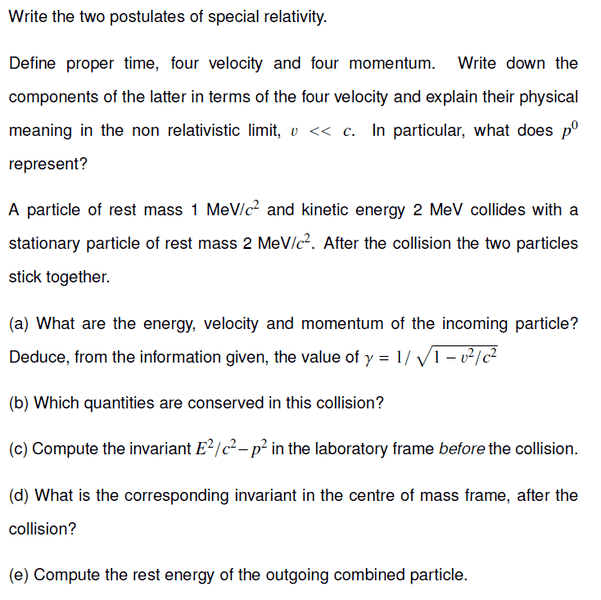
In part (a) we're asked to find the energy, velocity and momentum of the incoming particle AND then to find gamma, however I know the energy of the incoming particle is simply 3MeV but I'm not sure how to find the velocity without finding gamma first? I'm not sure whether this matters but I found E=3MeV, p=2√2 MeV/c and v=2c/3*√2... Is this right? and γ=3
Part (b) asks which quantities are conserved - surely this is just energy and momentum? Or is the invariant of energy and momentum?
Part (c) asks to compute the invariant of the system - I'm guessing 'E' is just the total energy i.e. sum of incoming with rest of stationary and 'p' is the momentum determined in part (a)
Thanks for any help/confirmation on answers,
SK
My question concerns parts (a), (b) and (c) in the below.
In part (a) we're asked to find the energy, velocity and momentum of the incoming particle AND then to find gamma, however I know the energy of the incoming particle is simply 3MeV but I'm not sure how to find the velocity without finding gamma first? I'm not sure whether this matters but I found E=3MeV, p=2√2 MeV/c and v=2c/3*√2... Is this right? and γ=3
Part (b) asks which quantities are conserved - surely this is just energy and momentum? Or is the invariant of energy and momentum?
Part (c) asks to compute the invariant of the system - I'm guessing 'E' is just the total energy i.e. sum of incoming with rest of stationary and 'p' is the momentum determined in part (a)
Thanks for any help/confirmation on answers,
SK