Using polar coordinates to describe rose petals

Click For Summary
SUMMARY

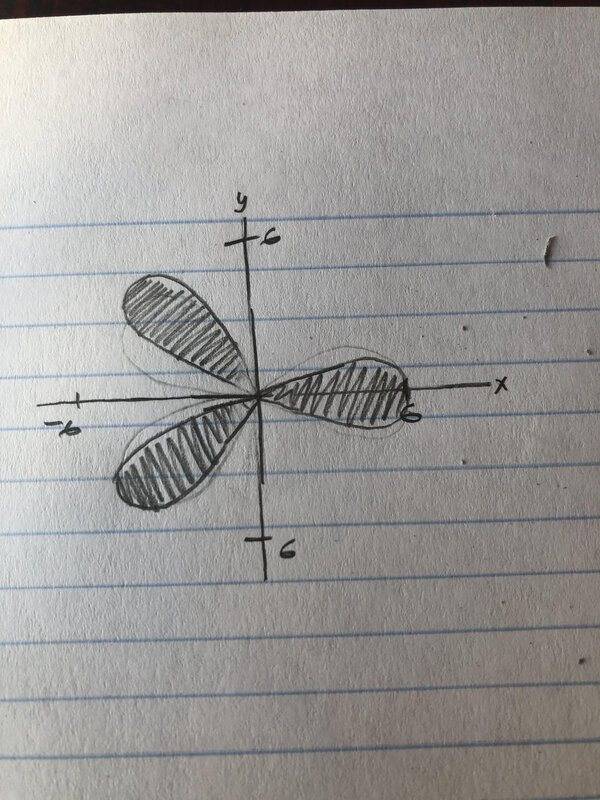
The discussion focuses on describing rose petals using polar coordinates, specifically the equation R = {(r, θ): 0 ≤ r ≤ 6 cos(3θ), 0 ≤ θ ≤ π}. The periodic nature of the function allows for the determination of additional petals by applying the phase shift r(θ + 2π/3) = r(θ). This periodicity means that once one petal is drawn, the others can be derived through this transformation, demonstrating the relationship between polar and Cartesian coordinates.

PREREQUISITES
  • Understanding of polar coordinates and their equations
  • Knowledge of periodic functions and phase shifts
  • Familiarity with trigonometric functions, specifically cosine
  • Basic concepts of Cartesian coordinates and their transformations
NEXT STEPS
  • Explore the properties of polar coordinates in depth
  • Learn about the graphical representation of polar equations
  • Study the implications of periodicity in trigonometric functions
  • Investigate transformations between polar and Cartesian coordinates
USEFUL FOR

Mathematicians, educators, and students studying polar coordinates and trigonometric functions, particularly those interested in graphical representations and transformations in mathematics.
Worn_Out_Tools
Messages
6
Reaction score
1
I encountered a question which asked me to describe the rose petal sketched below in polar coordinates. The complete answer is
R = {(r, θ): 0 ≤ r ≤ 6 cos(3θ), 0 ≤ θ ≤ π}. That makes sense to me for the right petal. What about the other two on the left?

Rose petal.jpg
 
Physics news on Phys.org
Worn_Out_Tools said:
I encountered a question which asked me to describe the rose petal sketched below in polar coordinates. The complete answer is
R = {(r, θ): 0 ≤ r ≤ 6 cos(3θ), 0 ≤ θ ≤ π}. That makes sense to me for the right petal. What about the other two on the left?

View attachment 267067
Welcome to the PF. :smile:

What is different about the other two petals in polar coordinates?
 
  • Like
Likes   Reactions: etotheipi
##r(\theta + \frac{2\pi}{3}) = r(\theta)## since ##r## is periodic at ##\frac{2\pi}{3}##, so once you have drawn one petal you can insert the rest
 
  • Like
Likes   Reactions: berkeman
etotheipi said:
##r(\theta + \frac{2\pi}{3}) = r(\theta)## since ##r## is periodic at ##\frac{2\pi}{3}##, so once you have drawn one petal you can insert the rest
Wait, I don’t understand, how’d you determine that?
 
  • Like
Likes   Reactions: etotheipi
Worn_Out_Tools said:
Wait, I don’t understand, how’d you determine that?
There are two ways you can think about it. Consider the function ##r = 6\cos{(3\theta)}##. If we consider some angle ##\theta_0## where ##r(\theta_0) = r_0##, then we see that$$r \left(\theta_0 + \frac{2\pi}{3} \right) = 6\cos{\left(3(\theta_0 + \frac{2\pi}{3})\right)} = 6\cos{(3\theta_0 + 2\pi)} = 6\cos{(3\theta_0)} = r(\theta_0) = r_0$$which means that both ##\theta_0## and ##\theta_0 + \frac{2\pi}{3}## correspond to equal radial coordinates. The other way to look at it is what I think @berkeman was suggesting, i.e. consider transforming the original function by a constant translation,$$r_2(\theta) := r(\theta + \frac{2\pi}{3})$$so ##r_2## is shifted left of ##r## by the amount ##\Delta \theta = -\frac{2\pi}{3}##. But the periods of both ##r## and ##r_2## are equal to ##\frac{2\pi}{3}##, so we've just shifted the waveform left an entire period. Since ##r## and ##r_2## are then equal everywhere, we have$$r(\theta) = r_2(\theta) = r(\theta + \frac{2\pi}{3})$$And finally, what amounts to a horizontal shift in ##r## vs ##\theta## on Cartesian axes corresponds to a rotation in polar coordinates!
 
Last edited by a moderator:
  • Like
Likes   Reactions: berkeman

Similar threads

Replies
1
Views
2K
  • · Replies 3 ·
Replies
3
Views
3K
  • · Replies 1 ·
Replies
1
Views
2K
  • · Replies 13 ·
Replies
13
Views
3K
  • · Replies 6 ·
Replies
6
Views
3K
  • · Replies 20 ·
Replies
20
Views
7K
  • · Replies 6 ·
Replies
6
Views
4K
  • · Replies 1 ·
Replies
1
Views
3K
  • · Replies 5 ·
Replies
5
Views
4K
  • · Replies 5 ·
Replies
5
Views
2K