Using polar coordinates to describe rose petals

Click For Summary

Discussion Overview

The discussion revolves around describing rose petals using polar coordinates, specifically focusing on the mathematical representation of these petals and the periodic nature of the functions involved. Participants explore the implications of the polar equation for the petals and how to derive the coordinates for multiple petals based on a single petal's equation.

Discussion Character

  • Technical explanation
  • Mathematical reasoning
  • Debate/contested

Main Points Raised

  • Some participants propose that the polar equation for the right petal is given by R = {(r, θ): 0 ≤ r ≤ 6 cos(3θ), 0 ≤ θ ≤ π} and question how this applies to the other petals.
  • Others argue that the periodicity of the function allows for the determination of the other petals, noting that ##r(\theta + \frac{2\pi}{3}) = r(\theta)## indicates that once one petal is drawn, the others can be derived from it.
  • A later reply provides a detailed mathematical explanation, showing how the periodic nature of the cosine function leads to equal radial coordinates for angles that differ by ##\frac{2\pi}{3}##.
  • Some participants express confusion about the reasoning behind the periodicity and seek clarification on how phase shifts in rectangular coordinates translate to polar coordinates.
  • One participant suggests that the transformation of the original function by a constant translation can help understand the relationship between the petals.

Areas of Agreement / Disagreement

Participants generally agree on the periodic nature of the polar function and its implications for describing multiple petals. However, there is some confusion regarding the reasoning and mathematical justification for these relationships, indicating that the discussion remains partially unresolved.

Contextual Notes

The discussion includes assumptions about the periodicity of the polar function and its implications, but these assumptions are not universally accepted or clarified, leading to some uncertainty in the reasoning presented.

Worn_Out_Tools
Messages
6
Reaction score
1
I encountered a question which asked me to describe the rose petal sketched below in polar coordinates. The complete answer is
R = {(r, θ): 0 ≤ r ≤ 6 cos(3θ), 0 ≤ θ ≤ π}. That makes sense to me for the right petal. What about the other two on the left?
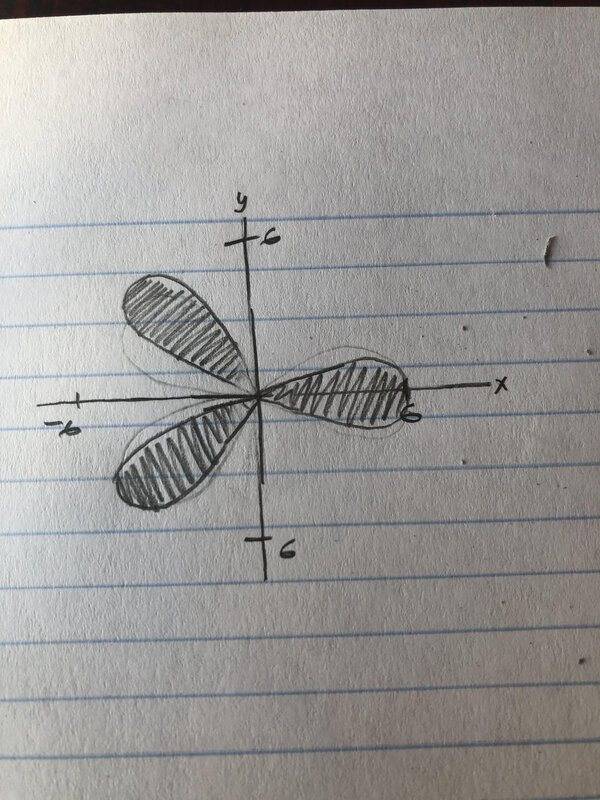
Rose petal.jpg
 
Physics news on Phys.org
Worn_Out_Tools said:
I encountered a question which asked me to describe the rose petal sketched below in polar coordinates. The complete answer is
R = {(r, θ): 0 ≤ r ≤ 6 cos(3θ), 0 ≤ θ ≤ π}. That makes sense to me for the right petal. What about the other two on the left?

View attachment 267067
Welcome to the PF. :smile:

What is different about the other two petals in polar coordinates?
 
  • Like
Likes   Reactions: etotheipi
##r(\theta + \frac{2\pi}{3}) = r(\theta)## since ##r## is periodic at ##\frac{2\pi}{3}##, so once you have drawn one petal you can insert the rest
 
  • Like
Likes   Reactions: berkeman
etotheipi said:
##r(\theta + \frac{2\pi}{3}) = r(\theta)## since ##r## is periodic at ##\frac{2\pi}{3}##, so once you have drawn one petal you can insert the rest
Wait, I don’t understand, how’d you determine that?
 
  • Like
Likes   Reactions: etotheipi
Worn_Out_Tools said:
Wait, I don’t understand, how’d you determine that?
There are two ways you can think about it. Consider the function ##r = 6\cos{(3\theta)}##. If we consider some angle ##\theta_0## where ##r(\theta_0) = r_0##, then we see that$$r \left(\theta_0 + \frac{2\pi}{3} \right) = 6\cos{\left(3(\theta_0 + \frac{2\pi}{3})\right)} = 6\cos{(3\theta_0 + 2\pi)} = 6\cos{(3\theta_0)} = r(\theta_0) = r_0$$which means that both ##\theta_0## and ##\theta_0 + \frac{2\pi}{3}## correspond to equal radial coordinates. The other way to look at it is what I think @berkeman was suggesting, i.e. consider transforming the original function by a constant translation,$$r_2(\theta) := r(\theta + \frac{2\pi}{3})$$so ##r_2## is shifted left of ##r## by the amount ##\Delta \theta = -\frac{2\pi}{3}##. But the periods of both ##r## and ##r_2## are equal to ##\frac{2\pi}{3}##, so we've just shifted the waveform left an entire period. Since ##r## and ##r_2## are then equal everywhere, we have$$r(\theta) = r_2(\theta) = r(\theta + \frac{2\pi}{3})$$And finally, what amounts to a horizontal shift in ##r## vs ##\theta## on Cartesian axes corresponds to a rotation in polar coordinates!
 
Last edited by a moderator:
  • Like
Likes   Reactions: berkeman

Similar threads

Replies
1
Views
2K
  • · Replies 3 ·
Replies
3
Views
3K
  • · Replies 1 ·
Replies
1
Views
2K
  • · Replies 13 ·
Replies
13
Views
3K
  • · Replies 6 ·
Replies
6
Views
3K
  • · Replies 20 ·
Replies
20
Views
7K
  • · Replies 6 ·
Replies
6
Views
4K
  • · Replies 1 ·
Replies
1
Views
3K
  • · Replies 5 ·
Replies
5
Views
4K
  • · Replies 5 ·
Replies
5
Views
2K