Graduate Variational derivative and Euler-Poincare equations

Click For Summary
SUMMARY

The discussion centers on the Euler-Poincare equations and their relationship with variational derivatives, specifically in the context of Lagrangians on Lie groups. Participants reference Darryl Holm's "Geometric Mechanics and Symmetry" and explore the definitions of variational derivatives, particularly the expression ##\frac{\delta l}{\delta u}##. The conversation clarifies that this variational derivative can be equated to the partial derivative ##\frac{\partial l}{\partial u}## when ##l## is an ordinary function of the vector ##u##. Additionally, the integral representation of the inner product in the context of differential forms is discussed, emphasizing the importance of understanding the roles of derivatives in various contexts.

PREREQUISITES
  • Understanding of Euler-Lagrange equations
  • Familiarity with variational calculus
  • Knowledge of Lie groups and their applications
  • Basic concepts of differential forms and inner products in functional spaces
NEXT STEPS
  • Study the Euler-Poincare reduction theorem in detail
  • Explore variational derivatives in the context of Lagrangian mechanics
  • Learn about differential forms and their role in variational calculus
  • Investigate the applications of Lie groups in geometric mechanics
USEFUL FOR

Mathematicians, physicists, and engineers interested in advanced mechanics, particularly those focusing on variational principles and geometric approaches to dynamics.

eipiplusone
Messages
9
Reaction score
0
Hi,

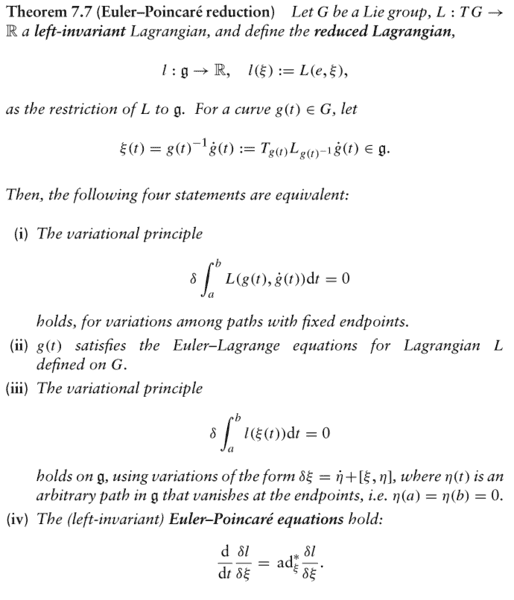
I'm trying to understand the Euler-Poincare equations, which reduce the Euler-Lagrange equations for certain Lagrangians on a Lie group. I'm reading Darryl Holm's "Geometric mechanics and symmetry", where he suddenly uses what seems to be a variational derivative, which I'm having a hard time understanding. The Euler-Poincare reduction theorem (and equation) goes as follows:
upload_2019-2-19_21-5-6.png


It is the ##\frac{\delta l}{\delta \xi}## - derivative which I'm guessing is a variational derivative. It must be a covector, and in computations it seems to reduce to partial derivatives of ##l## wrt. ##\xi## (in suitable coordinates) - I have also seen other sources where the EP-equation is stated in terms of ##\frac{\partial l}{\partial \xi}## instead of the abovementioned.

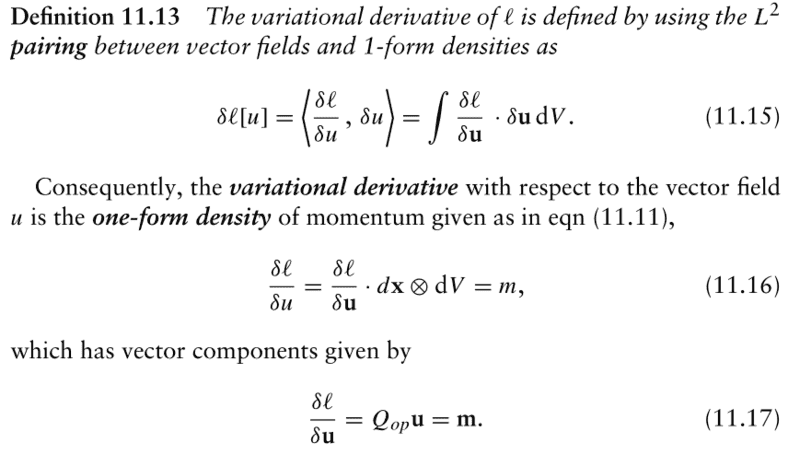
He defines it in two different ways. The first definition is found in one of the later chapters of the book (and it seems to be in a more general setting):
upload_2019-2-19_21-10-26.png

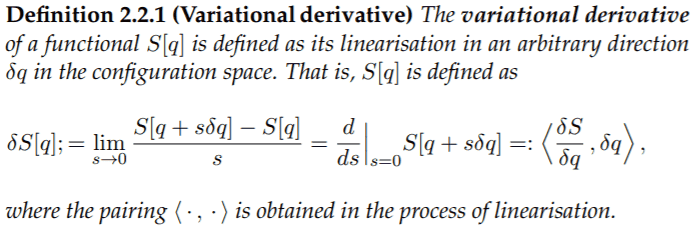
And in another book ("Geometric mechanics - part 2") he defines it as:
upload_2019-2-19_20-53-28.png


My questions are:

- which definition should I focus on?
- Is the pairing in the latter definition the usual covector-vector pairing?

Any explanations, hints or references would be greatly appreciated! Thanks.

<mentor: fix latex>
 

Attachments

  • upload_2019-2-19_20-45-5.png
    upload_2019-2-19_20-45-5.png
    26.4 KB · Views: 582
  • upload_2019-2-19_20-47-36.png
    upload_2019-2-19_20-47-36.png
    707 bytes · Views: 533
  • upload_2019-2-19_20-53-28.png
    upload_2019-2-19_20-53-28.png
    22.9 KB · Views: 922
  • upload_2019-2-19_20-58-44.png
    upload_2019-2-19_20-58-44.png
    10.8 KB · Views: 537
  • upload_2019-2-19_21-5-6.png
    upload_2019-2-19_21-5-6.png
    23.7 KB · Views: 1,244
  • upload_2019-2-19_21-10-26.png
    upload_2019-2-19_21-10-26.png
    23.2 KB · Views: 1,008
Last edited by a moderator:
Physics news on Phys.org
eipiplusone said:
My questions are:

- which definition should I focus on?
##11.13## The other definition ##(2.1.1)## is basically just the definition of a derivative. The crucial point is what is variated, namely the direction ##v:=\delta q##, resp. ##v:=\delta u##.
You could also combine them and get both in one:
$$
\delta l[ u ]= \lim_{t \to 0}\dfrac{l[ u+t\delta u ] - l[ u ]}{t}=\left. \dfrac{d}{dt}\right|_{t=0}l[ u+t\delta u ]=\left\langle \dfrac{\delta l}{\delta u},\delta u \right\rangle = \int \dfrac{\delta l}{\delta u} \cdot \delta u \,dV
$$
- Is the pairing in the latter definition the usual covector-vector pairing?
Yes. It's the view of the derivative as a linear function, similar to the gradient in ##\mathbb{R}^n##: ##d l(u)(v)=\langle \nabla l(u) , v \rangle##, except that we do not take the total differential here but only the partial along ##\delta u##.
 
Thanks for your answer. I am still confused though :/
  • I don't understand the last equality; ##\langle \frac{\delta l}{\delta u} , \delta u \rangle = \int \frac{\delta l}{\delta u} \cdot \delta u \hspace{1mm} d V ##. I would think that ## \frac{\delta l}{\delta u} \cdot \delta u ## is the euclidean inner product representation of the evaluation ## \frac{\delta l}{\delta u}[\delta u] \in \mathbb{R}##, where ##\frac{\delta l}{\delta u}, \delta u## are euclidean vectors. But in that case the integral doesn't make sense, since ##\langle \frac{\delta l}{\delta u} , \delta u \rangle = \frac{\delta l}{\delta u} \cdot \delta u ## . So... why the need for the integral? I'm probably missing something fundamental.
  • Is it correct to say that if ##l## is an ordinary function of a vector ##u##, then ##\frac{\delta l}{\delta u} = \frac{\partial l}{\partial u} ##?
 
eipiplusone said:
Thanks for your answer. I am still confused though :/
  • I don't understand the last equality; ##\langle \frac{\delta l}{\delta u} , \delta u \rangle = \int \frac{\delta l}{\delta u} \cdot \delta u \hspace{1mm} d V ##. I would think that ## \frac{\delta l}{\delta u} \cdot \delta u ## is the euclidean inner product representation of the evaluation ## \frac{\delta l}{\delta u}[\delta u] \in \mathbb{R}##, where ##\frac{\delta l}{\delta u}, \delta u## are euclidean vectors. But in that case the integral doesn't make sense, since ##\langle \frac{\delta l}{\delta u} , \delta u \rangle = \frac{\delta l}{\delta u} \cdot \delta u ## . So... why the need for the integral? I'm probably missing something fundamental.
The integral comes from the definition of the inner product in ##L^2(I)\, : \,\langle f,g \rangle = \int_I f(x)g^*(x)dx## only that ##f,g## in our case aren't functions but differential forms, and ##I## not an interval but a vector field ##V##.
  • Is it correct to say that if ##l## is an ordinary function of a vector ##u##, then ##\frac{\delta l}{\delta u} = \frac{\partial l}{\partial u} ##?
Yes. However, partials are usually meant as coordinate directions, and ##u## doesn't have to be one.

The main difficulty, at least mine, is to distinguish the roles a derivative is playing in a certain context. I've made the fun and listed a couple (10) of them here: https://www.physicsforums.com/insights/journey-manifold-su2mathbbc-part/ but this has meant to be more as a hint on how easy it is to get confused rather than an explanation. Fun fact: slope wasn't even on the list.

My attempt to sort things out was this one: https://www.physicsforums.com/insights/pantheon-derivatives-part-ii/#toggle-id-0
If you look at the pdf, then it's probably better to read, resp. easier to search for keywords, e.g. Gâteaux or Noether as in our case here.
 
Thank you. The documents you link to looks very nice, I will see if they can make things clear to me.
 

Similar threads

  • · Replies 36 ·
2
Replies
36
Views
5K
Replies
1
Views
2K
  • · Replies 2 ·
Replies
2
Views
595
  • · Replies 25 ·
Replies
25
Views
3K
  • · Replies 5 ·
Replies
5
Views
1K
  • · Replies 8 ·
Replies
8
Views
1K
  • · Replies 18 ·
Replies
18
Views
2K
  • · Replies 4 ·
Replies
4
Views
2K
  • · Replies 2 ·
Replies
2
Views
4K
  • · Replies 5 ·
Replies
5
Views
2K