Vector Notation Inconsistencies

Click For Summary
The discussion centers on the inconsistencies in vector notation between a teacher and a textbook, specifically regarding the representation of three-dimensional vectors. The participant questions whether to interpret the vector A = (2, 1, -4) as (2x, 1y, -4z) or (2z, 1x, -4y). It is clarified that both coordinate systems are right-handed and can be viewed from different orientations without changing their fundamental nature. The standard convention for writing vectors is to use the order (x, y, z), and deviating from this could lead to confusion. Overall, understanding the orientation and maintaining consistent notation is crucial for clarity in vector representation.
LearninDaMath
Messages
295
Reaction score
0
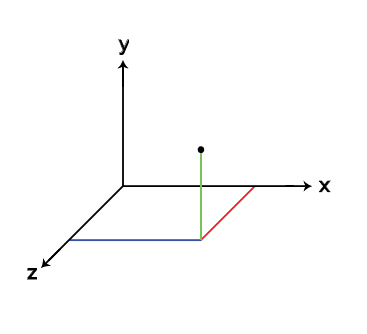
My teacher writes 3 dimensions like this:
3spaceaa-1.png


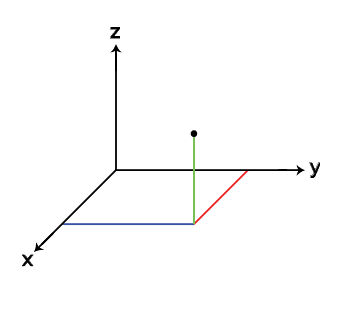
My textbook writes it like this:

3spacea.png


If my online H/W is not directly written by my teacher and not directly written by my textbook (MasteringPhysics online HW), then when presented with a vector such as:

A = (2,1,-4)

Should I read it as:

A = (2x, 1y, -4z) or A = (2z, 1x, -4y)


I'm going to guess the H/W is more in line with the teacher's convention than my textbook's convention and that's how I'm going to proceed. However, if anyone has more insightful input as to how to read this vector, I'm all ears.
 
Physics news on Phys.org
x= 2, y=1, z= -4

The coordinate system is a matter preference both is correct but a point is identified as (x,y,z)
 
both ARE correct, poor grammer
 
RTW, I appreciate your response, thanks.

P.S.

"is" ..."are...it's all the same to me. ..Good thing this good place is not called "Grammerforums" :)
 
LearninDaMath said:
My teacher writes 3 dimensions like this:

3spaceaa-1.png


My textbook writes it like this:

3spacea.png


If my online H/W is not directly written by my teacher and not directly written by my textbook (MasteringPhysics online HW), then when presented with a vector such as:

A = (2,1,-4)

Should I read it as:

A = (2x, 1y, -4z) or A = (2z, 1x, -4y)


I'm going to guess the H/W is more in line with the teacher's convention than my textbook's convention and that's how I'm going to proceed. However, if anyone has more insightful input as to how to read this vector, I'm all ears.

The two coordinate systems are the same. Both are "right-handed." They're just viewed from different orientations. Take the first one and rotate it 90 degrees counterclockwise around the x-axis. Then rotate it 90 degrees around the y-axis. The result is what is shown in the second diagram.

To actually *change* the coordinate system, (e.g. to make it "left-handed"), you'd have to change which direction is positive for one of the axes.

Now, to actually answer your question: when vectors are written down in terms of a comma-separated list of their Cartesian components in parentheses, the ordering is always (x,y,z). To do anything else would be very unusual and probably lead to confusion.
 
cepheid said:
The two coordinate systems are the same. Both are "right-handed." They're just viewed from different orientations. Take the first one and rotate it 90 degrees counterclockwise around the x-axis. Then rotate it 90 degrees around the y-axis. The result is what is shown in the second diagram.

To actually *change* the coordinate system, (e.g. to make it "left-handed"), you'd have to change which direction is positive for one of the axes.

Now, to actually answer your question: when vectors are written down in terms of a comma-separated list of their Cartesian components in parentheses, the ordering is always (x,y,z). To do anything else would be very unusual and probably lead to confusion.


I actually had to pick up the nearest box shaped item in my vicinity and rotate it to prove it to myself lol.

I appreciate your feedback, thanks.
 
The book claims the answer is that all the magnitudes are the same because "the gravitational force on the penguin is the same". I'm having trouble understanding this. I thought the buoyant force was equal to the weight of the fluid displaced. Weight depends on mass which depends on density. Therefore, due to the differing densities the buoyant force will be different in each case? Is this incorrect?

Similar threads

  • · Replies 21 ·
Replies
21
Views
2K
  • · Replies 3 ·
Replies
3
Views
3K
  • · Replies 7 ·
Replies
7
Views
753
  • · Replies 12 ·
Replies
12
Views
2K
  • · Replies 13 ·
Replies
13
Views
3K
  • · Replies 2 ·
Replies
2
Views
4K
Replies
3
Views
4K
  • · Replies 4 ·
Replies
4
Views
1K
  • · Replies 13 ·
Replies
13
Views
3K
  • · Replies 12 ·
Replies
12
Views
3K