Question on Calculating Coulomb force in VECTOR FORM

Click For Summary

Homework Help Overview

The discussion revolves around calculating the Coulomb force in vector form, focusing on the correct representation of force components and the use of unit vectors. Participants explore the transition from scalar to vector calculations in the context of electrostatics.

Discussion Character

  • Exploratory, Assumption checking, Mathematical reasoning

Approaches and Questions Raised

  • Participants discuss the need to express the force in vector form, with one original poster detailing their method for finding the unit vector and questioning the correctness of their calculations. Others raise points about the signs of the force components and the implications of charge interactions.

Discussion Status

The discussion has progressed with some participants identifying errors in sign conventions for force components, leading to corrections in their calculations. There is acknowledgment of the importance of using positive magnitudes when expressing force vectors, but no consensus on all aspects of the problem has been reached.

Contextual Notes

Participants are working under the constraints of an online homework platform, which may impose specific formatting or calculation requirements for vector representations. There is an emphasis on ensuring the correct signs for vector components based on charge interactions.

mhrob24
Messages
53
Reaction score
9
Homework Statement
Point charges q1 = 14 µC and q2 = −60 µC are fixed at r1 = (5.0î − 4.0ĵ) m and r2 = (9.0î + 7.5ĵ) m.

What is the force (in N) of q2 on q1?
(Express your answer in vector form.)
Relevant Equations
F = ke(Qq/r^2)
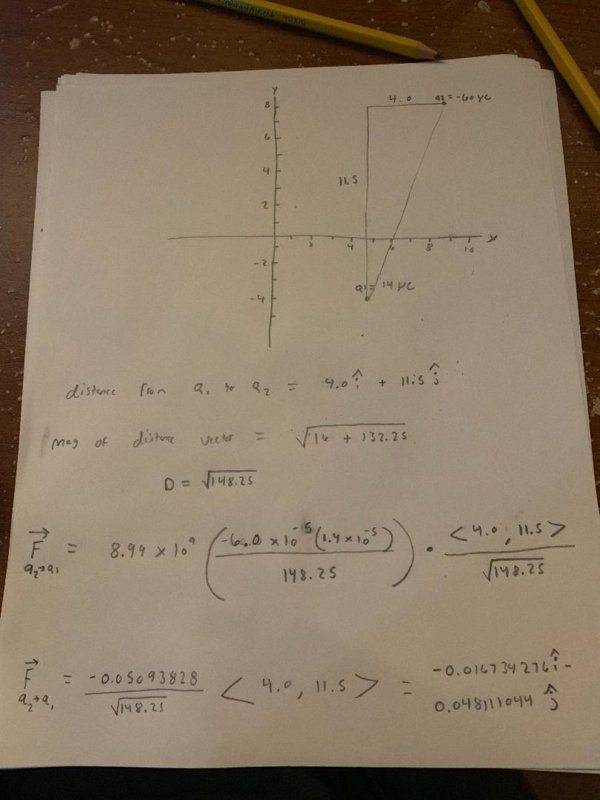
The only thing tripping me up here is that the answer needs to be in vector form. If the question was asking for the scalar form, then I would just find the distance between the charges (plot the charges according to their vector coordinates, then use pythagorean theorem to find the distance between the two. However, I believe (could be wrong here) that in order to get the vector form, I must calculate the force like I normally would for the scalar version, but then I would have to multiply the force by the unit vector representing the distance between the 2 charges. Here is my work done for this problem:
2ECFF85E-56D4-4911-829F-C590A3B71176 (1).jpeg
However, when I enter that vector at the bottom of my page into webassign (online HW platform), it is incorrect. I know the Force calculation is 100% correct so It has to be something with my unit vector, but I don't see the problem. The x-distance between the two charges is 4m and the y distance between the two charges is 11.5m right? So the vector representing the direct distance between the two charges is < 4.0, 11.5>. Then the unit vector is just this vector divided by its magnitude (sqrt(148.25)). I don't see where I'm going wrong...
 
Physics news on Phys.org
I haven't checked any of the arithmetic. But, without doing any calculation, you should be able to deduce the signs of the x and y components of the force.
 
  • Like
Likes   Reactions: mhrob24
Lmao. You're right. My signs of the components of the force vector were backwards. Q2 will attract Q1 so Q1 will accelerate in both the POSITIVE x and y directions. I had both components of the force vector as negative. I switched the signs and got the correct answer on Webassign. I spent like an hour trying to figure out what was going on :oldgrumpy: Thank you!
 
  • Like
Likes   Reactions: TSny
Yes. When you express the force vector in terms of a magnitude and a unit vector in the direction of the force, the magnitude part should be a positive number. When finding the magnitude of the force, just use the magnitudes (absolute values) of the charges in Coulomb's law.

1567794949413.png
 

Similar threads

  • · Replies 11 ·
Replies
11
Views
3K
  • · Replies 1 ·
Replies
1
Views
2K
Replies
3
Views
1K
Replies
17
Views
3K
  • · Replies 44 ·
2
Replies
44
Views
5K
  • · Replies 1 ·
Replies
1
Views
2K
Replies
1
Views
3K
Replies
1
Views
2K
Replies
11
Views
2K
Replies
21
Views
2K