Vector problem: Questions about a unit vector

Click For Summary
SUMMARY

The discussion centers on the vector problem involving a unit vector ##\vec{e}## and a vector ##\vec{v} = 3\vec{e}##. Participants confirm that since ##\vec{e}## is a unit vector, its magnitude is 1, leading to the conclusion that ##|v| = 3##. However, a contradiction arises with the statement that ##|v| = 5##, suggesting a potential typo in the problem statement. The conversation also touches on the geometric multiplication of vectors and the implications of defining operations in vector spaces.

PREREQUISITES
  • Understanding of vector notation and operations, specifically unit vectors and magnitudes.
  • Familiarity with geometric algebra concepts, including the geometric product of vectors.
  • Knowledge of scalar multiplication in vector spaces.
  • Basic comprehension of hyperbolic numbers as referenced in the discussion.
NEXT STEPS
  • Study the properties of unit vectors and their applications in vector analysis.
  • Explore geometric algebra, focusing on the geometric product and its implications.
  • Investigate the concept of hyperbolic numbers and their relevance in advanced vector mathematics.
  • Review the definitions and operations of inner and outer products in vector spaces.
USEFUL FOR

Students and educators in mathematics, particularly those studying vector calculus, linear algebra, and geometric algebra. This discussion is also beneficial for anyone interested in advanced vector operations and their applications in physics and engineering.

WendysRules
Messages
35
Reaction score
3
Homework Statement
Let ##\vec{e}## be a unit vector so that ##\vec{e}^2 = 1## and let ##\vec{v} = 3\vec{e}##.

Show that ##\hat{v} = \vec{e}## and ##|v| = \vec{v}\vec{e} = 5##
Relevant Equations
##\vec{x} = |x|\hat{x}##
Not sure how to show that because ##\vec{v} = |v|\hat{v} = 3|e|\hat{e}##, but since ##\vec{e}## is a unit vector we know ##|e| = 1## so our equation now becomes ##\hat{v} = \frac{3\hat{e}}{|v|}##. So, we're left to the task of showing that ##|v| = 3## in order to conclude that ##\hat{v} = \vec{e}##.

Another way I tried to do it was ##\vec{v}^2 = |v|^2\hat{v}^2= 9\vec{e}^2## which implies that ##|v|^2 = 9## or ##|v| = 3##

However, if this is true, the second part can't be true i.e ##|v| = 3 \neq 5##

So, either there is a typo in the problem, or I'm interpreting the first part that since ##\vec{e}## is a unit vector, that ##|e| = 1##

The questions that follow up on this have it being that ##|v| = 5## which makes since for the second part, but I can't see how both of these can be true.

Thanks for your help!
 
Physics news on Phys.org
WendysRules said:
Homework Statement:: Let ##\vec{e}## be a unit vector so that ##\vec{e}^2 = 1## and let ##\vec{v} = 3\vec{e}##.

Show that ##\hat{v} = \vec{e}## and ##|v| = \vec{v}\vec{e} = 5##
Relevant Equations:: ##\vec{x} = |x|\hat{x}##

Not sure how to show that because ##\vec{v} = |v|\hat{v} = 3|e|\hat{e}##, but since ##\vec{e}## is a unit vector we know ##|e| = 1## so our equation now becomes ##\hat{v} = \frac{3\hat{e}}{|v|}##. So, we're left to the task of showing that ##|v| = 3## in order to conclude that ##\hat{v} = \vec{e}##.

Another way I tried to do it was ##\vec{v}^2 = |v|^2\hat{v}^2= 9\vec{e}^2## which implies that ##|v|^2 = 9## or ##|v| = 3##

However, if this is true, the second part can't be true i.e ##|v| = 3 \neq 5##

So, either there is a typo in the problem, or I'm interpreting the first part that since ##\vec{e}## is a unit vector, that ##|e| = 1##

The questions that follow up on this have it being that ##|v| = 5## which makes since for the second part, but I can't see how both of these can be true.

Thanks for your help!
I think you might be right about a typo. Since ##\vec e## is a unit vector and ##\vec v = 3\vec e##, then ##\vec v## is just a scalar multiple of ##\vec e##, and both point in the same direction. So ##\hat v## will also be a unit vector with the same direction as ##\vec v##.
The typo is probably in what they're saying ##| \vec v|## is, which should be 3, not 5.

The part about ##\vec e^2## doesn't make sense to me unless they actually wrote ##|\vec e|^2## instead of what you have. Is there some info missing? What's the field here -- real numbers? Complex numbers?
 
  • Like
Likes   Reactions: WendysRules
Mark44 said:
The part about ##\vec e^2## doesn't make sense to me unless they actually wrote ##|\vec e|^2## instead of what you have. Is there some info missing? What's the field here -- real numbers? Complex numbers?
##\vec e^2## likely means ##\vec e \cdot \vec e##. Similarly, ##\vec v \vec e## probably means ##\vec v \cdot \vec e##.
 
  • Like
Likes   Reactions: SammyS
Mark44 said:
The part about ##\vec e^2## doesn't make sense to me unless they actually wrote ##|\vec e|^2## instead of what you have. Is there some info missing? What's the field here -- real numbers? Complex numbers?
It's a problem from a book that has a section on hyperbolic numbers (https://www.amazon.com/dp/1704596629/?tag=pfamazon01-20), and you're correct, I should've wrote ##\vec{v}^2 = |\vec{v}|^2\hat{v}^2## and define (for euclidean vectors) that ##\hat{v}^2 = 1##.

But thanks for confirming it should be a typo.
 
WendysRules said:
It's a problem from a book that has a section on hyperbolic numbers (https://www.amazon.com/dp/1704596629/?tag=pfamazon01-20), and you're correct, I should've wrote ##\vec{v}^2 = |\vec{v}|^2\hat{v}^2## and define (for euclidean vectors) that ##\hat{v}^2 = 1##.

But thanks for confirming it should be a typo.
That still doesn't look right to me, the parts about ##\vec{v}^2## and ##\hat{v}^2##. Multiplication of two vectors isn't usually defined unless the scalar product (AKA dot product) or cross product is meant.
 
While there may be no calculus,
the topic of "hyperbolic numbers"
from a reference entitled "Matrix Gateway to Geometric Algebra, Spacetime and Spinors"
is not your typical "precalculus topic".
 
Mark44 said:
That still doesn't look right to me, the parts about ##\vec{v}^2## and ##\hat{v}^2##. Multiplication of two vectors isn't usually defined unless the scalar product (AKA dot product) or cross product is meant.
Yes, unless it's all in 2 dimensions. Then the vectors are just like complex numbers. I suspect there's a backstory here we haven't heard yet.
 
Mark44 said:
That still doesn't look right to me, the parts about ##\vec{v}^2## and ##\hat{v}^2##. Multiplication of two vectors isn't usually defined unless the scalar product (AKA dot product) or cross product is meant.
Well, the point of the chapter is "Geometric multiplication of vectors" in which you ask what is ##\vec{v}^2## is, using the definition ##\vec{v} = |\vec{v}|\hat{v}## we see that $$\vec{v}^2 = (|\vec{v}|\hat{v})(|\vec{v}|\hat{v}) = |\vec{v}|^2\hat{v}^2 = |\vec{v}|^2$$ iff we define ##\hat{v}^2 = 1##. We can then use this to define an "multiplication inverse for vectors" and then it goes into bivectors. Which I don't think is needed for this problem, since you reach the same conclusion on this problem (a sub problem we are asked to show that ##\vec{v}^{-1} = \frac{1}{5}\vec{e}##)

The next two chapters are inner then outer products, but I'm self studying the book, so wanted to make sure I wasn't making some obvious error on this question before moving on.
 
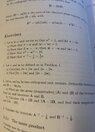
@WendysRules Can you post (insert an image of) the section of the page where the problem is posed?
 
  • #10
WendysRules said:
Well, the point of the chapter is "Geometric multiplication of vectors" in which you ask what is ##\vec{v}^2## is, using the definition ##\vec{v} = |\vec{v}|\hat{v}##
This makes sense, as it is multiplying a unit vector, ##\hat v## by the scalar |v|, the magnitude of ##\vec v##.
WendysRules said:
we see that $$\vec{v}^2 = (|\vec{v}|\hat{v})(|\vec{v}|\hat{v}) = |\vec{v}|^2\hat{v}^2 = |\vec{v}|^2$$ iff we define ##\hat{v}^2 = 1##.
The above is the part I have trouble with, namely the product of a vector with itself or another vector. What would you get for ##\vec u \vec v## if u and v are different vectors?

Of course, if one defines operations, then you can work from these definitions, but in ordinary vector spaces, the usual operations are addition of vectors and multiplication of vectors by scalars. When you extend these to spaces with an inner product, then a definition for multiplying vectors comes into play.
WendysRules said:
We can then use this to define an "multiplication inverse for vectors" and then it goes into bivectors. Which I don't think is needed for this problem, since you reach the same conclusion on this problem (a sub problem we are asked to show that ##\vec{v}^{-1} = \frac{1}{5}\vec{e}##)

The next two chapters are inner then outer products, but I'm self studying the book, so wanted to make sure I wasn't making some obvious error on this question before moving on.
 
  • #11
robphy said:
@WendysRules Can you post (insert an image of) the section of the page where the problem is posed?
 

Attachments

  • BABBEF7F-94C8-4F1B-8C9E-FDEEB46B3B2B.jpeg
    BABBEF7F-94C8-4F1B-8C9E-FDEEB46B3B2B.jpeg
    37.5 KB · Views: 169
  • Like
Likes   Reactions: robphy
  • #12
Mark44 said:
What would you get for ##\vec u \vec v## if u and v are different vectors?
Well, so far all the book has said on this is that ##\vec u \vec v = -\vec v \vec u## due to an argument with Pythagorean's theorem.

I skipped ahead a little bit, but according to the book ##\vec{u} \vec{v} = \vec{u} \cdot \vec{v} + \vec{u} \wedge \vec{v}## which makes sense from an algebraic standpoint, but id have to look into the geometric meaning. (where ##\vec{u} \cdot \vec{v} = \frac{1}{2} (\vec{u}\vec{v}+\vec{v} \vec{u})## and ##\vec{u} \wedge \vec{v} = \frac{1}{2} (\vec{u}\vec{v}-\vec{v}\vec{u})##)
 
  • #13
If ##V## is a vector space equipped with the geometric product, defined such that for ##\mathbf{u}, \mathbf{v} \in V## then ##\mathbf{u} \mathbf{v} \equiv \mathbf{u} \cdot \mathbf{v} + \mathbf{u} \wedge \mathbf{v}##, then ##V## becomes a (geometric) algebra.

@WendysRules, how familiar are you with geometric algebras? (the question is still wrong, btw.)
 
Last edited:
  • #14
ergospherical said:
@WendysRules, how familiar are you with geometric algebras? (the question is still wrong, btw.)
Not familiar at all, but section 2.3 is on it (##G_1, G_2, G_3##)!
 

Similar threads

  • · Replies 6 ·
Replies
6
Views
1K
  • · Replies 9 ·
Replies
9
Views
2K
  • · Replies 16 ·
Replies
16
Views
3K
Replies
20
Views
2K
Replies
26
Views
2K
Replies
7
Views
2K
Replies
3
Views
2K
  • · Replies 1 ·
Replies
1
Views
2K
  • · Replies 9 ·
Replies
9
Views
3K
Replies
9
Views
2K