Vector resolution onto axes not at right-angles

Click For Summary

Discussion Overview

The discussion revolves around resolving a vector onto axes that are not at right angles. Participants explore the methods and formulas applicable to this problem, including potential use of the parallelogram law.

Discussion Character

  • Homework-related
  • Technical explanation
  • Debate/contested

Main Points Raised

  • One participant expresses uncertainty about whether the problem is a resolution problem or involves the parallelogram law.
  • Another participant notes that homework help rules require showing effort before assistance can be provided.
  • A participant shares their current solution but indicates that their answers differ significantly from the provided key answers.
  • There is a correction regarding the interpretation of the angle of 65 degrees, with a participant clarifying that it pertains to the OB component rather than the OA vector.
  • A suggestion is made to draw a line parallel to OB to aid in visualizing the components of vector OA and to resolve the magnitudes of both components.
  • Several participants confirm that they arrived at the correct answer but do not provide details on their methods or calculations.

Areas of Agreement / Disagreement

Participants do not reach a consensus on the best approach to resolve the vector, and there are multiple interpretations of the problem and its components.

Contextual Notes

There are unresolved aspects regarding the assumptions made about the angles and the methods used for vector resolution, which may affect the outcomes.

Who May Find This Useful

Students working on vector resolution problems, particularly those involving non-right-angle axes, may find this discussion relevant.

AzureSekki
Messages
10
Reaction score
0
Summary:: I'm quite stuck on this problem i don't know what I am going to use formula to solve this one

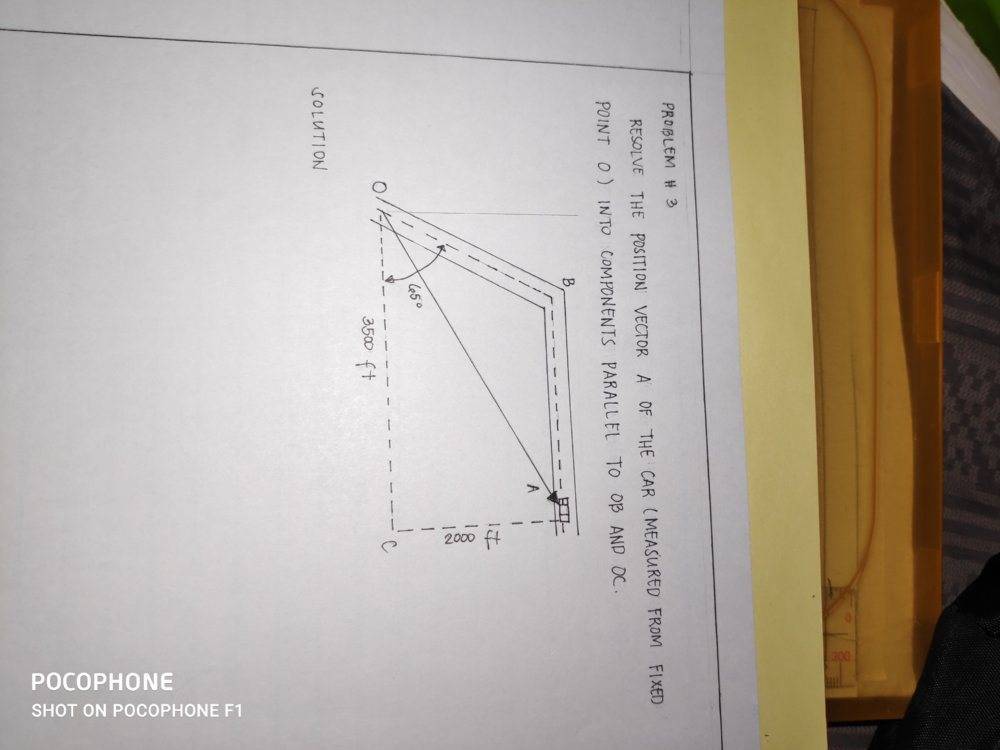
This is the given I am not sure if this is a resolution problem or it involve parallelogram law
IMG_20200222_090025.jpg
IMG_20200222_090030.jpg
 
Physics news on Phys.org
Welcome to PF. I moved your post to a homework forum because it looks like homework.

Why did you post the pictures sideways?

Our homework help rules require you to show your effort before our helpers can help. Show us how you would calculate the two components asked for.
 
IMG_20200222_092951.jpg

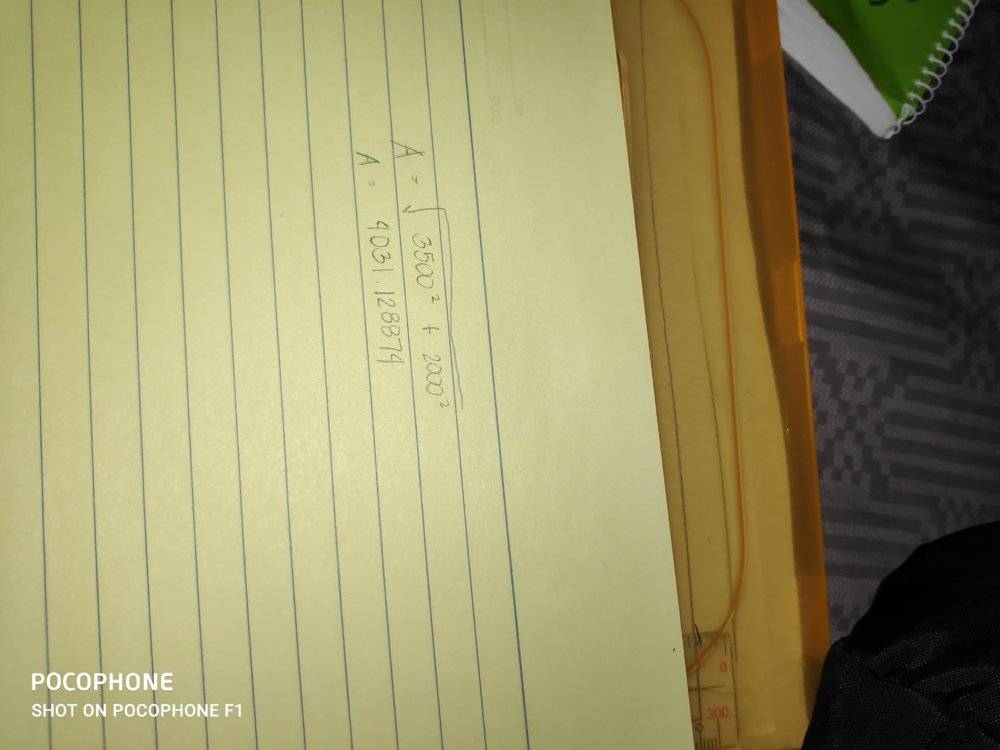
This is my current solution but the key answers were given to us except for the solution
The key answers were
2224 ft and 2551 ft
Most of my answers are faraway from the key answers that why I am quite stuck
 
You are incorrectly mixing the angle of 65 degrees with the OA vector.
It indicates the angle of the OB component of that vector instead.
 
Lnewqban said:
You are incorrectly mixing the angle of 65 degrees with the OA vector.
It indicates the angle of the OB component of that vector instead.
Can you elaborate much further in where i got wrong
 
Not really.
Draw a line that being parallel to OB, goes between A and the intersection point with OC.
In a triangulation diagram, that will be one of the components of vector OA.
The other component will be the line between that intersection point and O.
Try to draw that set of triangles and resolve for magnitudes of both components.
Good night.
 
IMG_20200222_130334.jpg

Is this what u meant
 
I got the answer thanks
 
AzureSekki said:
I got the answer thanks
Excellent!
Could you show your work and final values?
What method did you use?
 

Similar threads

  • · Replies 8 ·
Replies
8
Views
6K
  • · Replies 6 ·
Replies
6
Views
4K
  • · Replies 2 ·
Replies
2
Views
2K
  • · Replies 2 ·
Replies
2
Views
2K
  • · Replies 5 ·
Replies
5
Views
2K
  • · Replies 5 ·
Replies
5
Views
1K
  • · Replies 4 ·
Replies
4
Views
2K
  • · Replies 2 ·
Replies
2
Views
2K
Replies
9
Views
4K
  • · Replies 1 ·
Replies
1
Views
2K