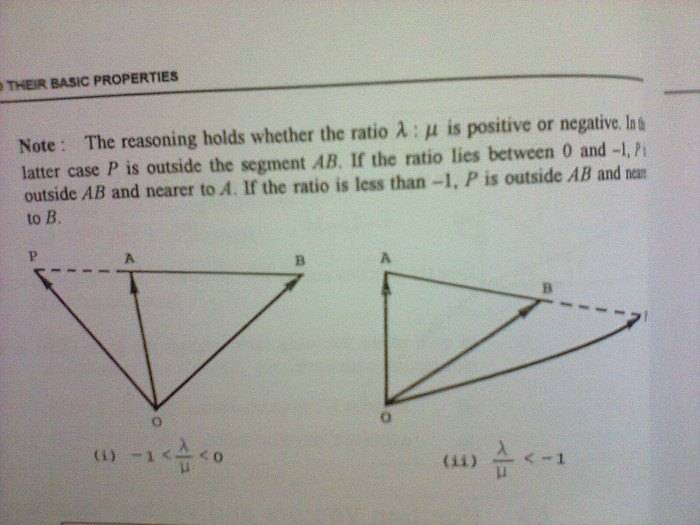
Why is P outside and nearer to A if λ/μ is between -1 and 0?

Click For Summary
When λ/μ is between -1 and 0, point P is located outside segment AB and is closer to point A. This is established by the relationship AP:PB = λ:μ, which implies that the lengths satisfy |AP| > |AB| and |AP| < |BP|. The analysis shows that if AP is positive, then BP must also be positive, leading to the conclusion that BP is greater than AP. The discussion also touches on the unnecessary nature of the condition stating that P is outside AB. The mathematical proof hinges on the ratios of the segments and their respective lengths.
matthew20103
Messages
2
Reaction score
0
Does anyone know why if
(i) -1 < λ/μ < 0 then P is outside AB and nearer to A;
(ii) λ/μ < -1 then P is outside AB and nearer to B?

Can anybody give me the proof? Thanks in advance!

Additional information: AP:PB = λ:μ
dBXcF.jpg
 
Mathematics news on Phys.org
AP:PB = λ:μ is equivalent to AP/PB=λ/μ

(i) -1 < λ/μ < 0 then P is outside AB and nearer to A;


P is outside AB: |AP|>|AB|
P is nearer to A: |AP| < |BP|

-1 < λ/μ < 0
-1 < AP/PB < 0
1 > AP/BP > 0

Let AP be +ve therefore BP is +ve (since AP/BP > 0)
1 > AP/BP > 0
BP > AP > 0
BP > AP
P is nearer to A
BP > AP > 0
AB+BP > AB+AP > AB
AP > AB
P is outside AB

I can't be bothered with (ii),
 
superg33k said:
AP:PB = λ:μ is equivalent to AP/PB=λ/μ

(i) -1 < λ/μ < 0 then P is outside AB and nearer to A;


P is outside AB: |AP|>|AB|
P is nearer to A: |AP| < |BP|

-1 < λ/μ < 0
-1 < AP/PB < 0
1 > AP/BP > 0

Let AP be +ve therefore BP is +ve (since AP/BP > 0)
1 > AP/BP > 0
BP > AP > 0
BP > AP
P is nearer to A
BP > AP > 0
AB+BP > AB+AP > AB
AP > AB
P is outside AB

I can't be bothered with (ii),

Thank you brother~
But I think the condition that "P is outside AB: |AP|>|AB|" is not necessary.
 
Here is a little puzzle from the book 100 Geometric Games by Pierre Berloquin. The side of a small square is one meter long and the side of a larger square one and a half meters long. One vertex of the large square is at the center of the small square. The side of the large square cuts two sides of the small square into one- third parts and two-thirds parts. What is the area where the squares overlap?

Similar threads

Replies
1
Views
2K
  • · Replies 15 ·
Replies
15
Views
5K
  • · Replies 5 ·
Replies
5
Views
1K
Replies
4
Views
2K
  • · Replies 1 ·
Replies
1
Views
2K
  • · Replies 2 ·
Replies
2
Views
4K
Replies
23
Views
3K
Replies
7
Views
2K
Replies
2
Views
2K
  • · Replies 5 ·
Replies
5
Views
2K