Undergrad Vector Space of Alternating Multilinear Functions ....

Click For Summary
The discussion centers on understanding the vector space of alternating multilinear functions as presented in Theodore Shifrin's "Multivariable Mathematics." Participants seek clarification on the expression T = ∑_{i increasing} a_I dx_I, where T represents an element of the space, a_I are coefficients, and dx_I are differential forms. The conversation highlights the significance of increasing k-tuples in defining the basis of the vector space, emphasizing that the coefficients a_J correspond to real numbers indexed by these tuples. The exchange also touches on the nature of the spanning set and the distinction between a spanning set and a basis in this context. Overall, the participants aim to solidify their understanding of the mathematical framework surrounding alternating multilinear functions.
Math Amateur
Gold Member
MHB
Messages
3,920
Reaction score
48
I am reading the book: Multivariable Mathematics by Theodore Shifrin ... and am focused on Chapter 8, Section 2, Differential Forms ...

I need some help in order to fully understand the vector space of alternating multilinear functions ...

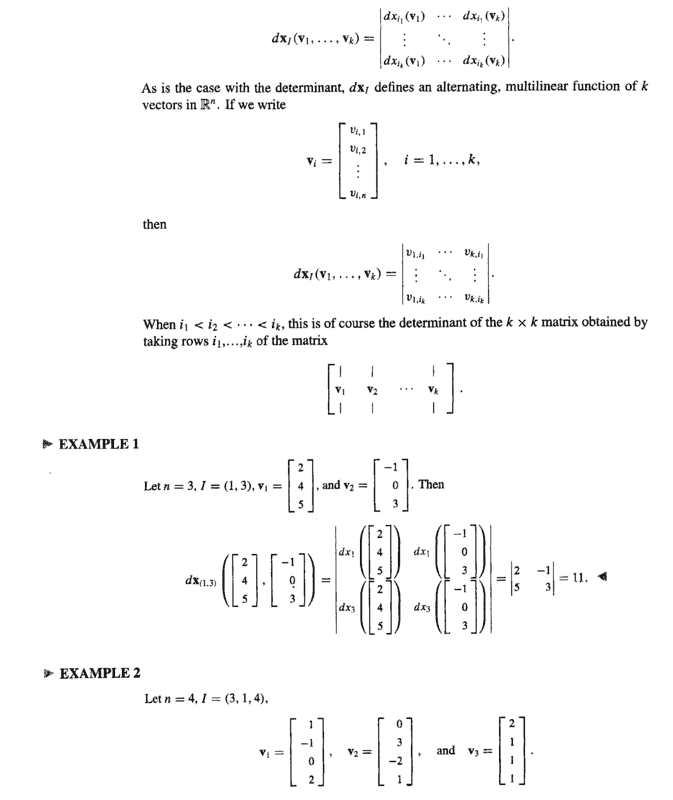
The relevant text from Shifrin reads as follows:
?temp_hash=c5a985b43e67ff351bbb3452d56f5618.png


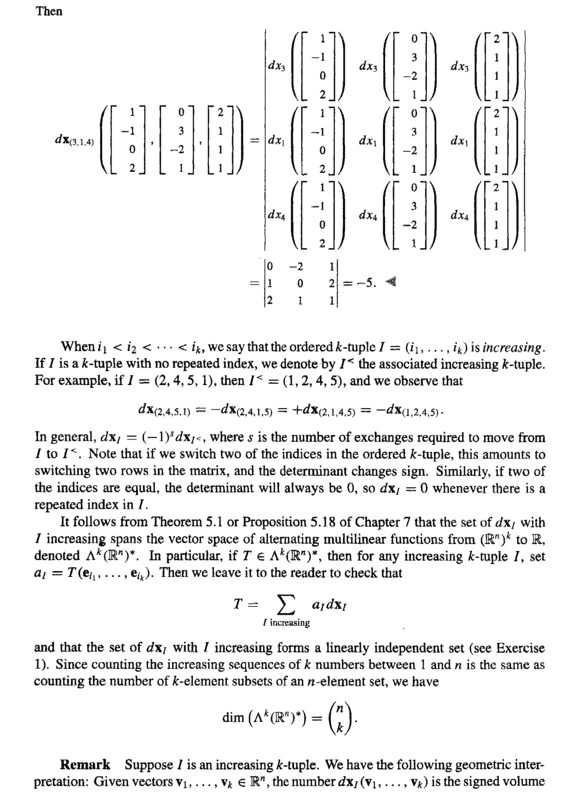
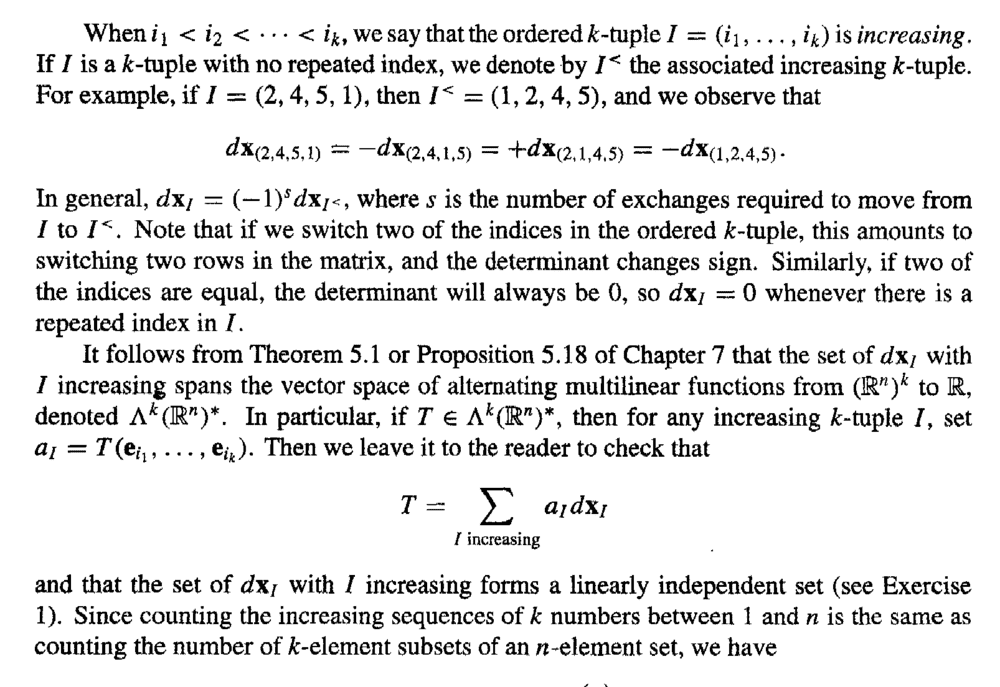
In the above text from Shifrin we read the following:

" ... ... In particular, if ##T \in {\bigwedge}^k ( \mathbb{R}^n )^{ \ast }##, then for any increasing ##k##-tuple ##I##, set ##a_I = T( e_{ i_1} , \cdot \cdot \cdot , e_{ i_k} )##. Then we leave it to the reader to check that##T = \sum_{ i \text{ increasing } }a_I \text{dx}_I##

... ... ... "
Can someone please help me to prove/demonstrate that ##T = \sum_{ i \text{ increasing } }a_I \text{dx}_I## ... ...
Help will be much appreciated ...

Peter
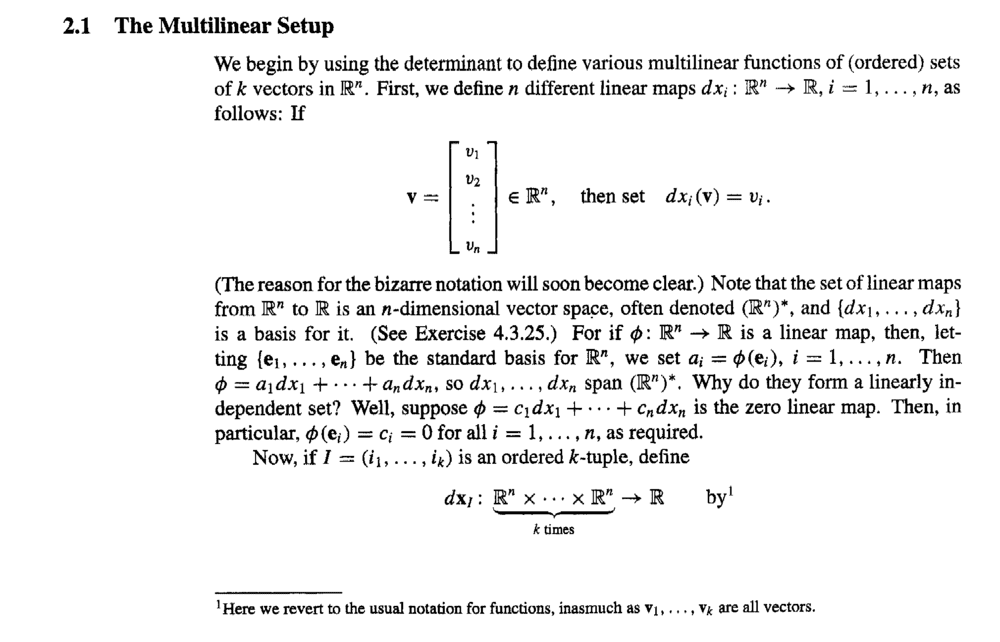
==========================================================================================In case someone needs access to the text where Shifrin defines the terms of the above post and explains the notation, I am providing access to the start of Chapter 8, Section 2.1 as follows:
?temp_hash=a6ac9c21b636d70cd5c23e172af350a3.png

?temp_hash=a6ac9c21b636d70cd5c23e172af350a3.png

?temp_hash=a6ac9c21b636d70cd5c23e172af350a3.png

Hope that helps ...

Peter
 

Attachments

  • Shifrin - Alternating Multilinear Functions ... .png
    Shifrin - Alternating Multilinear Functions ... .png
    71.6 KB · Views: 532
  • ?temp_hash=c5a985b43e67ff351bbb3452d56f5618.png
    ?temp_hash=c5a985b43e67ff351bbb3452d56f5618.png
    71.6 KB · Views: 969
  • Shifrin - 1 - Start of Ch. 8, Section 2.1 ... Differential Forms ... PART 1 ... .png
    Shifrin - 1 - Start of Ch. 8, Section 2.1 ... Differential Forms ... PART 1 ... .png
    47.6 KB · Views: 332
  • Shifrin - 2 - Start of Ch. 8, Section 2.1 ... Differential Forms ... PART 2 ... .png
    Shifrin - 2 - Start of Ch. 8, Section 2.1 ... Differential Forms ... PART 2 ... .png
    18.8 KB · Views: 378
  • Shifrin - 3 - Start of Ch. 8, Section 2.1 ... Differential Forms ... PART 3 ... .png
    Shifrin - 3 - Start of Ch. 8, Section 2.1 ... Differential Forms ... PART 3 ... .png
    48.5 KB · Views: 319
  • ?temp_hash=a6ac9c21b636d70cd5c23e172af350a3.png
    ?temp_hash=a6ac9c21b636d70cd5c23e172af350a3.png
    47.6 KB · Views: 995
  • ?temp_hash=a6ac9c21b636d70cd5c23e172af350a3.png
    ?temp_hash=a6ac9c21b636d70cd5c23e172af350a3.png
    18.8 KB · Views: 996
  • ?temp_hash=a6ac9c21b636d70cd5c23e172af350a3.png
    ?temp_hash=a6ac9c21b636d70cd5c23e172af350a3.png
    48.5 KB · Views: 907
Last edited:
Physics news on Phys.org
We are told that the set of ##d\mathbf x_I## with ##I## increasing spans the vector space ##\Lambda^k(\mathbb R^n)^*## of alternating multilinear functions from ##(\mathbb R^n)^k## to ##\mathbb R##. So for any ##T## in that space there exists a set of real numbers ##A_T## indexed by the set ##S## of increasing ##k##-tuples in ##\{1, ...,n\}^k##, such that:

$$T=\sum_{J\in S} a_J d\mathbf x_J$$

where ##a_J## is the element of ##A_T## indexed by ##k##-tuple ##J##.

Applying both sides to the ##k##-tuple of vectors ##(\mathbf e_{i_1},...,\mathbf e_{i_k})##, for increasing ##k##-tuple ##I=(i_1,...,i_k)##, we get:

\begin{align*}
T(\mathbf e_{i_1},...,\mathbf e_{i_k})
&=
\sum_{J\in S} a_J d\mathbf x_J (\mathbf e_{i_1},...,\mathbf e_{i_k})
\\&=
\sum_{I\in S} a_J \delta^{i_1,...,i_k}_{j_1,...,j_k}
\end{align*}

by the presumed definition of ##d\mathbf x_J## (not supplied in OP). All the Kronecker deltas in terms in that sum are zero except the one where ##J=I##, where the delta is 1. So the sum on the RHS equals ##a_I##, giving us the desired result.
 
  • Like
Likes Math Amateur
Hi Andrew ...

Thanks for your help ...

Shifrin defines ##\text{dx}_I## as follows ... ...

... Now if ##I = (i_1, \cdot \cdot \cdot , 1_k )## is an ordered ##k##-tuple, define

##\text{dx}_I : \mathbb{R}^n \times \cdot \cdot \cdot \mathbb{R}^n \to \mathbb{R}## by (note ##k## input factors)

##\text{dx}_I ( v_1, \cdot \cdot \cdot , v_k ) = \begin{vmatrix} \text{dx}_{ i_1} ( v_1) & \cdot \cdot \cdot & \text{dx}_{ i_1} ( v_k) \\ \cdot & \cdot \cdot \cdot & \cdot \\ \cdot & \cdot \cdot \cdot & \cdot \\ \text{dx}_{ i_k} ( v_1) & \cdot \cdot \cdot & \text{dx}_{ i_k} ( v_k) \end{vmatrix}##I think that that would give the result you state ...

Peter
 
andrewkirk said:
We are told that the set of ##d\mathbf x_I## with ##I## increasing spans the vector space ##\Lambda^k(\mathbb R^n)^*## of alternating multilinear functions from ##(\mathbb R^n)^k## to ##\mathbb R##. So for any ##T## in that space there exists a set of real numbers ##A_T## indexed by the set ##S## of increasing ##k##-tuples in ##\{1, ...,n\}^k##, such that:

$$T=\sum_{J\in S} a_J d\mathbf x_J$$

where ##a_J## is the element of ##A_T## indexed by ##k##-tuple ##J##.

Applying both sides to the ##k##-tuple of vectors ##(\mathbf e_{i_1},...,\mathbf e_{i_k})##, for increasing ##k##-tuple ##I=(i_1,...,i_k)##, we get:

\begin{align*}
T(\mathbf e_{i_1},...,\mathbf e_{i_k})
&=
\sum_{J\in S} a_J d\mathbf x_J (\mathbf e_{i_1},...,\mathbf e_{i_k})
\\&=
\sum_{I\in S} a_J \delta^{i_1,...,i_k}_{j_1,...,j_k}
\end{align*}

by the presumed definition of ##d\mathbf x_J## (not supplied in OP). All the Kronecker deltas in terms in that sum are zero except the one where ##J=I##, where the delta is 1. So the sum on the RHS equals ##a_I##, giving us the desired result.
Hi Andrew ...

Still reflecting on what you have written ...

Indeed ... you write:

" ... ... So for any ##T## in that space there exists a set of real numbers ##A_T## indexed by the set ##S## of increasing ##k##-tuples in ##\{1, ...,n\}^k## ... .. "Can you explain in simple terms what you mean by this ,,, perhaps also giving a simple example ...

Also ... what is the exact form and nature of the ##a_J## ... ?

Peter
 
Math Amateur said:
" ... ... So for any ##T## in that space there exists a set of real numbers ##A_T## indexed by the set ##S## of increasing ##k##-tuples in ##\{1, ...,n\}^k## ... .. "
Can you explain in simple terms what you mean by this ,,, perhaps also giving a simple example ...

Also ... what is the exact form and nature of the ##a_J## ... ?
Consider where n=5 and k=3 then ##A_T## is the set of all increasing 3-tuples out of the numbers 1,...,5, which is:

123, 124, 125, 134, 135, 145, 234, 235, 245, 345

The set ##A_T## has those ten members. The fourth member is the 3-tuple (1,3,4). If we use J to denote that member then we have ##J=(1,3,4)## and ##j_1=1,j_2=3,j_3=4##.

The set ##A_T## doesn't depend much on what T is. All it uses from T is the value of ##k##. Given a ##k##-tensor T, the set ##A_T## is the set of all increasing k-tuples out of the numbers 1...n. In this example, the tensor T has order 3, and ##A_T## is the set of all 3-tuples (triples) from 1,...,5.
 
  • Like
Likes Math Amateur
Thanks Andrew ... but ... I'm lost ... I'm probably trying you patience ,,,

But can you explain from the definition of the space ##\Lambda^k(\mathbb R^n)^*## how we end up considering a set a set of real numbers ##A_T## in the first place ...

My apologies for being slow to catch on ...

Peter
 
Math Amateur said:
Thanks Andrew ... but ... I'm lost ... I'm probably trying you patience ,,,

But can you explain from the definition of the space ##\Lambda^k(\mathbb R^n)^*## how we end up considering a set a set of real numbers ##A_T## in the first place ...

My apologies for being slow to catch on ...

Peter
Hi Andrew ... I should be more specific ...

... indeed ... I should ask a specific question ...

... so ...

Now ... ##\Lambda^k(\mathbb R^n)^*## is the vector space of alternating tensors or alternating multilinear mappings of degree or rank ##k## ... and I am assuming that it is a vector space over the field ##\mathbb{R}## ... is that assumption correct?

The basis of ##\Lambda^k(\mathbb R^n)^*## is the set of ##k##-linear covectors or mappings ...

##\text{dx}_{I_1}, \text{dx}_{I_2}, \text{dx}_{I_3}, \cdot \cdot \cdot , \text{dx}_{I_l}## where ##l = \begin{pmatrix} n \\ k \end{pmatrix}##

... so an element ##T## of ##\Lambda^k(\mathbb R^n)^*## can be expressed as

##T = a_1 \text{dx}_{I_1} + a_2 \text{dx}_{I_2} + \cdot \cdot \cdot + a_l \text{dx}_{I_l}## ... where ##a_i \in \mathbb{R}## for all ##i## such that ##1 \le i \le l ## ... ...

... ... is that correct?

So I am wondering how the ##a_i## above relate to your ##a_J## ... indeed are the ##a_J## just real numbers ... Hope you can help ...

Peter
 
Math Amateur said:
The basis of ##\Lambda^k(\mathbb R^n)^*## is the set of ##k##-linear covectors or mappings ...

##\text{dx}_{I_1}, \text{dx}_{I_2}, \text{dx}_{I_3}, \cdot \cdot \cdot , \text{dx}_{I_l}## where ##l = \begin{pmatrix} n \\ k \end{pmatrix}##
That is a spanning set, not a basis, because it includes ##d\mathbf x_I## for non-increasing ##I##. So for ##k=3## it would include ##d\mathbf x_{1,3,5}## and ##d\mathbf x_{3,1,5}##, which are linearly dependent since ##d\mathbf x_{1,3,5}=-d\mathbf x_{3,1,5}##.

To make it a basis, we need to restrict to ##d\mathbf x_I## for increasing ##I##.

... so an element ##T## of ##\Lambda^k(\mathbb R^n)^*## can be expressed as

##T = a_1 \text{dx}_{I_1} + a_2 \text{dx}_{I_2} + \cdot \cdot \cdot + a_l \text{dx}_{I_l}## ... where ##a_i \in \mathbb{R}## for all ##i## such that ##1 \le i \le l ## ... ...

... ... is that correct?
That is correct if you use the numbers ##1,...,m## to index ##A_T##, where ##m## is the number of distinct, increasing ##k##-tuples that can be drawn from ##1,...,n##. In my example above with k=3,n=5, we have m=10. But you also need to specify an indexing of ##A_T##, ie label its elements with the numbers 1 to m.

My approach avoids having to do that, as well as simplifying the notation, by noting that indexes don't have to be integers. We can use the k-tuples themselves to index the k-forms. That is what the author has done above when he writes things like ##d\mathbf x_{2,4,5,1}##. That is for the case k=4 and##n\ge 5##, and the example k-tuple is (2,4,5,1). The corresponding coefficient would be ##a_{(2,4,5,1)}##.

A longer, but more explanatory presentation of the formula [EDIT: fixed an error in that, which used ##I## instead of ##J## for the index]:

$$T = \sum_{J\in A_T} a_J d\mathbf x_J$$

is

$$T = \sum_{\substack{(i_1,...,i_k)\in \{1,...,n\}^k\\i_1<i_2<...<i_k}} a_{(i_1,...,i_k)} d\mathbf x_{(i_1,...,i_k)}$$

or, even more lengthily:

$$T = \sum_{i_1=1}^n \sum_{i_2=i_1+1}^n...\sum_{i_k=i_{k-1}+1}^n
a_{(i_1,...,i_k)} d\mathbf x_{(i_1,...,i_k)}$$

It may help to read the short wiki article on index sets. We are first introduced to indexing in cases where the index set is always a contiguous set of natural numbers starting with 1 or 0. But as we move into more advanced maths, it becomes useful to realize that an indexing of a set is just a surjection from another set (the index set) onto the first one, and the index set doesn't have to be integers. It can for instance be k-tuples. Doing this allows simplification of notation and avoids begging questions such as 'how do we order and number the set ##A_T## of increasing k-tuples?'.
 
Last edited:
  • Like
Likes Math Amateur
Andrew ... thank you for a most helpful post ...

Have gotten the main ideas now ...

Still reflecting on what you have written ...

Thanks again...

Peter
 

Similar threads

  • · Replies 0 ·
Replies
0
Views
834
  • · Replies 1 ·
Replies
1
Views
2K
  • · Replies 2 ·
Replies
2
Views
2K
  • · Replies 23 ·
Replies
23
Views
2K
  • · Replies 25 ·
Replies
25
Views
3K
  • · Replies 3 ·
Replies
3
Views
2K
Replies
3
Views
2K
  • · Replies 2 ·
Replies
2
Views
2K
  • · Replies 13 ·
Replies
13
Views
3K
Replies
4
Views
2K