Vector subtraction and addition questions

  • Thread starter Thread starter victorhugo
  • Start date Start date
  • Tags Tags
    Addition Vector
Click For Summary
The discussion revolves around confusion regarding vector addition and subtraction in physics, particularly in calculating changes in velocity. The user is seeking clarification on how to apply formulas correctly, especially when dealing with direction and magnitude. They provide specific examples, including a cricket ball's change in velocity and a plane's required heading to counteract wind. Participants emphasize the importance of showing work in a readable format and suggest using Pythagoras' theorem for vector calculations. The user expresses a desire to learn and improve their understanding of physics concepts.
victorhugo
Messages
127
Reaction score
5
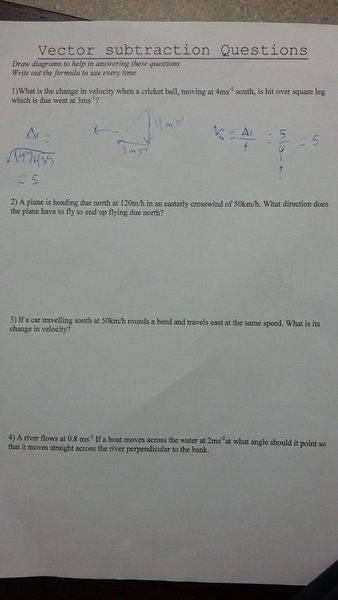
I have a couple of really basic and easy worksheets for vector addition and subtraction, but I'm getting confused because I used the formula Square root of (A^2 + B^2) to figure out most of them (change in velocity is displacement / time interval) and I don't see where I need to add or subtract :l

Here is a photo of both worksheets, if you don't mind doing about 1-2 problems for each and showing me the working out step by step I would greatly appreciate it :)
Thank you!

11830802_860992457269809_1193244301_n.jpg
https://s.yimg.com/hd/answers/i/62cd5a320d734a9c9028cd0a978e746c_A.jpeg?a=answers&mr=0&x=1438958548&s=dd5b4d11fa2770da7d0cb66c550ea4e3
 
Last edited by a moderator:
Physics news on Phys.org
victorhugo said:
Here is a photo of both worksheets, if you don't mind doing about 1-2 problems for each and showing me the working out step by step I would greatly appreciate it :)
That's not how this works. You post an attempt, in a way we can read and follow (not images of handwritten algebra) and we'll figure out where you are going wrong or getting stuck.
For the first one, let's start with something a bit simpler. The cricket ball is going S at 4 m/s then is brought to a stop. What is its change in velocity (magnitude and direction)?
 
haruspex said:
That's not how this works. You post an attempt, in a way we can read and follow (not images of handwritten algebra) and we'll figure out where you are going wrong or getting stuck.
For the first one, let's start with something a bit simpler. The cricket ball is going S at 4 m/s then is brought to a stop. What is its change in velocity (magnitude and direction)?
The direction of the change in velocity is south, but I don't know how to find the magnitude by only knowing the speed that it was going at without any distances :(
 
victorhugo said:
The direction of the change in velocity is south, but I don't know how to find the magnitude by only knowing the speed that it was going at without any distances :(
No, it had been going S. It is no longer going S. So which way is the change?
Once you've got that straight, correct the diagram in the image you posted. Use Pythagoras' theorem, as you did, to find the magnitude of the total change.
Adding vectors looks the same whether the vectors are displacements, velocities or accelerations. If it bothers you, think of the velocity vectors as representing the distance it would travel in a fixed short time.
 
haruspex said:
No, it had been going S. It is no longer going S. So which way is the change?
Once you've got that straight, correct the diagram in the image you posted. Use Pythagoras' theorem, as you did, to find the magnitude of the total change.
Adding vectors looks the same whether the vectors are displacements, velocities or accelerations. If it bothers you, think of the velocity vectors as representing the distance it would travel in a fixed short time.
Alright my teacher does not want the homework back, I just want to do this because I want to learn and I love physics :) So for the 4 questions:

the change in velocity ΔV= V-U (where V= final velocity and U= initial velocity)
The way I was shown is to add negative U to V, which would give us the same triangle and wouldn't change the answer(change in displacement is still 5m) so I believe the answer is just 3m/s-4m/s= -1m/s

For the second question:
"A plane is heading due north at 120m/h (Im assuming the teacher made a mistake and it is km/h because 120 m/h is extremely slow)in an easterly crossswind of 50km/h. What direction does the plane have to fly to end up flying due north?"
My attempt:
I haven't been shown how to do this, but I am assuming that the plane needs to fly north east, at an angle greater than what it is now, and i believe we can get the angle now by using SOH CAH TOA:
tan=opp./adj. (wind at 50km/h is opposite and the 120km/h north is the adjacent) to the angle is tan^-1(50/120) = 22.6 degrees.
Now to find at what direction the plane must fly to cancel the 50km/h easterly wind, i don't know. Even if I were to add negative 50 to 120 in a graph, the angle would be the same... I would appreciate a hint!

For the third question:
"If a car traveling south at 50km/h rounds a bend and travels east at the same speed. What is its change in velocity?"
ΔV=V-U = 50-50 = 0m/s
No change in velocity.

Fourth and last question:
Just like question 2, I have no idea how to find the angle it should point to. If someone could give me a hint, woudl highly appreciate it :)
 
The book claims the answer is that all the magnitudes are the same because "the gravitational force on the penguin is the same". I'm having trouble understanding this. I thought the buoyant force was equal to the weight of the fluid displaced. Weight depends on mass which depends on density. Therefore, due to the differing densities the buoyant force will be different in each case? Is this incorrect?

Similar threads

  • · Replies 3 ·
Replies
3
Views
1K
  • · Replies 13 ·
Replies
13
Views
2K
  • · Replies 1 ·
Replies
1
Views
3K
  • · Replies 10 ·
Replies
10
Views
2K
Replies
3
Views
1K
Replies
20
Views
7K
  • · Replies 2 ·
Replies
2
Views
4K
  • · Replies 2 ·
Replies
2
Views
7K
  • · Replies 9 ·
Replies
9
Views
1K
  • · Replies 20 ·
Replies
20
Views
3K