Why Isn't the Right Side Negative in a Vertical Spring-Mass System Equation?

Click For Summary
SUMMARY

The discussion centers on the dynamics of a vertical spring-mass system, specifically addressing the sign convention in the equation of motion. The equilibrium position is defined as y0 = mg/k, where mg represents the weight of the mass and k is the spring constant. When the mass is displaced downward and released, the net force acting on the mass is upward, leading to a positive acceleration. This is consistent with Newton's second law, which dictates that the direction of acceleration must align with the net force acting on the system.

PREREQUISITES
  • Understanding of Newton's second law of motion
  • Familiarity with spring constants and Hooke's Law
  • Knowledge of free body diagrams (FBD)
  • Basic calculus for interpreting motion equations
NEXT STEPS
  • Study the derivation of the equation of motion for spring-mass systems
  • Learn about the implications of sign conventions in physics
  • Explore the concept of simple harmonic motion (SHM) in spring systems
  • Investigate the effects of damping on spring-mass systems
USEFUL FOR

Students studying classical mechanics, physics educators, and anyone interested in understanding the dynamics of spring-mass systems and their equations of motion.

Ark236
Messages
24
Reaction score
3
Homework Statement
Hi everyone,

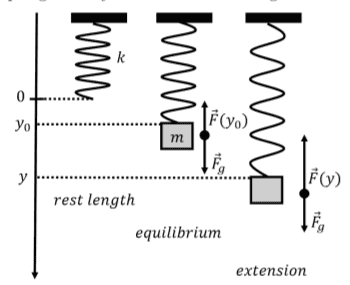
The problem has two parts. The first is to determine the equilibrium position of a mass attached to a spring. The second is to determine the equation of motion of the system, assuming that the block is pulled 1 cm down from its equilibrium position.
Relevant Equations
I choose the downward direction as positive. For the first part and using the FBD:

mg - k y_{0} = 0

Then the equilibrium position is y_{0} = mg/k.

For the second part, we have that:

mg -k y = m d^2 y/dt^2
I have a doubt with the last part. Why isn't the right side negative? Because when the block is released, it moves upwards.

thanks

image was obtained from here

Thanks.
C_3oscilador.png
 
Physics news on Phys.org
Ark236 said:
Homework Statement: Hi everyone,

The problem has two parts. The first is to determine the equilibrium position of a mass attached to a spring. The second is to determine the equation of motion of the system, assuming that the block is pulled 1 cm down from its equilibrium position.
Relevant Equations: I choose the downward direction as positive. For the first part and using the FBD:

mg - k y_{0} = 0

Then the equilibrium position is y_{0} = mg/k.

For the second part, we have that:

mg -k y = m d^2 y/dt^2

I have a doubt with the last part. Why isn't the right side negative? Because when the block is released, it moves upwards.

thanks

image was obtained from here

Thanks.View attachment 334759
When ##y>y_0, mg-ky<0##, and then the right side, ##m \frac {d^2y} {dt^2}## is negative.
 
Both sides are negative at that point. The net force points upwards and the body accelerates upwards. The equation shows that thenet force and the acceleration have the same sign. They are either both positive or both negative. If you put a minus sign in the equation itself, it would mean that the acceleration is in direction opposite to the net force. This would contradict Newton's second law, wouldn't?
 
Ark236 said:
mg -k y = m d^2 y/dt^2

I have a doubt with the last part. Why isn't the right side negative? Because when the block is released, it moves upwards.
When the mass is below it's equilibrium position, which is bigger: mg or ky?
 
The book claims the answer is that all the magnitudes are the same because "the gravitational force on the penguin is the same". I'm having trouble understanding this. I thought the buoyant force was equal to the weight of the fluid displaced. Weight depends on mass which depends on density. Therefore, due to the differing densities the buoyant force will be different in each case? Is this incorrect?

Similar threads

Replies
3
Views
2K
Replies
17
Views
2K
Replies
13
Views
4K
  • · Replies 10 ·
Replies
10
Views
5K
Replies
8
Views
6K
Replies
16
Views
3K
Replies
2
Views
1K
  • · Replies 3 ·
Replies
3
Views
2K
Replies
1
Views
1K
Replies
2
Views
2K