- 2,739
- 11,972
Recently I ran across this very nice picture of a developing alligator embryo (lower jaw yet to grow out).
http://www.faseb.org/Resources-for-the-Public/Scientific-Contests/BioArt/Past-Winners/2017-BioArt-Winners.aspx to the original picture.
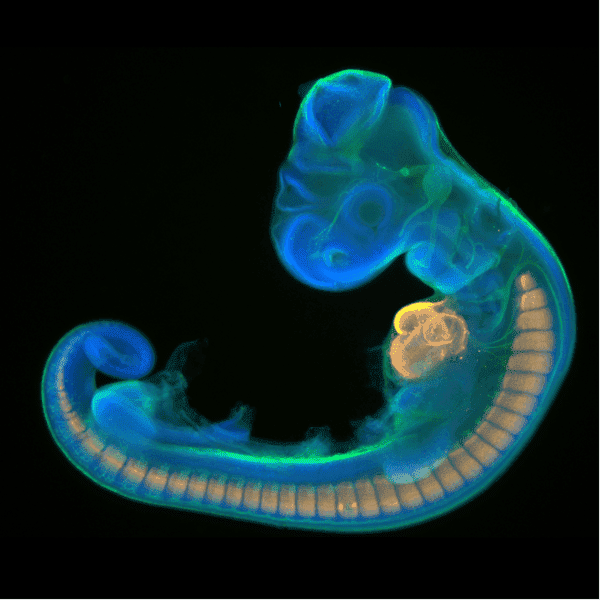
It is fluorescently labeled: orange muscle cells, green neural cells and some skin, and bluish on other tissues, and shows a lot of interesting development going on. There are also some green cells that could be neural crest cells.
For the developmentally unaware, I have made a key to this figure:
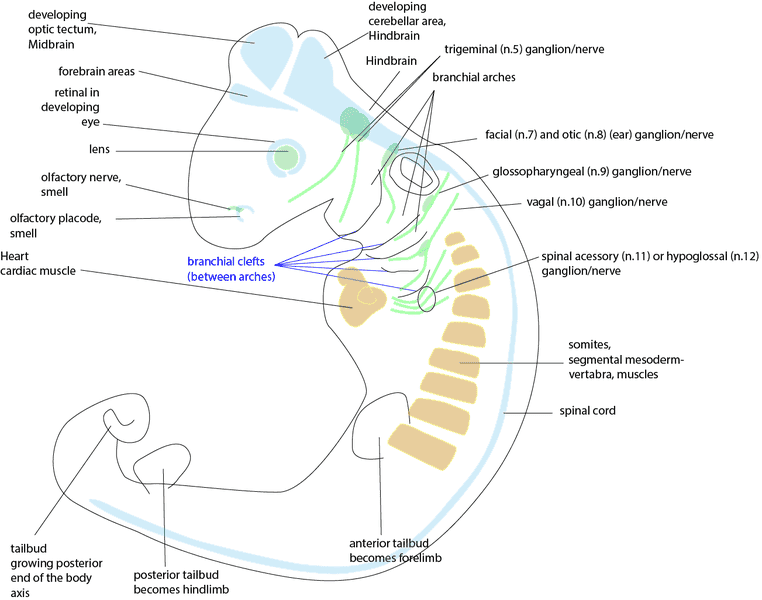
All of these embryo parts are conserved among and found in all vertebrates. They all share the same embryological layout, which generates similar but different adult forms. You can see all these parts (in distorted form) in fish, frog, bird, whale, and human embryos.
Here is a wikipedia article on the cranial nerves, some of which I have labeled.
Here is one on the pharyngeal arches (same as branchial arches) and their derivatives.
Invertebrate embryos are vastly different and generate body plans that are vastly different, which is why so much medical research (focused on particular body parts) is done on vertebrates.
http://www.faseb.org/Resources-for-the-Public/Scientific-Contests/BioArt/Past-Winners/2017-BioArt-Winners.aspx to the original picture.
It is fluorescently labeled: orange muscle cells, green neural cells and some skin, and bluish on other tissues, and shows a lot of interesting development going on. There are also some green cells that could be neural crest cells.
For the developmentally unaware, I have made a key to this figure:
All of these embryo parts are conserved among and found in all vertebrates. They all share the same embryological layout, which generates similar but different adult forms. You can see all these parts (in distorted form) in fish, frog, bird, whale, and human embryos.
Here is a wikipedia article on the cranial nerves, some of which I have labeled.
Here is one on the pharyngeal arches (same as branchial arches) and their derivatives.
Invertebrate embryos are vastly different and generate body plans that are vastly different, which is why so much medical research (focused on particular body parts) is done on vertebrates.
Attachments


Last edited by a moderator: