Visualizing a Segment of a Unit Circle

Click For Summary

Discussion Overview

The discussion revolves around visualizing a segment of a unit circle using polar coordinates and understanding the mathematical reasoning behind a specific equation related to the segment's representation. The scope includes technical explanations and mathematical reasoning.

Discussion Character

  • Technical explanation
  • Mathematical reasoning

Main Points Raised

  • One participant describes a MATLAB command sequence that visualizes a segment of a unit circle from 60° to 120° and questions the reasoning behind the equation "rho1 = rho*sin(a1)./sin(theta)" and its behavior from 1 to 0.866 to 1.
  • Another participant suggests converting from polar to Cartesian coordinates to gain insight into the straight line produced by the equation, emphasizing the importance of understanding the roles of rho and rho1 in polar coordinates.
  • A third participant provides the conversion formulas between Cartesian and polar coordinates and attempts to clarify the behavior of rho1, showing its values as it transitions from 1 to 0.866 to 1.
  • A fourth post introduces a different topic unrelated to the unit circle discussion, asking for help with a rational function problem.

Areas of Agreement / Disagreement

Participants have not reached a consensus on the reasoning behind the equation for rho1, and the discussion remains unresolved regarding its geometric interpretation.

Contextual Notes

The discussion includes assumptions about the understanding of polar and Cartesian coordinates, and the specific mathematical steps leading to the behavior of rho1 are not fully resolved.

chrisych
Messages
32
Reaction score
0
a = 60*pi/180;
a1 = (pi - a)/2;
a2 = (pi + a)/2;
theta = a1: a/60: a2;
rho = ones(size(theta));
rho1 = rho*sin(a1)./sin(theta);
polar(theta, rho);
hold on;
polar(theta, rho1)
03.jpg


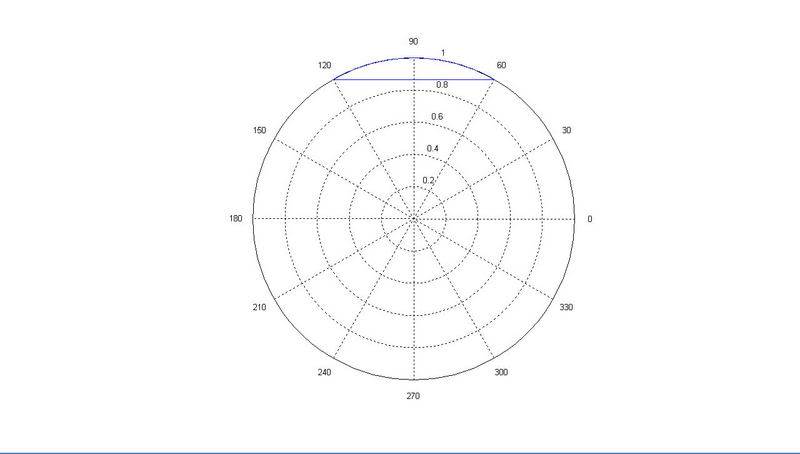
The above commands will draw a segment of a unit circle which starts from 60[tex]^{o}[/tex] to 120[tex]^{o}[/tex].

I know everything except the line of "rho1 = rho*sin(a1)./sin(theta);" that I don't know why this equation works from 1 --> 0.866 --> 1 and becomes a straight line. Can anyone tell me the reason? Is it related to a similar triangle or inverse proportion?
 
Physics news on Phys.org
try converting from polar to euclidean/cartesian...to see if you can figure out how they got that straight line. Remember what does rho,rho1 stand for in polar.
 
Cartesian to Polar:
r = sqrt(x^2 + y^2)
theta = arctan(y/x)

Polar to Cartesian:
x = r cos theta
y = r sin theta

rho = 1 (for unit circle)

rho1 = rho*sin(a1)/sin(theta) = 1*sin(60)/sin(60) to 1*sin(60)/sin(120) = 1 --> 0.866 --> 1
 
Last edited:
Write the equation of a rational function that has vertical asymptotes at x=2 and x=3 and a horizontal asymptote at y=2

yeah, i really need help with this problem. Thanks so much
 

Similar threads

  • · Replies 2 ·
Replies
2
Views
2K
  • · Replies 1 ·
Replies
1
Views
3K
  • · Replies 4 ·
Replies
4
Views
5K
  • · Replies 11 ·
Replies
11
Views
2K
  • · Replies 6 ·
Replies
6
Views
2K
  • · Replies 2 ·
Replies
2
Views
2K
  • · Replies 3 ·
Replies
3
Views
2K
  • · Replies 12 ·
Replies
12
Views
4K
  • · Replies 8 ·
Replies
8
Views
3K
  • · Replies 1 ·
Replies
1
Views
2K