chrisych
- 32
- 0
a = 60*pi/180;
a1 = (pi - a)/2;
a2 = (pi + a)/2;
theta = a1: a/60: a2;
rho = ones(size(theta));
rho1 = rho*sin(a1)./sin(theta);
polar(theta, rho);
hold on;
polar(theta, rho1)
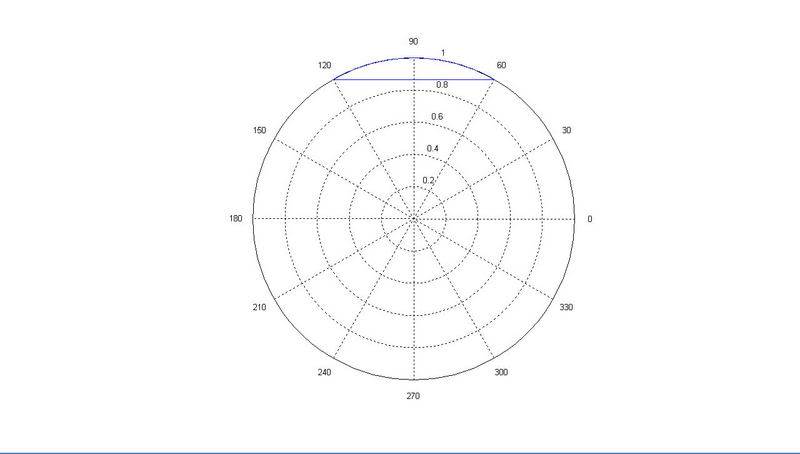
The above commands will draw a segment of a unit circle which starts from 60[tex]^{o}[/tex] to 120[tex]^{o}[/tex].
I know everything except the line of "rho1 = rho*sin(a1)./sin(theta);" that I don't know why this equation works from 1 --> 0.866 --> 1 and becomes a straight line. Can anyone tell me the reason? Is it related to a similar triangle or inverse proportion?
a1 = (pi - a)/2;
a2 = (pi + a)/2;
theta = a1: a/60: a2;
rho = ones(size(theta));
rho1 = rho*sin(a1)./sin(theta);
polar(theta, rho);
hold on;
polar(theta, rho1)
The above commands will draw a segment of a unit circle which starts from 60[tex]^{o}[/tex] to 120[tex]^{o}[/tex].
I know everything except the line of "rho1 = rho*sin(a1)./sin(theta);" that I don't know why this equation works from 1 --> 0.866 --> 1 and becomes a straight line. Can anyone tell me the reason? Is it related to a similar triangle or inverse proportion?