Voltage Doubler help: 6V ac 36W alternator in ~ 12V dc out

Click For Summary
SUMMARY

This discussion focuses on building a Voltage Doubler using a 6V AC alternator from a Honda CT110 motorcycle to power a 12V LED headlight rated at 36W. The proposed configuration is based on the Greinacher circuit, which allows for a common ground connection, simplifying installation and restoration. Key considerations include determining appropriate diode and capacitor values for the current and frequency range, as well as evaluating the feasibility of the project given the alternator's specifications, including the number of magnets and coil configurations.

PREREQUISITES
  • Understanding of Greinacher circuit configuration
  • Knowledge of diode and capacitor selection for voltage doubling
  • Familiarity with AC to DC conversion techniques
  • Basic electrical principles related to alternators and coils
NEXT STEPS
  • Research diode and capacitor specifications for high-frequency applications
  • Learn about the operation of DC-DC boost converters, specifically the LTC1871 module
  • Investigate the implications of using a bridge rectifier with LED lighting
  • Explore the effects of ripple voltage on LED performance and potential solutions
USEFUL FOR

This discussion is beneficial for motorcycle enthusiasts, electrical engineers, and hobbyists interested in DIY electrical projects, particularly those involving voltage conversion and LED lighting systems.

DonKiwi
Messages
6
Reaction score
5
I am trying to build a Voltage Doubler to use a motorcycle 6 Volt a.c. alternator's dedicated headlight coil (which presently runs a 36W incandescent headlight bulb) to provide 12 Volt d.c. to drive a commercially-bought 12V LED headlight unit (also rated at 36W). Frequency will be (1500 ~ 5000 r.p.m * 60) 90kHz ~ 300 kHz.
I want to use the Greinacher circuit configuration
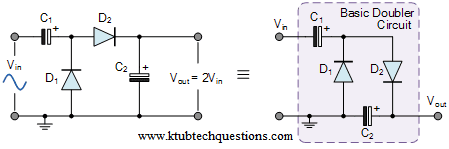
4-1.png

to allow common Earth between alternator and headlight. This will avoid any alteration to the Alternator internal wiring or the added complication of a floating 12V d.c.output above chassis ground (as would be necessary in "Bridge" or "Full-Wave" configurations).
It will also give full reversibility to enable restoration of the bike's wiring to factory standard by simply removing the Voltage Doubler unit from its series connections in the wiring loom.

I have searched online in vain to find guidance for the purpose of establishing Diode and Capacitor values for the proposed Current and Frequency range, or even sufficient information to ascertain if this project is indeed feasible.
All assistance, comments and criticism is invited.
 

Attachments

  • images?q=tbn:ANd9GcQQlN8CxI-SNcnVHv_T3_R6V6NMQeEroOcGQTtYqhOuPy2sHS2n7A.png
    images?q=tbn:ANd9GcQQlN8CxI-SNcnVHv_T3_R6V6NMQeEroOcGQTtYqhOuPy2sHS2n7A.png
    2.8 KB · Views: 766
  • 4-1.png
    4-1.png
    4.5 KB · Views: 1,639
Engineering news on Phys.org
I have built several such circuits, but never one with a 3A output. As far as I can remember, voltage doublers also double the source impedance. I would recommend a small boost regulator (start with specifying your needs in http://www.linear.com/solutions/).
 
  • Like
Likes   Reactions: berkeman
Frequency doesn't look right to me.
How many magnets in that alternator ?

1500 to 5000 rpm is (1500 to 9000)/60 = 25 to 150 revolutions per second.

Multiply 25 to 1500 by half the number of magnets to get hz.
 
Thank you, gentlemen. I was consulting a high frequency example at the time of writing and my brain must have become overclocked and missed my outrageous frequency error until the editing widow closed. I have been waiting for someone to "spot my deliberate mistake" :)
I considered the issue of number of magnets but will have to remove the whole engine side cover to count not only the magnets but investigate the stator coil configuration. The alternator has three independent a.c. circuits: [Battery charge to rectifier (6V floating); Ignition (6V earthed to CDI module); Headlight (6V earthed)] provided by FOUR stator coils. I will have to ascertain which circuit uses two of these coils (and whether another factor-of-2 is involved).
For reference the bike is a Honda CT110 ("Honda Trail" in USA) with Hi-Lo sub-transmission (A switchable Torque-Doubler !).

These corrected parameters may enable the Wise to advise me whether it is worth pursuing the project or whether a transformer & rectifier would be better. (One problem is where to put anything of size on the small bike).

Thank you for the link, Svein. It offered no insight relating to this minimalist project but will be a valued resource for my future reference.
 
I'd hook up a rectifier to that 6 volt coil and see if it lights the headlamp satisfactorily.
Is(or are) the headlight coil(or coils) wound on the same stator poles as the battery charge or ignition coils?
 
Last edited:
jim hardy said:
Is(or are) the headlight coil(or coils) wound on the same stator poles as the battery charge or ignition coils?
Reason i ask is - if you're lucky it operates as a constant current source and might well make 12 volts at somewhat reduced LED current. One experiment is worth a thousand expert guesses.
 
  • Like
Likes   Reactions: Averagesupernova
Thanks, guys. I will investigate further when I can get a chance to open the alternator. It does indeed have individual coils on their own cores for each of the three circuits. I may yet have to consider rewinding the (quite accessible) headlight coil for 12V and use a small bridge rectifier and smoothing capacitor. I would then have to either float the 12V alternator output above ground or have a floating 12V d.c; ground-independent headlight supply. It is starting to look like a too-complicated mission but even so, this inquiry may encourage someone with a similar idea to not bother fixing something which is not really broken. :)
 
DonKiwi said:
use a small bridge rectifier and smoothing capacitor
The smoothing capacitor is probably not needed. At least with incandescent lamps, the flicker from a 25Hz supply is just barely visible in your peripheral vision, get much above that and your eyes don't respond fast enough to notice.
 
  • #10
Thanks, Tom. As you say, the ripple is only just noticeable on the present incandescent bulb and, like personal ugliness, is really the problem of people in oncoming traffic rather than my own. :) My only thought of using a "smoothing" Capacitor was to hold a proposed diode-bridge rectified voltage above the bias threshold of the LED headlight, not allowing V.out to twice-periodically drop below that value between plus and minus V.cutoff levels of the a.c. wave.
I would expect a more noticeable "strobe" with LED lights since they lack the thermal hysteresis of an incandescent filament.
My bike came with an aftermarket single-wire series "Light Regulator" hanging loose in the headlight (for standard 6V a.c. operation). It may only have an inductive coil inside the case but it is filled with Top-Secret Resin and I have not had a chance to operate yet.
 
  • Like
Likes   Reactions: Tom.G
  • #11
You do not need to open the alternator to count the poles.
To see a picture, just look in the maintenance manual, or for the spare part on the web.

Look on eBay or AliExpress for something like, $5. free shipping;
100W DC-DC 3~35V to 3.5~35V LTC1871 Booster step up module.
You may need a rectifier diode and a capacitor to remove input ripple.
 

Similar threads

  • · Replies 7 ·
Replies
7
Views
4K
  • · Replies 68 ·
3
Replies
68
Views
16K
Replies
3
Views
7K
Replies
1
Views
7K