Water flow thru 18" corrugated culvert

Join the discussion
Ask a follow-up here, or get your own question answered by working scientists, mathematicians and engineers — people, not an autocomplete.
Real named experts · corrections over time · the nuance an AI answer skips
2 replies · 3K views
John1397
Messages
189
Reaction score
18
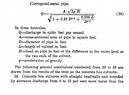
Attached formula can't figure out. H is 12 inches, Q is what I want to know, L is 40 feet, D is 18 inches, A I assume is area of 18 inches, g have no clue what this is. The Culver is 18" X 40 foot long coragated with water 1 foot over inlet and water on outlet 2" lower than culvert and the culverts tail is 2 inches lower than head. end
 

Attachments
  • Screenshot_20220730_103311~2.png
    Screenshot_20220730_103311~2.png
    27 KB · Views: 220
Physics news on Phys.org
Q=discharge in cubic feet per second.
D=diameter of pipe in feet. 18" = 3/2 feet, radius = 3/4 ft.
A=cross-sectional area of pipe in square feet. = Pi * 9/16 sq ft.
L=length of culvert in feet. = 40 ft.
H=head on pipe in feet or the difference in the water level at the two ends. = (12+2+2)/12 ft.
g=acceleration of gravity. = 32 ? ft/s²

What is the problem?
 
If you are using this for an actual culvert, do not be surprised if the calculation seems to give a wrong answer. The correct procedure for calculating culvert flow is in a document titled HDS5 - Hydraulic Design of Highway Culverts, 3rd Edition. It's from the U.S. Department of Transportation, Federal Highway Administration. Here's a link: https://www.fhwa.dot.gov/engineering/hydraulics/pubs/12026/hif12026.pdf.

Be advised that at least one of the nomograms gives wrong answers for corrugated steel pipe culverts. The equations are correct. Note that one single equation cannot cover all cases of headwater level, tailwater level, entrance conditions, culvert slope, culvert length, approach velocity and direction, downstream channel velocity, inlet control vs outlet control, etc.

If you just want to know the flow rate of a nearby culvert, you could measure the flow cross sectional area and culvert length, then throw a stick in and measure the time to flow through. Velocity times area equals flow.
 
Reply
  • Informative
Likes   Reactions: berkeman and anorlunda