Waveguide: get I and II M.eq. from III and IV M.eq.

Click For Summary
SUMMARY

This discussion focuses on the derivation of Maxwell's equations in a waveguide context, specifically how to obtain the divergence equations from the curl equations. The equations in question are ##\nabla \cdot E=0## and ##\nabla \cdot B=0##, which are valid under the assumption of no sources. The user initially confused the equations, mistakenly equating vector and scalar forms. The clarification emphasizes that vectors cannot equal scalars, reinforcing the importance of correctly identifying the nature of the equations involved.

PREREQUISITES
  • Understanding of Maxwell's equations in electromagnetism
  • Familiarity with vector calculus concepts
  • Knowledge of waveguide theory and propagation
  • Proficiency in using Cartesian coordinates for field representation
NEXT STEPS
  • Study the derivation of Maxwell's equations in different coordinate systems
  • Explore wave propagation in waveguides using MATLAB or Python
  • Learn about boundary conditions in electromagnetic theory
  • Investigate the implications of divergence and curl in vector fields
USEFUL FOR

Physicists, electrical engineers, and students studying electromagnetism or waveguide theory will benefit from this discussion, particularly those interested in the mathematical foundations of Maxwell's equations.

crick
Messages
39
Reaction score
4
Consider a waveguide with axis parallel to axis ##z##. Using cartesian coordinates the fields inside the waveguide can be written as

Immaginiie.png

Where ##\alpha## is the wavenumber and ##k=\frac{\omega}{c}## .

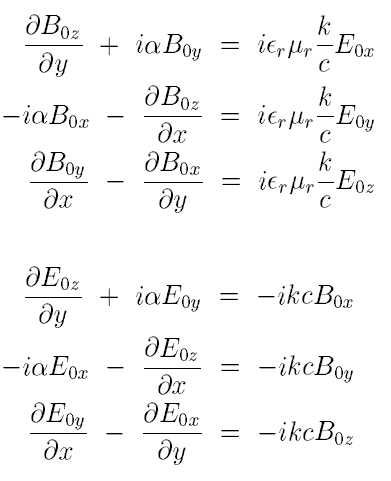
The maxwell equations ##\nabla \times E=-\frac{\partial B}{\partial t}## and ##\nabla \times B=\epsilon \mu \frac{\partial E}{\partial t}## are written in components as
Immaginke.png
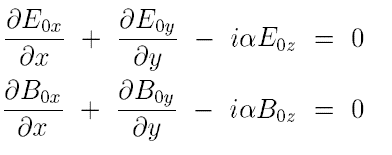
##\tag{(A)}##While the maxwell equations ##\nabla \cdot E=-\frac{\partial B}{\partial t}## and ##\nabla \cdot B=\epsilon \mu \frac{\partial E}{\partial t}## are written in components as
Immagikne.png

##\tag{(B)}##

On textboox it is claimed that equations ##B## are not useful, since they can obtained from equations ##A##. So how to obtain equations ##B## using equations ##A##?
 
Physics news on Phys.org
crick said:
∇×E=−∂B/∂t

crick said:
∇⋅E=−∂B/∂t
Are these both true? One should be a vector and one a scalar.
 
Of course, they are not true since
$$\vec{\nabla} \cdot \vec{E}=0, \quad \vec{\nabla} \cdot \vec{B}=0.$$
A vector can never ever be equal to a scalar!
 
mjc123 said:
Are these both true? One should be a vector and one a scalar.
vanhees71 said:
Of course, they are not true since
$$\vec{\nabla} \cdot \vec{E}=0, \quad \vec{\nabla} \cdot \vec{B}=0.$$
A vector can never ever be equal to a scalar!

EDIT OF THE QUESTION: I apologize, I made a mistake, I intended to write the first two maxwell equations, that are ##\nabla \cdot E=0## and ##\nabla \cdot B=0## (if there are no sources). ##E## and ##B## are intended to be vectors.
 
  • Like
Likes   Reactions: vanhees71

Similar threads

  • · Replies 1 ·
Replies
1
Views
604
  • · Replies 5 ·
Replies
5
Views
665
  • · Replies 3 ·
Replies
3
Views
683
  • · Replies 5 ·
Replies
5
Views
841
  • · Replies 10 ·
Replies
10
Views
679
  • · Replies 6 ·
Replies
6
Views
2K
  • · Replies 3 ·
Replies
3
Views
725
  • · Replies 7 ·
Replies
7
Views
2K
  • · Replies 29 ·
Replies
29
Views
2K
  • · Replies 1 ·
Replies
1
Views
2K