Wavelength and laser basics (ND:YAG)

Click For Summary
SUMMARY

The discussion focuses on the use of ND:YAG lasers, specifically their wavelengths and applications in processing and cleaning metals. ND:YAG lasers operate at a wavelength of 532 nm when frequency-doubled, making them effective for cleaning reflective surfaces like silver. In contrast, CO2 lasers are less effective for these applications due to higher reflection rates. The participants clarify that most metals, except silver, absorb significant energy at this wavelength, emphasizing the importance of understanding absorption characteristics for effective laser use.

PREREQUISITES
  • Understanding of laser types, specifically ND:YAG and CO2 lasers
  • Knowledge of wavelength and frequency-doubling concepts
  • Familiarity with metal absorption characteristics at different wavelengths
  • Basic principles of laser processing and cleaning techniques
NEXT STEPS
  • Research the specific applications of ND:YAG lasers in metal processing
  • Study the absorption spectra of various metals at different wavelengths
  • Learn about the advantages and limitations of CO2 lasers compared to ND:YAG lasers
  • Explore advanced techniques for optimizing laser cleaning processes
USEFUL FOR

Engineers, laser technicians, and metalworking professionals seeking to enhance their understanding of laser applications in metal processing and cleaning.

joslaz90
Hey guys!
I hope my English skills are enough to describe my problems sufficiently.(Homework Statement )
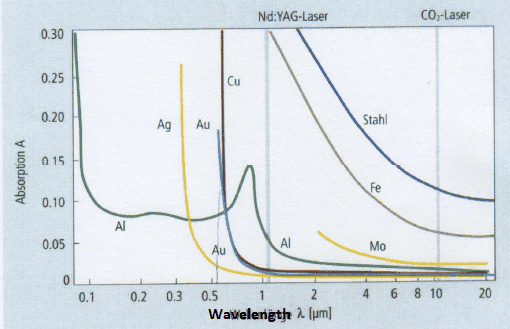
Unbenannt.PNG


I. Following the following picture, what wavelength should a laser be used to process aluminum?

II. What metal surface can be cleaned with a frequency-doubled NDYAG laser?

To I:
The literature says that both ND: YAG and CO2 lasers can be used for this. The high reflection rate can be operated by both laser types

To II:
Such a laser has a wavelength of 532 nm and is particularly suitable for reflecting surfaces, corresponding to a significant advantage over a Co2 laser. Which metals are primarily to be mentioned here? Silver? Or is my approach wrong?I am glad about every contribution and every help (:
 
Last edited by a moderator:
Physics news on Phys.org
Doubling the frequency is half the wavelength. You are correct there. From the graph, all metals except silver will be absorbing a significant portion of energy at this wavelength.
 
  • Like
Likes   Reactions: joslaz90
Many thanks for your response!

However, I do not quite understand how the diagram is to be read. Is the value with the least absoption at 532nm to be read (ie Ag)?
 

Similar threads

  • · Replies 6 ·
Replies
6
Views
1K
  • · Replies 10 ·
Replies
10
Views
3K
  • · Replies 7 ·
Replies
7
Views
3K
  • · Replies 6 ·
Replies
6
Views
1K
  • · Replies 7 ·
Replies
7
Views
2K
Replies
2
Views
4K
Replies
9
Views
6K
  • · Replies 2 ·
Replies
2
Views
2K
  • · Replies 3 ·
Replies
3
Views
6K
  • · Replies 19 ·
Replies
19
Views
10K