Weight Distribution Across Multiple Support Points (Load on Trailer)

Click For Summary

Discussion Overview

The discussion focuses on methodologies for calculating load distribution across multiple support points on a trailer when transporting a heavy object. Participants explore the implications of load distribution in relation to the center of gravity (CoG) of the object and the fixed support points on the trailer deck.

Discussion Character

  • Technical explanation
  • Debate/contested

Main Points Raised

  • Ahmed seeks a methodology for calculating load distribution on multiple supports beneath a heavy object, noting that existing resources primarily address two-point support scenarios.
  • Some participants inquire about the suspension of the trailer's wheels or axles, suggesting that this could affect the calculations.
  • One participant emphasizes the need to ensure that the total weight applied to the load points equals the weight of the object, and that moments about the CoG must sum to zero.
  • Another participant points out that the choice of load points is predetermined by the design of the vessel or bridge, complicating the calculation of load transfer to the trailer deck.
  • There are suggestions that sub-frames may be necessary to distribute point loads more evenly across the trailer bed, but concerns are raised about the potential increase in load mass and height affecting stability.
  • Participants discuss the use of timber packing to adjust loads and improve surface compliance, though this introduces additional considerations regarding friction and stability.

Areas of Agreement / Disagreement

Participants express differing views on the feasibility of adjusting load points and the implications of using sub-frames. The discussion remains unresolved, with multiple competing perspectives on how best to approach the load distribution problem.

Contextual Notes

Participants highlight limitations related to the fixed nature of support points and the rigidity of the object compared to the trailer, which may affect the accuracy of load distribution calculations.

Ahmed
Messages
5
Reaction score
2
TL;DR
Weight Distribution Across Multiple Support Points
Hi All,

Please note that I am looking for a methodology to calculate load distribution on multiple supports (3 and more)located underneath a heavy object at different spans/locations from the objects CoG, please see below example:
View attachment 336373
I searched here in Physics Forums and found article gave solution on simple 2 points support only.
Could you help me to find that please ?

Thanks,
Ahmed
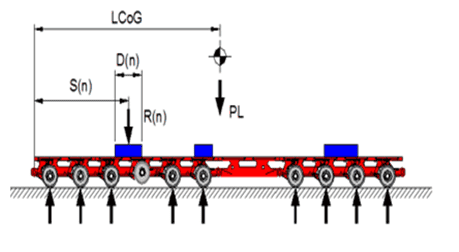
1701356150114.png
 
  • Like
Likes   Reactions: DeBangis21
Engineering news on Phys.org
Welcome to PF. :smile:

Does each wheel or axle have suspension ("sprung")? If not and they are rigidly attached to the rigid frame, do you see an issue with this calculation?
 
berkeman said:
Welcome to PF. :smile:

Does each wheel or axle have suspension ("sprung")? If not and they are rigidly attached to the rigid frame, do you see an issue with this calculation?
Hi Berkeman, yes they are on suspension, but I want to know the concept on how to distribute the loads on the saddles to assess the bending moment on the trailer deck (I have the load on each axle line).
 
  • Like
Likes   Reactions: berkeman
Is the object more rigid than the trailer ?

You must solve for a distribution of the object's mass, to the individual load-carrying points selected on the trailer deck.

The weight applied to each of the load-points, should sum to the weight of the object.

Consider the point on the trailer deck below the CoG. The moment of the applied load forces, about that point, should sum to zero.

Now you select convenient load points on the trailer deck, then solve the linear system to find the load applied to each.
 
  • Like
Likes   Reactions: DeBangis21 and Ahmed
Baluncore said:
Is the object more rigid than the trailer ?

You must solve for a distribution of the object's mass, to the individual load-carrying points selected on the trailer deck.

The weight applied to each of the load-points, should sum to the weight of the object.

Consider the point on the trailer deck below the CoG. The moment of the applied load forces, about that point, should sum to zero.

Now you select convenient load points on the trailer deck, then solve the linear system to find the load applied to each.
 
Hi Baluncore, The issue is I don't have the option to choose the load points on trailer deck, the horizontal vessel or steel bridge it has their own saddles/support points which I've to deal with it, so i need a calculation to tell me how much load will be transferred from the vessel/bridge to the trailer deck through the saddles/supports based on location of each saddles/supports from the CoG.
 
Ahmed said:
The issue is I don't have the option to choose the load points on trailer deck, the horizontal vessel or steel bridge it has their own saddles/support points which I've to deal with it, ...
The decision has been made for you, because you have decided to use the available points. That is as expected.
Now you must allocate the total load to those points, with sum zero moment.
 
  • Like
Likes   Reactions: DeBangis21
So you need sub-frames etc to spread the point loads more evenly across the trailer bed...
 
  • #10
Nik_2213 said:
So you need sub-frames etc to spread the point loads more evenly across the trailer bed...
Adding sub-frames would increase the load mass, and increase the load height. That would reduce stability, and might impose travel route restrictions.

The trailer bed is a truss, with a linear stiffness matrix. The bed is designed to be a sub-frame, placed between the axle suspension points, and the intended loads.

If needed, timber packing between the load-points and the bed, will adjust the load applied at each position along the deck. In many cases, timber will also increase the surface compliance, and the friction coefficient.
 
  • Like
Likes   Reactions: berkeman and Lnewqban

Similar threads

Replies
33
Views
5K
  • · Replies 6 ·
Replies
6
Views
10K
Replies
2
Views
3K
Replies
3
Views
4K
  • · Replies 7 ·
Replies
7
Views
2K
Replies
3
Views
6K
Replies
13
Views
4K
  • · Replies 15 ·
Replies
15
Views
5K
  • · Replies 9 ·
Replies
9
Views
8K
Replies
6
Views
5K