What am I missing here in this difference quotient problem?

  • Context: Undergrad 
  • Thread starter Thread starter JR Sauerland
  • Start date Start date
  • Tags Tags
    Difference quotient
Click For Summary

Discussion Overview

The discussion revolves around understanding the manipulation of the difference quotient in calculus, specifically the process of taking limits as Δx approaches zero. Participants are examining how Δx is treated in the context of a lecture example, with a focus on the cancellation of terms and the implications of limits.

Discussion Character

  • Technical explanation
  • Conceptual clarification
  • Debate/contested

Main Points Raised

  • One participant expresses confusion about how Δx is 'dropped' in the limit process, noting that they understand the distribution but not the cancellation.
  • Another participant suggests that the cancellation of Δx acts as a factor of 1, indicating that as Δx approaches zero, it becomes negligible.
  • A different participant clarifies that there is no dropping of Δx, but rather a cross-cancellation of terms, emphasizing that the limit is taken as Δx approaches zero.
  • Some participants reiterate that Δx approaching zero means it can be considered small enough to be omitted in the limit process, but express ongoing confusion about this concept.
  • One participant questions the understanding of limits and suggests that a foundational review may be necessary for clarity.

Areas of Agreement / Disagreement

Participants generally agree that Δx approaching zero allows for certain simplifications in the limit process, but there is disagreement on the clarity of this concept and how it is applied in the example. Confusion remains among some participants regarding the treatment of Δx.

Contextual Notes

There are unresolved questions about the foundational understanding of limits and the specific steps taken in the example, which may depend on individual interpretations of the limit process and the cancellation of terms.

JR Sauerland
Gold Member
Messages
44
Reaction score
0
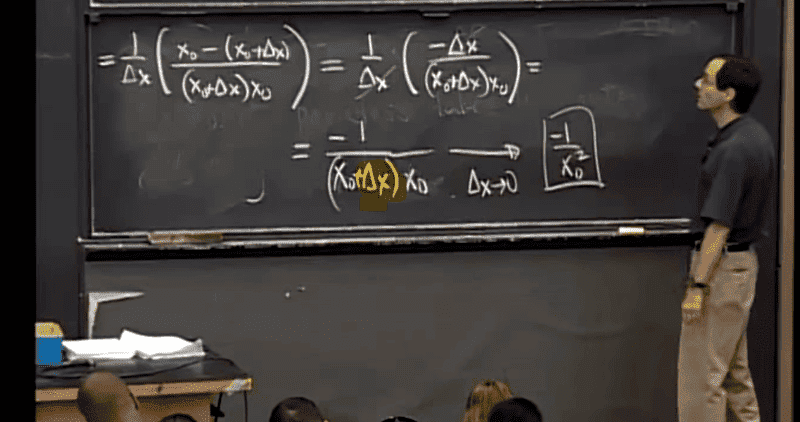
I've highlighted the part in yellow I don't understand. He apparently 'drops' Δx in the last line, but doesn't display how. What I do know is that he is taking the limit as Δx→0, or as Delta x approaches zero. I'm simpy missing what he did though to drop the Δx. I mean, I understand he distributed x into the parentheses to get x0 squared, but not how he just dropped the Δx.

Any insight?
YOQR7yN.png
 
Physics news on Phys.org
The work on the chalkboard looks good. The first pair of delta x which the lecturer canceled acted as a factor of 1. The highlighted delta x would become increasingly, vanishingly small and so is taken as near enough to zero. The lecturer has shown the limit of the original expression as delta x approaches zero.(minor edit)
 
Last edited:
He did not drop anything. He DID do a cross-cancellation of a delta X on top and a delta X on bottom. He even shows lines through them to emphasize this.

If you are asking about the very last bit of "= -1 / (X0) ^ 2 then that is, as he clearly states, a limit as delta X approaches zero.
 
symbolipoint said:
The highlighted delta x sub zero would become increasingly, vanishingly small and so is taken as near enough to zero. The lecturer has shown the limit of the original expression as delta x sub zero approaches zero.

Does that mean that since delta x is approaching zero, it is just left out because it is so small? I guess I just don't understand at all.
 
JR Sauerland said:
Does that mean that since delta x is approaching zero, it is just left out because it is so small? I guess I just don't understand at all.
Yes, that is exactly what it means. The concept of the limit is that you see what would happen if it actually GOT to the limiting amount.
 
JR Sauerland said:
Does that mean that since delta x is approaching zero, it is just left out because it is so small? I guess I just don't understand at all.
phinds said:
Yes, that is exactly what it means. The concept of the limit is that you see what would happen if it actually GOT to the limiting amount.
Understand that in the shown example, letting delta x become zero does not make the denominator part of the expression undefined.(Reminder: I made a minor edit to my response.)
 
Um, do you have a textbook or anything? It doesn't seem that you grasp limits at all or what they're supposed to be. If you don't understand things like this, it's silly to move on. You need to go back in your book and read it from the start again until you grasp what a limit is.
 

Similar threads

  • · Replies 12 ·
Replies
12
Views
5K
  • · Replies 13 ·
Replies
13
Views
2K
  • · Replies 3 ·
Replies
3
Views
1K
  • · Replies 5 ·
Replies
5
Views
3K
  • · Replies 25 ·
Replies
25
Views
4K
  • · Replies 3 ·
Replies
3
Views
2K
  • · Replies 8 ·
Replies
8
Views
3K
  • · Replies 24 ·
Replies
24
Views
4K
  • · Replies 17 ·
Replies
17
Views
3K
  • · Replies 8 ·
Replies
8
Views
2K