What Are Co-Phasal Wave Fronts in Fizeau Interferometry?

  • Context: Undergrad 
  • Thread starter Thread starter Ahmed123
  • Start date Start date
  • Tags Tags
    Interferometer
Join the discussion
Ask a follow-up here, or get your own question answered by working scientists, mathematicians and engineers — people, not an autocomplete.
Real named experts · corrections over time · the nuance an AI answer skips
7 replies · 3K views
Ahmed123
Messages
6
Reaction score
1
TL;DR
Question and discussion about wave fronts and phases of the rays at the Fizeau interferometer
I am studying Fizeau analysis for wedge problem. I reached to this part and I cant follow. I have two questions and any help will be appreciated
1) what is meant by co-phasal wave fronts? does it mean that they have the same phase? ( how can I Think about the wave fronts in this case)
2) why the pass difference between the two rays is calculated by this formula?
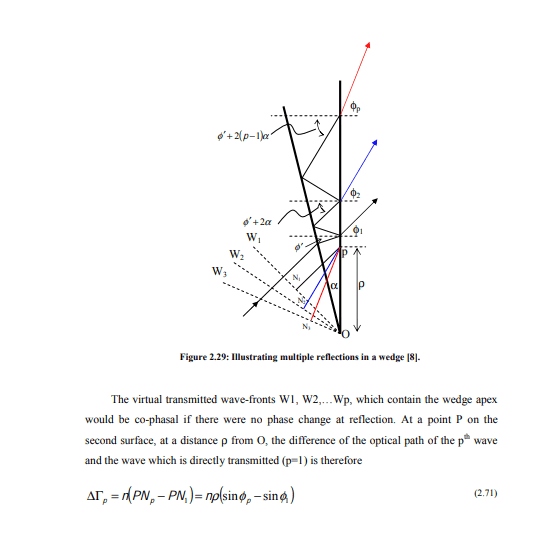
image.PNG

Thanks in advance
 
Physics news on Phys.org
Ahmed123 said:
TL;DR Summary: Question and discussion about wave fronts and phases of the rays at the Fizeau interferometer

what is meant by co-phasal wave fronts?
It means that the waves emerging along both paths are in phase. That will happen when the lengths of the two paths differ by a whole number of wavelengths. So the distance travelled in the diagram between the blue exit point and the red exit point will be one, two three . . . . whole wavelengths. The term is "Path Difference" and not 'pass difference' (translation problem, no doubt).

An easier example to start with is when the plates are parallel and the incident wave is plane; you get full addition, all over the emerging wave for one angle (say normal) and cancellation at another angle. Put the appropriate angles in your calculations and it should work for that.

PS it's always worth while looking at more than just one source to resolve this sort of confusion. There are dozens available. :smile:
 
Reply
  • Love
Likes   Reactions: Ahmed123
The wavefronts are planes perpendicular to the direction of propagation. This means that the wavefronts are in phase with each other, and they will interfere constructively.
 
gravisxv said:
The wavefronts are planes perpendicular to the direction of propagation. This means that the wavefronts are in phase with each other, and they will interfere constructively.
Where? It is angle dependent.
 
It is certainly angle dependent. I understand what you're telling, in the Fizeau wedge interferometer, the path difference between the rays depends on the angle at which they emerge from the wedge.
 
gravisxv said:
It is certainly angle dependent. I understand what you're telling, in the Fizeau wedge interferometer, the path difference between the rays depends on the angle at which they emerge from the wedge.
If you accept that, then how would you not get fringes?
The details of that equation under your quoted diagram would need some fleshing out. I asked you for more info or a link. Do you have it?

Alternatively, look for another source and we could discuss that. You can't expect a one stop shop on Google.