Discussion Overview
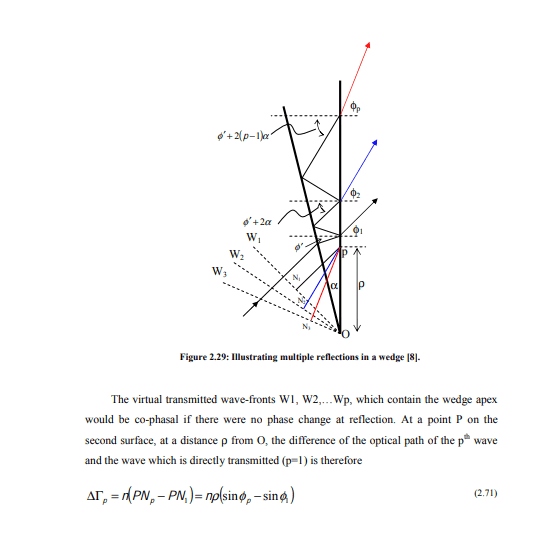
The discussion revolves around the concept of co-phasal wave fronts in the context of Fizeau interferometry, particularly focusing on the wedge problem. Participants explore the implications of wave phase relationships and path differences in interference patterns.
Discussion Character
- Exploratory
- Technical explanation
- Debate/contested
Main Points Raised
- One participant questions the meaning of co-phasal wave fronts, suggesting it may imply that the waves have the same phase.
- Another participant explains that co-phasal wave fronts occur when the lengths of two paths differ by whole wavelengths, leading to constructive interference.
- Some participants clarify that wavefronts are planes perpendicular to the direction of propagation, indicating they are in phase and will interfere constructively.
- There is a discussion about the angle dependency of the path difference in the Fizeau wedge interferometer, with multiple participants acknowledging this aspect.
- One participant expresses uncertainty about the derivation of a final equation related to the discussion and requests additional context or resources.
- A participant raises a concern about potential misunderstandings regarding how interference is generated, referencing the two-slit experiment as a foundational concept.
Areas of Agreement / Disagreement
Participants generally agree on the concept of co-phasal wave fronts and their relation to path differences, but there is ongoing debate about the specifics of how these concepts apply in the context of the Fizeau interferometer, particularly regarding angle dependency and the derivation of related equations.
Contextual Notes
Some participants note that the discussion may be hindered by translation issues, particularly regarding terminology like "pass difference" versus "path difference." Additionally, there are requests for further information and clarification on specific equations and diagrams.
Who May Find This Useful
This discussion may be useful for students and researchers interested in wave optics, particularly those studying interferometry and the principles of wave interference in varying geometries.