What are Immediate Early response Genes?

  • Thread starter Thread starter Matt204823545
  • Start date Start date
  • Tags Tags
    Genes Response
Click For Summary
SUMMARY

The discussion centers on Immediate Early response Genes (IEGs), specifically their role in the MAPK pathway and their activation in response to stimuli such as cocaine. IEGs, including Myc, Fos, and Jun, are expressed at the mRNA level without requiring new protein synthesis, utilizing pre-existing proteins for transcription. This contrasts with late response genes, which necessitate the synthesis of new proteins activated by IEGs. The conversation highlights the complexity of gene transcription regulation and the functional implications of IEGs in cellular responses.

PREREQUISITES
  • Understanding of the MAPK pathway and its components
  • Knowledge of gene expression mechanisms, including transcription and translation
  • Familiarity with transcription factors and their roles in gene regulation
  • Basic concepts of protein synthesis and its stages
NEXT STEPS
  • Explore the role of transcription factors in gene regulation, focusing on c-Fos and c-Jun
  • Investigate the differences between Immediate Early Genes and Late Response Genes
  • Learn about the mechanisms of RNA transcription and the impact of histones on gene accessibility
  • Study the effects of external stimuli on gene expression, particularly in the context of the nervous system
USEFUL FOR

Researchers, molecular biologists, and students studying gene expression, transcription regulation, and the MAPK signaling pathway will benefit from this discussion.

Matt204823545
Messages
18
Reaction score
5
TL;DR
I don't understand when people explain it.
So I'm studying the MAPK pathway and Erk (MAPK) activates IEGs (Immediate Early response Genes) such as Myc, Fos and Jun. What are IEGs?
I was told:
IEGs:
- expressed at the mRNA level (what does this mean? what's a "level"? what does "expressed" mean?)
- and hence don't require protein synthesis (what does this mean? why is this special? what is protein synthesis?)
- Myc is an IEG and a transcription factor that activates expression of late response genes (what's the difference between late response and IEG?)

Here's the 2 minute lecture that I'm referring to:

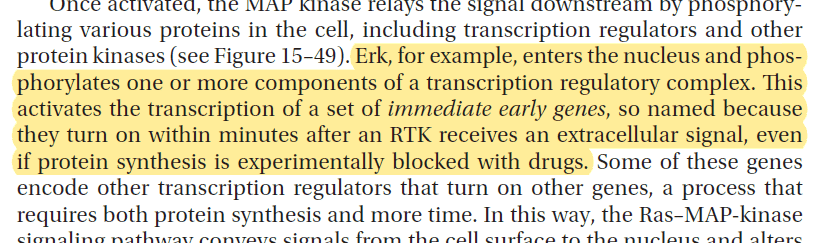
This is from my textbook:
Capture.PNG
 
Last edited:
Biology news on Phys.org
A gene is a DNA sequence. Let's say you give an animal an injection of cocaine. An immediate early gene is a a gene that is activated soon after the cocaine injection. By activated, we mean that complementary RNA is made or transcribed from the DNA sequence of the immediate early gene. After the complementary RNA has been transcribed, protein is made or expressed according to the sequence of the complementary RNA.

In the view of the textbook, the transcription of RNA from DNA when an immediate early gene does not require new proteins to be synthesized, ie, the transcription is mediated by proteins that are already present in the cell at the time of cocaine injection.

In contrast, late response genes require proteins to be made via the activation of immediate early genes.
 
  • Like
Likes   Reactions: BillTre
atyy said:
A gene is a DNA sequence. Let's say you give an animal an injection of cocaine. An immediate early gene is a a gene that is activated soon after the cocaine injection. By activated, we mean that complementary RNA is made or transcribed from the DNA sequence of the immediate early gene. After the complementary RNA has been transcribed, protein is made or expressed according to the sequence of the complementary RNA.

I fully understand this.

atyy said:
In the view of the textbook, the transcription of RNA from DNA when an immediate early gene does not require new proteins to be synthesized, ie, the transcription is mediated by proteins that are already present in the cell at the time of cocaine injection.

In contrast, late response genes require proteins to be made via the activation of immediate early genes.

I don't fully understand this.

So are all DNA→RNA transcriptions in the body either 'early' or 'late'? Just those two categories? Or are 'early' and 'late' special types of transcriptions?
What do you mean "they don't require new proteins to be synthesized"? Who said they do require them in the first place? Do most transcriptions require new proteins to be synthesized? Why is my professor stating that as if it's a surprising idea? Why do late genes require proteins? The proteins help the RNA polymerase to create an mRNA from a DNA strand?
I thought the transcription factor goes to the DNA strand in the nucleus and triggers RNA polymerase to generate an mRNA strand from the DNA strand, then the mRNA leaves the nucleus and gets translated into a full protein in the cytosol by a ribosome, that's my entire idea of transcription.
 
Regulation of transcription is quite a bit more complicated than just attaching a transcription factor + RNA polymerase to a DNA strand. For instance, much of a cell's DNA is inaccessible to immediate transcription because of the involvement of histones (proteins which DNA wraps around and which provide structure for chromatin during mitosis). Histones can physically block RNA polymerase from attaching to sections of DNA. So the immediate early genes are often involved in transcribing and upregulating genes that make these histone-associated regions accessible. If a region is accessed frequently (infrequently), certain chemical modifications to histones may take place to make regulations of those genes more (less) responsive. These types of effects are seen in areas like the nervous system, where repeated stimulation of a neural pathway can lead to long-term potentiation and synapse growth (alterations that are driven by late-response genes--sort of the complement to immediate early genes).
 
  • Like
Likes   Reactions: atyy, BillTre and Matt204823545
Matt204823545 said:
So are all DNA→RNA transcriptions in the body either 'early' or 'late'? Just those two categories? Or are 'early' and 'late' special types of transcriptions?

Good point. I don't think it is too useful to classify everything too strictly - for example - do we know that immediately early genes are not sometimes also late response genes (and vice versa)? Also, what is early - 15 minutes, 30 minutes, 60 minutes? When I see the term "immediate early gene" in a paper, I simply think that in some context, that gene is "rapidly" transcribed in response to a stimulus.

Matt204823545 said:
What do you mean "they don't require new proteins to be synthesized"? Who said they do require them in the first place? Do most transcriptions require new proteins to be synthesized? Why is my professor stating that as if it's a surprising idea?

I'm not sure what percentage of transcriptions require new protein synthesis. I don't find the idea of immediate early genes surprising, but surprise is subjective, so I would allow your professor to be surprised.

Matt204823545 said:
Why do late genes require proteins? The proteins help the RNA polymerase to create an mRNA from a DNA strand?
I thought the transcription factor goes to the DNA strand in the nucleus and triggers RNA polymerase to generate an mRNA strand from the DNA strand, then the mRNA leaves the nucleus and gets translated into a full protein in the cytosol by a ribosome, that's my entire idea of transcription.

Yes, the transcription factor goes to the DNA strand in the nucleus and triggers transcription followed by translation. Some immediate early genes are themselves transcription factors. If an immediate early gene is a transcription factor, after it has been transcribed and translated, it will go on to help activate transcription of other genes. Since the translation of the immediate early gene is protein synthesis, the genes that the immediate early gene goes on to activate will be (in this context) late response genes.

Immediate early genes that are transcription factors include the genes that encode c-Fos and c-Jun.
https://en.wikipedia.org/wiki/C-Fos
https://en.wikipedia.org/wiki/C-jun
 
Last edited:
  • Like
Likes   Reactions: Matt204823545
Regarding this:

1594553448296.png


How is the immediate early gene able to transcribe an mRNA which then goes on to translate a protein if "protein synthesis has been experimentally blocked with drugs"? Which part of protein synthesis has been blocked? The transcription? Translation? Isn't it called "protein synthesis" when Myc, Jun and Fos are created? Because they're proteins. Then why are they produced even when protein synthesis is blocked?
 
Matt204823545 said:
Regarding this:

View attachment 266250

How is the immediate early gene able to transcribe an mRNA which then goes on to translate a protein if "protein synthesis has been experimentally blocked with drugs"? Which part of protein synthesis has been blocked? The transcription? Translation? Isn't it called "protein synthesis" when Myc, Jun and Fos are created? Because they're proteins. Then why are they produced even when protein synthesis is blocked?

In that passage, "turn on" refers to transcription. Myc, Jun and Fos must also be translated (synthesized as proteins from mRNA) to work as trabnscription factors - that part of the pathway is blocked if protein synthesis is blocked.

What book is the passage from?
 
  • Like
Likes   Reactions: BillTre

Similar threads

  • · Replies 4 ·
Replies
4
Views
6K
Replies
2
Views
3K
Replies
0
Views
2K
  • · Replies 11 ·
Replies
11
Views
6K
  • · Replies 20 ·
Replies
20
Views
4K
  • · Replies 2 ·
Replies
2
Views
2K
  • · Replies 6 ·
Replies
6
Views
3K
  • · Replies 5 ·
Replies
5
Views
3K
  • · Replies 5 ·
Replies
5
Views
3K
  • · Replies 15 ·
Replies
15
Views
4K