What Are the Connections Between 120-Sided Dice and Eigenvalues?

  • Context: High School 
  • Thread starter Thread starter mike1000
  • Start date Start date
  • Tags Tags
    Dice Eigenvalues
Click For Summary
SUMMARY

The discussion centers on the relationship between 120-sided dice and eigenvalues, emphasizing that each die has 120 eigenvalues and that as the number of eigenvalues increases, the probability of any specific eigenvalue diminishes. Participants clarify that probabilities are related to the square of probability amplitudes rather than the components of a vector. The conversation also touches on the implications of superposition in quantum mechanics and how the shape of the die approaches a sphere as the number of outcomes increases. The key takeaway is that the mathematical representation of a die's state can be modeled using Hilbert space concepts.

PREREQUISITES
  • Understanding of eigenvalues and eigenstates in quantum mechanics
  • Familiarity with Hilbert space and probability amplitudes
  • Knowledge of superposition and measurement in quantum systems
  • Basic concepts of continuous spectra in quantum observables
NEXT STEPS
  • Study the mathematical foundations of Hilbert space in quantum mechanics
  • Learn about the implications of superposition and measurement in quantum systems
  • Explore the concept of density matrices and their applications in quantum mechanics
  • Investigate the differences between discrete and continuous spectra in quantum observables
USEFUL FOR

Quantum physicists, students of quantum mechanics, and anyone interested in the mathematical modeling of quantum states and their implications in measurement theory.

mike1000
Messages
271
Reaction score
20
Here is a picture of a set of 120 sided dice. Each die has 120 eigenvalues. It is easy to see that as the number of eigenvalues increases, the probability of any eigenvalue gets smaller. In the limit where the number of eigenvalues is ##\infty## the probability of anyone eigenvalue approaches zero and the shape becomes a sphere.

I suppose that in 120 dimensional space, each die would be represented by a single point. The vector describing that point would have 120 components. Each component would represent the probability that the die would be found in that particular eigenstate.
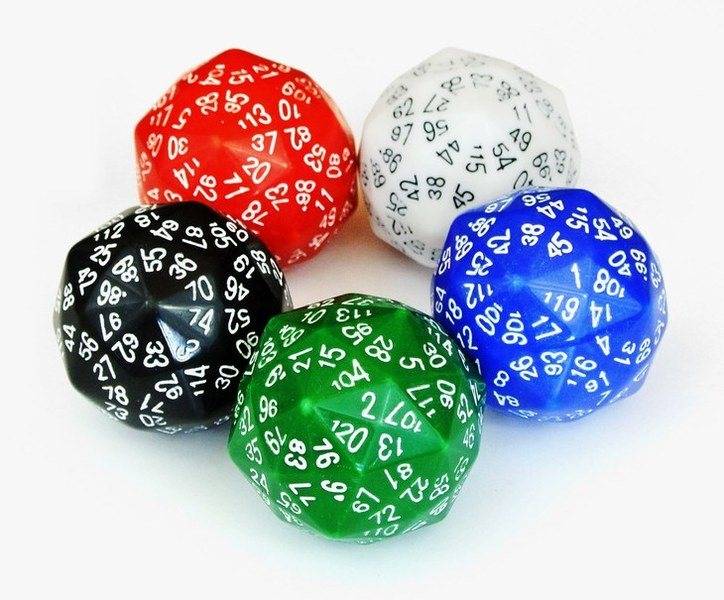
Dice.jpg
 
Physics news on Phys.org
mike1000 said:
Here is a picture of a set of 120 sided dice. Each die has 120 eigenvalues.
How can a die have eigenvalues?

mike1000 said:
It is easy to see that as the number of eigenvalues increases, the probability of any eigenvalue gets smaller.
That's incorrect. There is not reason to assume that all outcomes are equiprobable.

mike1000 said:
I suppose that in 120 dimensional space, each die would be represented by a single point.
This I really don't get.

mike1000 said:
The vector describing that point would have 120 components. Each component would represent the probability that the die would be found in that particular eigenstate.
I get the analogy you are trying to make, but this is also incorrect. Probabilities are related to absolute values square, not components. Also, you have to differentiate the space of possible outcomes with the actual state of a given die.
 
DrClaude said:
How can a die have eigenvalues?

Well a die can have eigenvalues because the result of a measurement on a die can only be one of the 120 values on the die.(I suspect there has to be some matrix operator that exists that actually has those 120 possible outcomes as real eigenvalues.)

That's incorrect. There is not reason to assume that all outcomes are equiprobable.

Yes. I should have stated in my original post that I was talking about a system where all outcomes were equally probable. The state vector would look like \begin{equation}|\psi\rangle=\frac{1}{\sqrt{120}}\begin{pmatrix}1\\1\\1\\ \vdots\\1\end{pmatrix}\end{equation}
This I really don't get.
I am assuming that each possible outcome can be considered a dimension in some probability space. Since there are 120 possible outcomes the total dimension of the space is 120. An arbitrary point in that space would be defined by a vector that has 120 components. When the die is shaking the state would be a superposition of all possible states as shown in Equation (1)
I get the analogy you are trying to make, but this is also incorrect. Probabilities are related to absolute values square, not components. Also, you have to differentiate the space of possible outcomes with the actual state of a given die.

I should have said "probability amplitudes" in my original post.
 
Last edited:
I get what the OP is trying to get at, so I wouldn't say that it's wrong. Yes, you can model this with a Hilbert space and take the components to be the probability amplitudes (this is just quantum mechanics restricted to only one basis) or the probabilities themselves i.e. using 1-norm instead of 2-norm. See this lecture by Scott Aaronson: http://www.scottaaronson.com/democritus/lec9.html
 
Truecrimson said:
I get what the OP is trying to get at, so I wouldn't say that it's wrong.
It's certainly not "not even wrong" :smile:

Maybe one can use it to motivate a lesson on density matrices on a continuum type state space.
 
mike1000 said:
Here is a picture of a set of 120 sided dice. Each die has 120 eigenvalues. It is easy to see that as the number of eigenvalues increases, the probability of any eigenvalue gets smaller. In the limit where the number of eigenvalues is ##\infty## the probability of anyone eigenvalue approaches zero and the shape becomes a sphere.

I suppose that in 120 dimensional space, each die would be represented by a single point. The vector describing that point would have 120 components. Each component would represent the probability that the die would be found in that particular eigenstate.

View attachment 133273
What's your point? What did we learn from the 120-sides case that we didn't already know from the 6-sides case?
 
Demystifier said:
What's your point? What did we learn from the 120-sides case that we didn't already know from the 6-sides case?

My point was that superposition is not a real state that the die can be measured in. When the die is being shaken it is put into an indeterminate state that is described mathematically as a superposition of possible outcomes but does not correspond to an actual outcome.

Also, I realized that as the number of possible outcomes goes to infinity the shape of the die becomes a sphere. How do you determine what the outcome of a shake is when the die is a sphere? It must be the tangent point of the sphere to the table when the die hits the table.
 
mike1000 said:
My point was that superposition is not a real state that the die can be measured in. When the die is being shaken it is put into an indeterminate state that is described mathematically as a superposition of possible outcomes but does not correspond to an actual outcome.
Couldn't you do all this with 6 sides?

mike1000 said:
Also, I realized that as the number of possible outcomes goes to infinity the shape of the die becomes a sphere. How do you determine what the outcome of a shake is when the die is a sphere?
Ah, now I see why 6 is not big enough. On the sphere the spectrum is continuous, and continuos observables cannot be measured with perfect accuracy.
 
Demystifier said:
Ah, now I see why 6 is not big enough. On the sphere the spectrum is continuous, and continuos observables cannot be measured with perfect accuracy.

If an observable with a continuous spectrum cannot be measured with perfect accuracy, does that mean that when we measure it we find that it actually is in a superposition of one or more states?
 
  • #10
mike1000 said:
If an observable with a continuous spectrum cannot be measured with perfect accuracy, does that mean that when we measure it we find that it actually is in a superposition of one or more states?
Yes.
 

Similar threads

  • · Replies 25 ·
Replies
25
Views
3K
Replies
2
Views
2K
  • · Replies 41 ·
2
Replies
41
Views
6K
  • · Replies 2 ·
Replies
2
Views
2K
  • · Replies 5 ·
Replies
5
Views
2K
  • · Replies 3 ·
Replies
3
Views
7K
  • · Replies 10 ·
Replies
10
Views
5K
  • · Replies 20 ·
Replies
20
Views
9K
  • · Replies 6 ·
Replies
6
Views
3K
Replies
4
Views
3K