Exploring Transformer Connections for Step Up/Down Transformers

Click For Summary

Discussion Overview

The discussion revolves around the various transformer connections used in step-up and step-down transformers, focusing on configurations at different voltage levels and their implications for safety and reliability. Participants explore the connections typically employed in consumer, substation, and generator applications, as well as the grounding practices associated with these configurations.

Discussion Character

  • Exploratory
  • Technical explanation
  • Debate/contested

Main Points Raised

  • Some participants propose that a star connection with neutral is commonly used on the secondary side at the 120/240 voltage level to support single-phase circuits.
  • There is uncertainty regarding whether the star "neutral point" is always grounded, with some noting that in the UK, earthing strategies can vary.
  • One participant mentions that in the US, a four-wire connection with an earthed neutral is standard to ensure safety during phase-to-ground faults.
  • Another participant describes that in their experience, the step-up transformer secondary is typically wye-connected with a grounded neutral, while the primary side is delta-connected, emphasizing the importance of grounding to limit fault currents.
  • Some participants discuss historical preferences for delta secondary configurations for reliability, noting that this approach had safety risks due to the potential for undetected ground faults.
  • There are mentions of modern practices that utilize wye secondary configurations for both safety and filtering benefits, including the use of resistors on the neutral-grounding point to provide a known ground reference.
  • One participant highlights that there is no single ideal solution for transformer configurations, as safety and reliability requirements can vary significantly based on application.

Areas of Agreement / Disagreement

Participants express multiple competing views regarding the configurations and grounding practices for transformers, indicating that the discussion remains unresolved with no consensus reached.

Contextual Notes

Participants reference specific practices in the US and UK, highlighting that regional differences in earthing and transformer configurations may influence the discussion. There are also mentions of historical practices that may no longer be considered safe or reliable.

KraakeCrest
Messages
18
Reaction score
2
Hi
Take a look at the picture below, I am curious of what transformer connections are used at each step up/step down transformer. I am sure that there are several way of connecting them and each have their pros and cons, but what are the most usual connections?

Lets start at the consumer and work backwards:
I would assume that there is a star connection with neutral on the secondary side at the 120/240 voltage level to support single phase circuits etc. On the primary side, maybe a delta connection or star with neutral to be able to support the flow of zero sequence currents?

Green substation step-down transformer:
Not sure, but I would assume a three conductor configuration to avoid the extra cost of a 4th wire on the primary side.

Generator step up transformer:
Same here, three conductor configuration on the secondary to avoid a 4th wire. Unsure about primary side.

And are the star "neutral point" always grounded or are there exceptions?
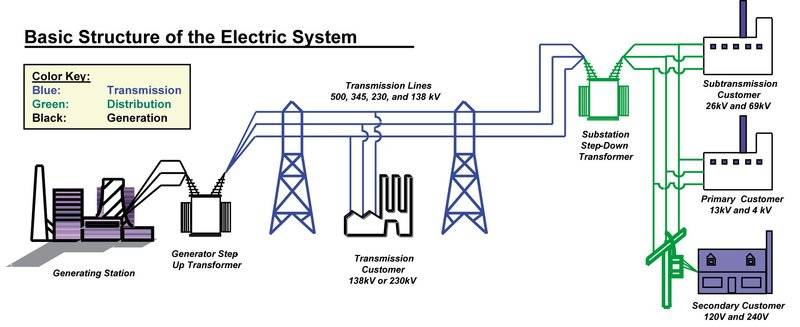
ElectricPowerSystem.jpg
 
Engineering news on Phys.org
KraakeCrest said:
I would assume that there is a star connection with neutral on the secondary side at the 120/240 voltage level to support single phase circuits etc.
KraakeCrest said:
And are the star "neutral point" always grounded or are there exceptions?
The Neutral is usually Earthed (in the UK) but that Earth isn't always made available to the house, in such cases a local Earth rod may have to be used. There are various earthing strategies used in the UK..

http://wiki.diyfaq.org.uk/index.php/Earthing_Types

Sorry no idea why the font size is off in this post.
 
  • Like
Likes   Reactions: KraakeCrest
KraakeCrest said:
Green substation step-down transformer:
Not sure, but I would assume a three conductor configuration to avoid the extra cost of a 4th wire on the primary side.

Be aware my experience is all In US

Here it's a four wire connection with neutral earthed so that a phase to ground fault will trip its feed.
Look at the poles in your neighborhood,
around here the neutral wire is the smaller one on shorter insulators usually installed lower than the phase conductors.
In high lightning areas it's often run on top to serve as a lightning rod,
in other areas it's run below the others so that should a phase wire fall it will likely hit the neutral and trip the feeder rather than falling across a roadway energized..
Also - should an overheight truck hit a wire you'd want it to be the neutral.

KraakeCrest said:
Generator step up transformer:
Same here, three conductor configuration on the secondary to avoid a 4th wire. Unsure about primary side.
Only configuration I've seen for power plants -

Stepup secondary is wye, grounded neutral for same reason as above.

On primary side the stepup transformer is delta connected and hardwired to generator by what @anorlunda referred to as "isophase" bus.
Generator is wye wound.
Generator's neutral is earthed through a huge high power resistor whose job it is to limit fault current to a value low enough it won't cause an electrical explosion inside the generator, twenty amps or less.. In my plant that resistor was the size of a pickup truck.

old jim
 
  • Like
Likes   Reactions: KraakeCrest and Asymptotic
jim hardy said:
In my plant that resistor was the size of a pickup truck.
Indeed. I just Googled for an image and found this one. (compliments of http://www.kiantajhiz.com/en/Products/211)

dimensions.jpg
 
  • Like
Likes   Reactions: KraakeCrest, Asymptotic and jim hardy
To further Jim's comment... many older systems were Delta secondary, this had been preferred for reliability, as a single ground fault would not cause an outage since it would actually take 2 ground faults, typically on different phases to get the system to trip - but this was very dangerous and unreliable. Then rudimentary Ground Fault detection schemes were set up - the 3 light bulbs... often not causing a trip, but an indicator that there was a fault relying on those inconstant humans to monitor and take action..

Today - the wye secondary, has both safety and filtering benefits. Using a resistor on the neutral-grounding point connection when there is no neutral load, provides a known ground reference to the whole system. Or a known state. It is relatively easy to detect an abnormal conditions now by monitoring the current flow through the resistor. This can trigger an investigation or a system trip, all depending on the application, safety aspects, and reliability requirements. For example feeding a neighborhood the emphasis is on safety, feeding the back-up cooling of a nuke... well reliability.

So - for safety - you may be just wanting to limit the fault current, and trip almost instantly, for reliability, the system can be configured to allow a full time, continuous ground fault, setting off alarms, but not tripping off the system. Also - the Ground Fault current can be traced, sometimes allowing the location of the fault to be identified, and isolated without tripping the entire system.

Basically - there is never a one ideal solution for every situation.
 

Similar threads

Replies
2
Views
1K
Replies
3
Views
2K
  • · Replies 8 ·
Replies
8
Views
3K
Replies
6
Views
4K
  • · Replies 6 ·
Replies
6
Views
13K
  • · Replies 9 ·
Replies
9
Views
3K
  • · Replies 13 ·
Replies
13
Views
4K
  • · Replies 3 ·
Replies
3
Views
2K
  • · Replies 18 ·
Replies
18
Views
5K
  • · Replies 14 ·
Replies
14
Views
3K