Discussion Overview
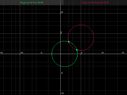
The discussion revolves around finding the coordinates of points that are equidistant from the points (1,0) and (5,4). The participants explore the mathematical formulation of the problem using equations of circles and engage in solving for the intersection points of these circles.
Discussion Character
- Mathematical reasoning, Technical explanation, Debate/contested
Main Points Raised
- One participant proposes using the general equation of a circle to represent the distances from the points (1,0) and (5,4) as $(x-1)^2+(y-0)^2=10$ and $(x-5)^2+(y-4)^2=10$.
- Another participant corrects the equation for the second circle, ensuring the coordinates are accurately represented as $(x-5)^2+(y-4)^2=10$.
- Further calculations lead to the equation $-2x + 1 = -10x - 8y + 41$, which simplifies to $y = -x + 5$.
- One participant suggests substituting $y = 5 - x$ into the circle equation to find the values of x and corresponding y values.
- Another participant performs the algebraic steps to arrive at the quadratic equation $x^2 - 6x + 8 = 0$, yielding solutions $x = 2$ and $x = 4$, with corresponding y values $y = 3$ and $y = 1$.
- There is a mention of a graphical representation using TikZ, with one participant noting that the radius should be $\sqrt{10}$ instead of 10.
Areas of Agreement / Disagreement
Participants generally agree on the method of using circle equations to find the points, but there are corrections and refinements made throughout the discussion, indicating some uncertainty in the initial setup and calculations.
Contextual Notes
There are unresolved aspects regarding the graphical representation and the initial assumptions about the radius of the circles, which may affect the interpretation of the results.
Who May Find This Useful
Readers interested in mathematical problem-solving, particularly in geometry and algebra, may find this discussion relevant.