What are the correct conditions for Simple Harmonic Motion?

  • Thread starter Thread starter Bolter
  • Start date Start date
  • Tags Tags
    Conditions Shm
Click For Summary
SUMMARY

The discussion centers on the conditions necessary for Simple Harmonic Motion (SHM). Participants agree that SHM is characterized by a restoring force proportional to displacement, with option C being the most accurate representation of this definition. The conversation also highlights the importance of distinguishing between mathematical definitions and physical concepts, particularly in questions regarding angular velocity and the period of SHM. Overall, clarity on the definitions and characteristics of SHM is emphasized as crucial for understanding the topic.

PREREQUISITES
  • Understanding of Simple Harmonic Motion (SHM)
  • Familiarity with Hooke's Law
  • Basic knowledge of periodic motion and oscillation
  • Concept of angular velocity in physics
NEXT STEPS
  • Research the mathematical formulation of Simple Harmonic Motion
  • Study the relationship between restoring force and displacement in SHM
  • Explore the definitions and implications of period in oscillatory motion
  • Learn about the differences between mathematical and physical interpretations of motion
USEFUL FOR

Students of physics, educators teaching mechanics, and anyone seeking to deepen their understanding of oscillatory motion and its mathematical foundations.

Bolter
Messages
262
Reaction score
31
Homework Statement
See below
Relevant Equations
None
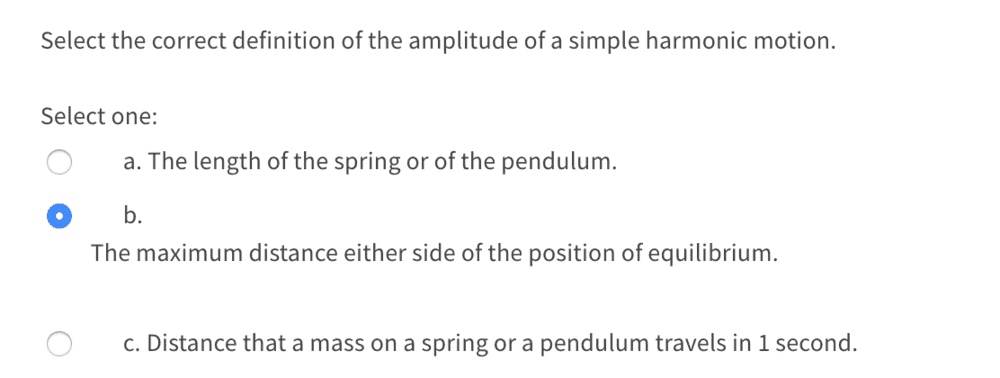
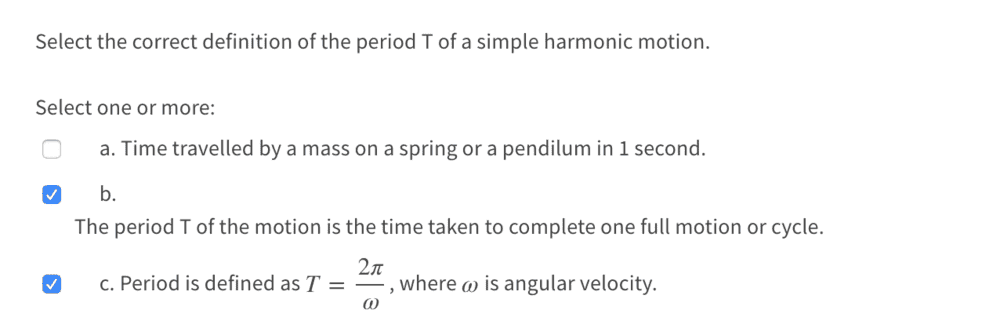
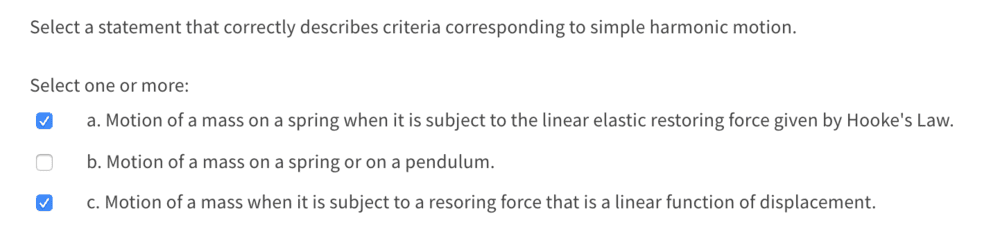
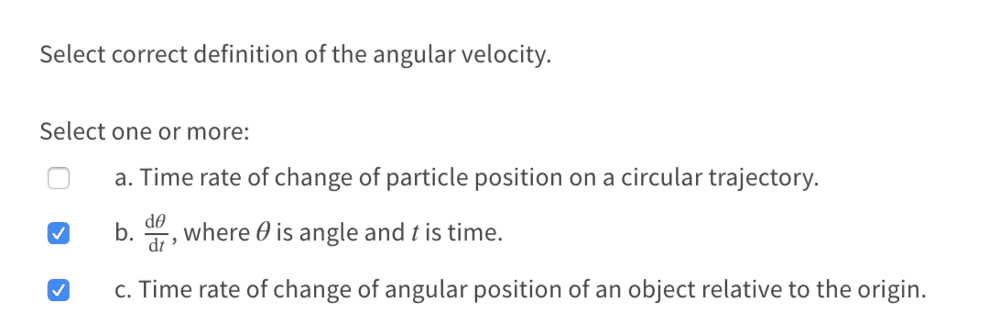
Ok so here are a few multiple choice questions that I have been given to me and these are what my selected options turned out to be
Screenshot 2020-02-28 at 09.25.31.png


Screenshot 2020-02-28 at 09.25.45.png


Screenshot 2020-02-28 at 09.25.53.png


Screenshot 2020-02-28 at 09.26.00.png


Do they seem right?

I am rather confused on the wording of the first question?

Is it asking to state the conditions of SHM for it be in SHM?
I know that from the definition in my head SHM is a type of periodic motion or oscillation motion where the restoring force is directly proportional to the displacement and acts in the direction opposite to that of displacement

I know it must be option C as that matches in with the above definition I had given. Cannot be option B as it simply just says motion on a pendulum or spring but does not describe any features of SHM. But option A is describing Hooke's law and says nothing about the displacement or how acceleration is directly proportional to its displacement from equilibrium position?

Any help would be appreciated! Thanks
 
Physics news on Phys.org
Q1. I'd agree with you that( a) is almost the same as (c), but (c) is a bit more general, so better.

Q2. Again, I'd vote (c) as best answer. I don't like (b) because Θ is undefined and I think angular velocity needs to be about some point/axis , but (b) might be liked by people here because it is mathematical rather than words. I'll wait to see what they come up with.

Q3. correct, (b).

Q4. This one I find most difficult. My first reaction was to prefer (b) as the general definition of period, rather than (c) which seems to me to be a mathematical consequence of the definition of SHM.
On further reflection (& re-reading the question) (c), being a consequence of SHM is actually an advantage, when the question asks for a definition specifically of period for SHM. So I'll go for (c) despite my loathing of math's taking ownership of physics!
 
  • Like
Likes   Reactions: Bolter
Merlin3189 said:
Q1. I'd agree with you that( a) is almost the same as (c), but (c) is a bit more general, so better.

Q2. Again, I'd vote (c) as best answer. I don't like (b) because Θ is undefined and I think angular velocity needs to be about some point/axis , but (b) might be liked by people here because it is mathematical rather than words. I'll wait to see what they come up with.

Q3. correct, (b).

Q4. This one I find most difficult. My first reaction was to prefer (b) as the general definition of period, rather than (c) which seems to me to be a mathematical consequence of the definition of SHM.
On further reflection (& re-reading the question) (c), being a consequence of SHM is actually an advantage, when the question asks for a definition specifically of period for SHM. So I'll go for (c) despite my loathing of math's taking ownership of physics!

Ok thanks this has definitely cleared up a bit of misunderstanding that I had :) This was helpful
 

Similar threads

  • · Replies 51 ·
2
Replies
51
Views
4K
  • · Replies 17 ·
Replies
17
Views
3K
  • · Replies 10 ·
Replies
10
Views
3K
  • · Replies 2 ·
Replies
2
Views
2K
  • · Replies 1 ·
Replies
1
Views
8K
  • · Replies 18 ·
Replies
18
Views
1K
Replies
11
Views
3K
  • · Replies 8 ·
Replies
8
Views
6K
  • · Replies 1 ·
Replies
1
Views
2K
  • · Replies 15 ·
Replies
15
Views
6K