dRic2
Gold Member
- 887
- 225
Hi, I've been reading out of curiosity about linear accelerators to get a general ideal of the principles behind them. My main concern is that, as far as I could tell, there are two different types (I'm sure there are more than two, but I want to keep things simple) of Linear Accelerators (Linac).
The first type, usually used for electrons, is simply a cylindrical waveguide where an EM wave is propagating (generally TM_010). Irises are added to "slow down" the phase velocity of the wave to match the velocity of the electrons (http://web.mit.edu/course/22/22.09/ClassHandouts/Charged Particle Accel/CHAP12.PDF pag 393):
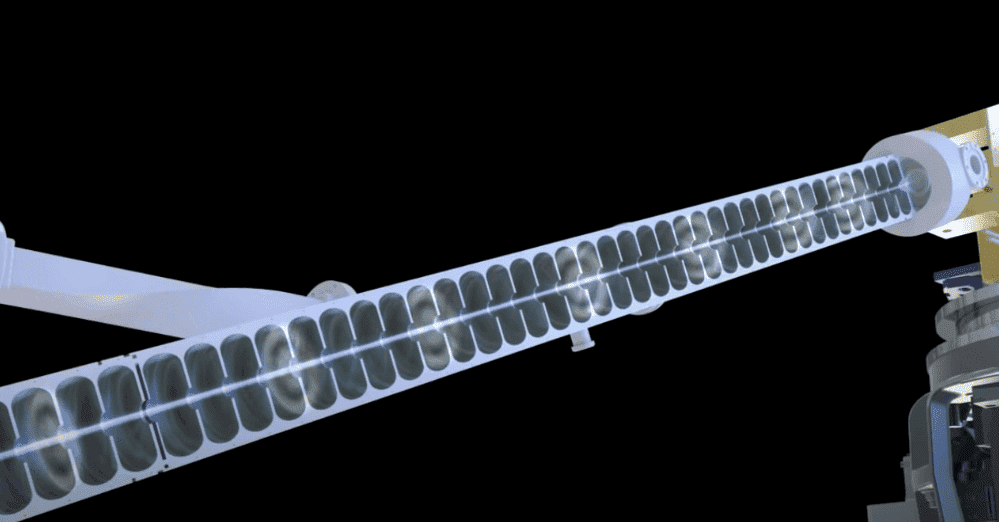 (taken from a YT video)
This type of Linac is used for electrons since they posses a very high velocity (due to their low mass) and relativistic speed are easely achieved.
The second type of Linac, used for ions, is the made by a lots of cavities connected to an alternating potential source as sketched below:
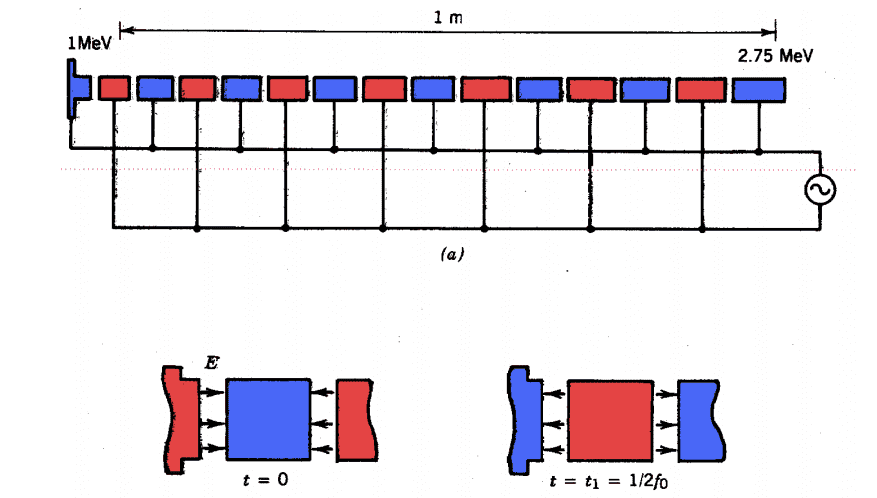
(http://web.mit.edu/course/22/22.09/ClassHandouts/Charged Particle Accel/CHAP14.PDF pag 453)
Here, each cavity is an equipotential surface so no E field is inside. The ion is accelerated only in gaps between cavities and the whole structure support a standing wave (not a propagating wave as in the first case). I see no waveguide here, but probably the whole structure could be enclosed in a cylindrical conductor (thus forming a waveguide)... I don't know.
Is what I said correct ? Because I am really confused. If I keep reading those document I run into Traveling wave Linac and Standing wave Linac, but I don't understand if they are referring to what I already said or if there are other types of Linac which I am neglecting... I am pretty confused right now.
The first type, usually used for electrons, is simply a cylindrical waveguide where an EM wave is propagating (generally TM_010). Irises are added to "slow down" the phase velocity of the wave to match the velocity of the electrons (http://web.mit.edu/course/22/22.09/ClassHandouts/Charged Particle Accel/CHAP12.PDF pag 393):
This type of Linac is used for electrons since they posses a very high velocity (due to their low mass) and relativistic speed are easely achieved.
The second type of Linac, used for ions, is the made by a lots of cavities connected to an alternating potential source as sketched below:
(http://web.mit.edu/course/22/22.09/ClassHandouts/Charged Particle Accel/CHAP14.PDF pag 453)
Here, each cavity is an equipotential surface so no E field is inside. The ion is accelerated only in gaps between cavities and the whole structure support a standing wave (not a propagating wave as in the first case). I see no waveguide here, but probably the whole structure could be enclosed in a cylindrical conductor (thus forming a waveguide)... I don't know.
Is what I said correct ? Because I am really confused. If I keep reading those document I run into Traveling wave Linac and Standing wave Linac, but I don't understand if they are referring to what I already said or if there are other types of Linac which I am neglecting... I am pretty confused right now.