What Are the Implications of Changing Component Values in a Tube Amp Circuit?

Click For Summary
Changing the output tube cathode capacitor from 50μF to 250μF is expected to enhance bass response while lowering the corner frequency from 160Hz to 53Hz, potentially affecting feedback in the cathode circuit. The transition from 500K to 1M pots is unlikely to produce noticeable differences in volume. Understanding the relationship between resistance, capacitance, and frequency response is crucial, with the time constant calculated as RC, where a larger capacitor value leads to a longer time constant. Current flow through the tube is influenced by various parameters, including the primary of the output transformer and the cathode resistor value. Continued exploration of these concepts will deepen comprehension of tube amp circuitry.
Planobilly
Messages
440
Reaction score
105
Hi Guys,

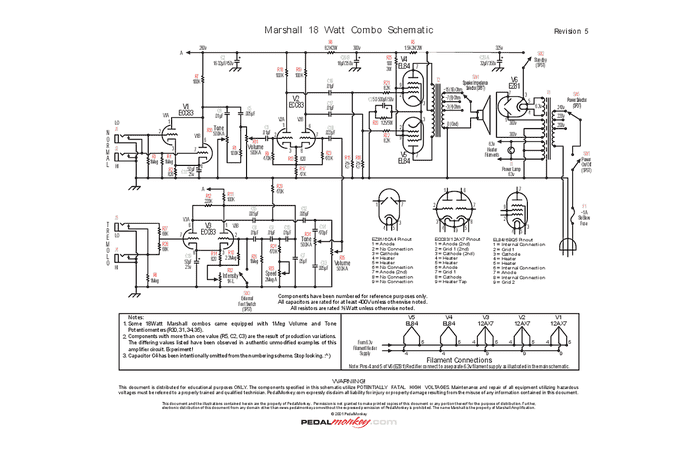
The schematic

WR8r9LT.png


What do you think the effect of changing the value of the output tube cathode capacitor from 50uf to 250uf would be?

Also the original schematic showed 500K pots and other newer schematics show 1M pots. What do you think the effect of that change would be?

Next, assuming a 330 VDC plate voltage and a 100 ohm cathode resistor can you show me the process to predict the likely current flow. What I don't clearly understand is all the parameters that would affect the amount of current that would flow through the tube. Obviously the current is affected by the primary of the output transformer. What tube parameters also have an effect on the current?

Thanks,

Billy
 
Last edited:
Engineering news on Phys.org
Planobilly said:
What do you think the effect of changing the value of the output tube cathode capacitor from 50uf to 250uf would be?
It looks like a bypass capacitor, so I'd expect to hear more bass in the output.

Planobilly said:
Also the original schematic showed 500K pots and other newer schematics show 1M pots. What do you think the effect of that change would be?
Not much. You probably wouldn't notice the difference.

See if you can find a set of graphs of the characteristics for this pentode.
 
Thanks for the feed back. I assumed the RC circuit would change the frequency response...so the larger the cap value the more the high frequencies are attenuated I assume.

I have to run out for a bit. I will post a data sheet for the EL84 tubes when I get back.

Thanks for the education!

Cheers,

Billy
 
Planobilly said:
Thanks for the feed back. I assumed the RC circuit would change the frequency response...so the larger the cap value the more the high frequencies are attenuated I assume.
Just the opposite...

The schematics are a bit hard to read, but it seems to me that the cathode resistor is 125Ω. 125Ω and 50μF makes for a time constant of 6.25ms.This corresponds to a corner frequency of 160Hz. This is where you start to get a slight negative feedback in the cathode circuit.

Going to 250μF, the time constant increases to 18.75ms, giving a corner frequency of 53Hz. Whether this has any effect is doubtful (now the frequency response of the output transformer starts to dominate).

In short - use a 250μF. I strongly doubt that it will have any effect on the amplifier.
Planobilly said:
Also the original schematic showed 500K pots and other newer schematics show 1M pots. What do you think the effect of that change would be?
If it is a volume pot, I doubt that it will have any effect.
 
Hi Svein,

Yes, I had that (freq change) reversed in my mind. The cathode on this schematic is 125 ohm. The original 1958 Marshall schematic had a 50uf cap and a100 ohm resistor. I repaired a 18 watt reissue Marshall the other day and had to increase the 100 ohm resistor value to get the bias under control. I have a 18 watt Marshall kit clone I am building ATM. I also have an order for two other new builds, both 18 watt Marshalls. I am not having many issues building new amps or repairing amps. I understand the "how to do it" part...I just am not to the point I understand the "why it works this way" part.

I basically understand everything you said, I just don't yet know how to do the math and certainly don't have an idea of how the time constant relates to the change in sound.
I have been relegated to changing out components to hear the difference. There is nothing wrong with that but I want to get a little smarter. Circuits like the above should be dead simple...well, more or less. I am to the point I want to understand things at a much deeper level.

Can you show me or point me to a link that will describe in detail, how based on 50uf an 125 ohms you arrive at 6.24ms and how to convert that to 160 Hz?

Here is a data sheet for the JJ EL84 tubes I use that NascentOxygen ask for. http://www.drtube.com/datasheets/el84-jj2003.pdf

Cheers,

Billy
 
nsaspook said:
The frequency is just 1/RC
don't forget the 2pi
 
  • Like
Likes nsaspook
Where does the 2pi come in? I thought the time constant was just as stated, 1/RC.
 
  • #10
Thanks for all the info guys. I have been really busy building new amps..three this week. Two 18 watt Marshalls and a Fender Bassman.

Not so much time to study but little by little I am getting there. So..thanks to everyone for all the kind help.

Cheers,

Billy
 

Similar threads

Replies
9
Views
7K
Replies
7
Views
2K
  • · Replies 3 ·
Replies
3
Views
2K
  • · Replies 19 ·
Replies
19
Views
2K
  • · Replies 23 ·
Replies
23
Views
3K
Replies
2
Views
3K
Replies
12
Views
3K
  • · Replies 11 ·
Replies
11
Views
2K
Replies
2
Views
4K
Replies
23
Views
6K