What Are the Odd Relationships Between Integers and Their Representations?

  • Context: Graduate 
  • Thread starter Thread starter Simon Bridge
  • Start date Start date
  • Tags Tags
    Integer Relationships
Click For Summary
SUMMARY

This discussion explores the relationships between integers and their mathematical representations, particularly focusing on how integers can be expressed using other integers. The conversation highlights specific examples, such as the integer 12, which has many divisors, and the use of operations like square roots and division to derive representations. The participants suggest that with sufficient mathematical creativity, it is feasible to find integers z less than Z that can represent all integers less than or equal to Z using a consistent number of instances of z.

PREREQUISITES
  • Understanding of integer properties and divisors
  • Familiarity with basic mathematical operations (addition, division, square roots)
  • Knowledge of mathematical notation and expressions
  • Concept of mathematical creativity in problem-solving
NEXT STEPS
  • Research integer factorization and its applications in representation
  • Explore advanced mathematical operations and their properties
  • Study the concept of mathematical creativity and problem-solving techniques
  • Investigate the relationships between numbers and their representations in number theory
USEFUL FOR

Mathematicians, educators, students, and anyone interested in the creative aspects of number theory and integer representations.

Simon Bridge
Science Advisor
Homework Helper
Messages
17,871
Reaction score
1,653
I come across some odd stuff online...
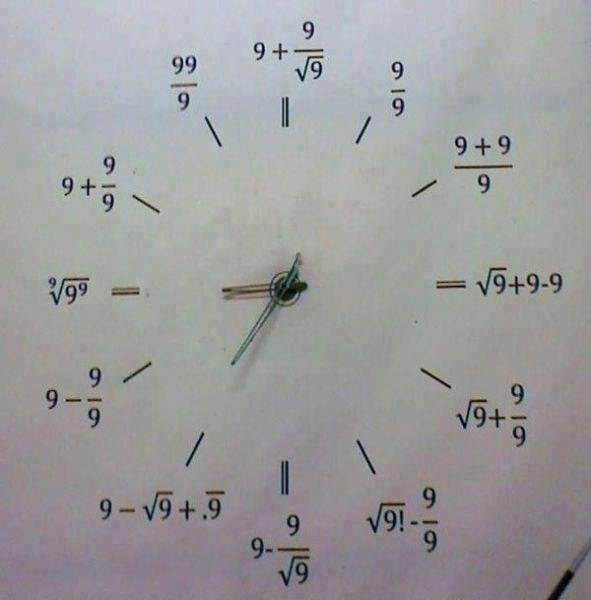
528836_325385777573552_804137390_n.jpg


... OK there's a typo for the 5 ... should be ##\small [\sqrt{9}]!-(9/9)## and the one for 7 looks a bit forced...
What I'm wondering is if there are other sets that do something like this ... i.e. so for a given integer Z, we can find another integer z<Z so that the integers ≤Z can be represented using the same n (integer) instances of z in each case.

It'll probably help of Z is something with lots of divisors ... i.e. Z= oh I dunno... 12.
Or is it just a case of "given sufficient cleverness" - which is to say that there are so many legitimate mathematical operations that it is always possible to create this effect?

Aside:
Millenialists take note: hold the clock upside down and all the numbers are made out of three 6's.
 
Mathematics news on Phys.org
I'm sure there are lists of that somewhere.

1=(X/X)^X
2=(X+X)/X
Those two are always possible.
9 is nice, as you can choose between 9 and 3 via the square root.
With small even numbers, it is tricky to get large odd numbers.
 

Similar threads

  • · Replies 4 ·
Replies
4
Views
3K
  • · Replies 2 ·
Replies
2
Views
2K
  • · Replies 2 ·
Replies
2
Views
2K
  • · Replies 3 ·
Replies
3
Views
3K
  • · Replies 1 ·
Replies
1
Views
3K
  • · Replies 17 ·
Replies
17
Views
3K
  • · Replies 1 ·
Replies
1
Views
3K
  • · Replies 27 ·
Replies
27
Views
4K
  • · Replies 137 ·
5
Replies
137
Views
20K
  • · Replies 66 ·
3
Replies
66
Views
8K