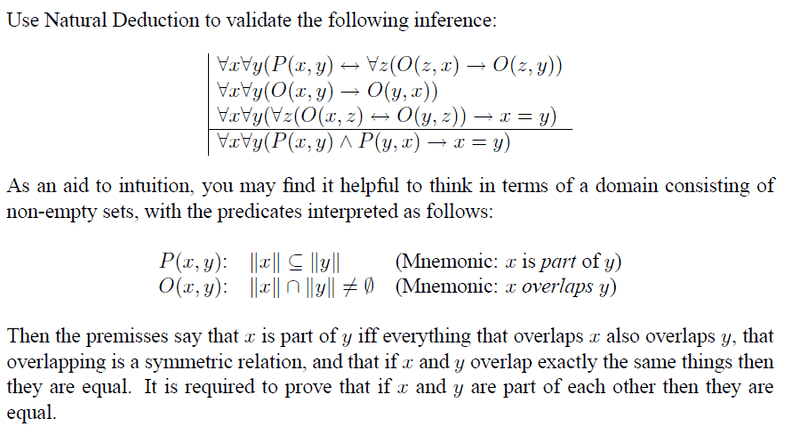
What are the steps for using natural deduction in logic?

  • Thread starter Thread starter Firepanda
  • Start date Start date
  • Tags Tags
    Logic Natural
Click For Summary
The discussion focuses on the challenges of using natural deduction in logic, specifically in starting a subderivation with an appropriate assumption after breaking down premises using 'for all' elimination. The user expresses uncertainty about the strategy needed to reach the conclusion and what to manipulate to achieve it. They mention having learned several inference rules but find their current approach invalid, leading to confusion. The initial assumption considered is P(a,b) & P(b,a), indicating a struggle to progress in the proof. Assistance is sought to clarify the next steps in the natural deduction process.
Firepanda
Messages
425
Reaction score
0
Logic: Natural Deduction

8wzi2p.png


Can anyone lead me off here? I've broken down the three premises using 'for all' elimination, now I need to start a subderivation with an assumption, but I'm not sure what!

Right now I'm unsure of the strategy I need to use to get to the conclusion, what do I want to be left with to manipulate into the conclusion?

Would be grateful for any help!

A list of the inference rules I have learned so far for Natural deduction can be found HERE
 
Last edited:
Physics news on Phys.org
2ngtzpx.png


I've reduced the problem to the above, if I can prove the above then I can prove the whole thing! (I think..!)

Any help on this one? Thanks :)
 
Last edited:
Apparantly my above inference isn't valid so I cannot proceed with this method

My initial assumption is assuming P(a,b) & P(b,a)

Really stuck, would appreciate help!

Thanks
 
Question: A clock's minute hand has length 4 and its hour hand has length 3. What is the distance between the tips at the moment when it is increasing most rapidly?(Putnam Exam Question) Answer: Making assumption that both the hands moves at constant angular velocities, the answer is ## \sqrt{7} .## But don't you think this assumption is somewhat doubtful and wrong?

Similar threads

  • · Replies 12 ·
Replies
12
Views
2K
  • · Replies 4 ·
Replies
4
Views
728
  • · Replies 3 ·
Replies
3
Views
2K
Replies
3
Views
1K
  • · Replies 5 ·
Replies
5
Views
2K
  • · Replies 3 ·
Replies
3
Views
1K
  • · Replies 34 ·
2
Replies
34
Views
3K
  • · Replies 2 ·
Replies
2
Views
2K
  • · Replies 2 ·
Replies
2
Views
2K
  • · Replies 8 ·
Replies
8
Views
2K