What Are the Velocity and Acceleration of a Particle at t = 5.0 s?

Click For Summary
SUMMARY

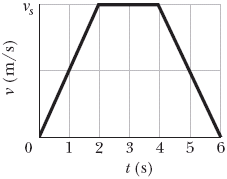
The discussion focuses on calculating the velocity and acceleration of a particle at t = 5.0 s, based on a provided velocity-time graph. The particle starts from the origin and moves along the positive x-axis. Key calculations include the particle's coordinate at t = 5.0 s, which is derived from the graph, yielding a velocity of 2 m/s and an acceleration of 2 m/s². Average velocity and acceleration between t = 1.0 s and t = 5.0 s are also computed, confirming that the average acceleration is 0 m/s².

PREREQUISITES
  • Understanding of kinematic equations, specifically Vf = Vi + at
  • Familiarity with average velocity calculations, Vavg = (Vf + Vi) / 2
  • Knowledge of average acceleration concepts, a_avg = change in v / change in time
  • Ability to interpret velocity-time graphs
NEXT STEPS
  • Study the derivation and application of kinematic equations in one-dimensional motion
  • Learn how to analyze velocity-time graphs for various motion scenarios
  • Explore the relationship between displacement, velocity, and acceleration in physics
  • Investigate the implications of constant versus variable acceleration on particle motion
USEFUL FOR

Students studying physics, particularly those focusing on kinematics, as well as educators seeking to clarify concepts related to motion and graph interpretation.

P-Illiterate
Messages
28
Reaction score
0
A particle starts from the origin at t = 0 and moves along the positive x axis. A graph of the velocity of the particle as a function of the time is shown in Fig. 2-43;
144302b2-a5d9-4a80-a60b-3143ed308917.png


the v-axis scale is set by vs = 7.00 m/s. (a) What is the coordinate of the particle at t = 5.0 s? (b) What is the velocity of the particle at t = 5.0 s? (c) What is the acceleration of the particle at t = 5.0 s? (d) What is the average velocity of the particle between t = 1.0 s and t = 5.0 s? (e) What is the average acceleration of the particle between t = 1.0 s and t = 5.0 s?

Homework Equations


Vf= Vi+at
Vavg = (Vf+Vi)/2
a avg= change in v/change in time


The Attempt at a Solution


I think all my answers are wrong!
a) (2,5) --> Looking at the graph

b) t =5s, v=2 m/s

c) Vf= Vi+at
(4-2)/1 = a
a = 2 m/s

d) Vavg = (Vf+Vi)/2
(2=2)/2
= 2 m/s

e) a avg= change in v/change in time
=0 m/s
 
Physics news on Phys.org
you cannot calculate the coordinate by just looking at the graph. You have to use x=at^2/2
for b.) its just v_s/2 from the graph

c, how much the velocity decrease from t=4 to t=5? i.e. in one second?

d.) the formula is right but u read it wrong from the graph.

e,) correct.
 
for A, x=at^2/2
how do I find a??

Thanks though :D
 

Similar threads

  • · Replies 7 ·
Replies
7
Views
1K
  • · Replies 5 ·
Replies
5
Views
3K
  • · Replies 17 ·
Replies
17
Views
3K
  • · Replies 14 ·
Replies
14
Views
2K
  • · Replies 4 ·
Replies
4
Views
1K
  • · Replies 2 ·
Replies
2
Views
779
  • · Replies 1 ·
Replies
1
Views
2K
  • · Replies 14 ·
Replies
14
Views
6K
  • · Replies 8 ·
Replies
8
Views
2K
  • · Replies 4 ·
Replies
4
Views
2K