What causes Bragg planes in materials?

Click For Summary
SUMMARY

Bragg planes are defined as planes within a crystal that contain a significant fraction of the crystal's atoms, facilitating the reflection of matter waves. The reflection occurs due to the interaction of incident electromagnetic (EM) radiation with groups of atoms, rather than a single atom. Bragg reflection is contingent upon the wavelength of the incident light being much larger than the atomic scale, allowing for constructive interference of reradiated wavelets from polarized atoms along the Bragg plane.

PREREQUISITES
  • Understanding of crystal structures and atomic arrangements
  • Familiarity with electromagnetic radiation and its interaction with matter
  • Knowledge of wave-particle duality and polarization of atoms
  • Basic principles of constructive interference in wave physics
NEXT STEPS
  • Study the principles of Bragg's Law in X-ray diffraction
  • Explore the concept of constructive interference in wave mechanics
  • Learn about the polarization of atoms in electromagnetic fields
  • Investigate the relationship between wavelength and atomic dimensions in materials science
USEFUL FOR

Physicists, materials scientists, and students studying crystallography or wave physics will benefit from this discussion on Bragg planes and their role in the reflection of matter waves.

ninevolt
Messages
21
Reaction score
0
I am having trouble understanding what exactly Bragg planes are physically.
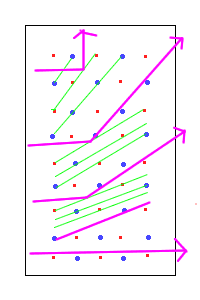
I understand how they behave, in that they act like mirrors and reflect matter waves, but what exactly is the wave bouncing off of?

for instance
jen%201.png


I can guarantee any physics textbook always has a picture like this, with the light bouncing off of what it seems to be nothing physical, not an atom, just the Bragg plane. I am really having trouble swallowing what exactly causes the Bragg plane. Or is it something that we just accept like electrons not emitting radiation in atoms even though they seem to be accelerating?
 
Physics news on Phys.org
ninevolt said:
I am having trouble understanding what exactly Bragg planes are physically.
I understand how they behave, in that they act like mirrors and reflect matter waves, but what exactly is the wave bouncing off of?

for instance
jen%201.png


I can guarantee any physics textbook always has a picture like this, with the light bouncing off of what it seems to be nothing physical, not an atom, just the Bragg plane. I am really having trouble swallowing what exactly causes the Bragg plane. Or is it something that we just accept like electrons not emitting radiation in atoms even though they seem to be accelerating?

Well, what do you think the little spots in the diagram are? Reflection, even normal reflection off a mirror, is a scattering problem arising from groups of atoms responding to incident EM radiation - so the "bouncing off" analogy is flawed. A Bragg reflection plane is a plane in a crystal containing some significant fraction of the atoms that make up the crystal, and generally there are many such planes in a crystal depending on the symmetry of the atoms - the diagram you posted shows several, there are many more including many that are tilted into and out of the plane of the diagram. There's nothing unphysical or imaginary about them.
 
So are you saying that in real life the wave will reflect off of the atoms in the plane? And that macroscopically the atoms are close enough together to constitute the Bragg plane?

If this is the case, I still do not understand why the waves bounce off of the atoms as if they are in a plane. Atoms are round, and to my knowledge we would get a different reflection pattern that that of a simple plane.
 
Bragg reflection happens when the wavelength of the incident light is much larger than an atom. For high frequencies the light will impact a single atom, but for lower frequencies it affects many neighboring atoms. What does an individual atom see? It sees a uniform, slowly varying E field. When exposed to a uniform E field, an atom will become polarized, i.e. acquire an electric dipole moment. As the E field slowly varies, the dipole moment slowly varies, reradiating the light in all directions. Along the direction of a Bragg plane, the reradiated wavelets are in sync with each other and add constructively.
 

Similar threads

Replies
6
Views
2K
  • · Replies 7 ·
Replies
7
Views
3K
  • · Replies 4 ·
Replies
4
Views
6K
  • · Replies 4 ·
Replies
4
Views
5K
  • · Replies 1 ·
Replies
1
Views
2K
Replies
1
Views
2K
  • · Replies 1 ·
Replies
1
Views
3K
  • · Replies 10 ·
Replies
10
Views
8K
  • · Replies 3 ·
Replies
3
Views
6K
  • · Replies 4 ·
Replies
4
Views
4K