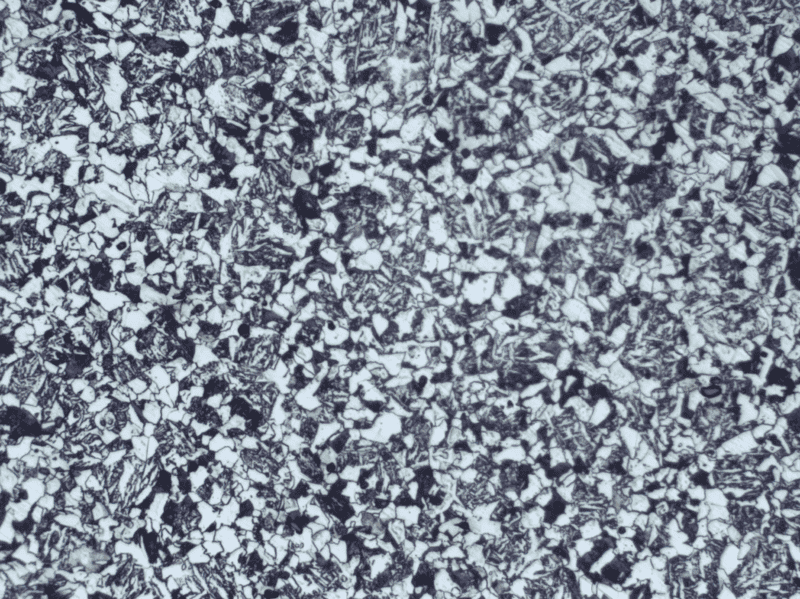
What could be causing this microstructural difference?

  • Thread starter Thread starter Quentin_alex
  • Start date Start date
  • Tags Tags
    Difference
Click For Summary

Discussion Overview

The discussion revolves around the observed differences in pearlite size between two rebar samples with nearly identical chemical compositions and similar rolling mill parameters. Participants explore potential causes for these microstructural variations, focusing on factors such as cooling rates, carbon content, bar dimensions, and processing conditions.

Discussion Character

  • Exploratory
  • Technical explanation
  • Debate/contested

Main Points Raised

  • Some participants suggest that cooling rate could be a factor, with faster cooling leading to smaller crystal sizes.
  • Variation in carbon content is proposed as another possible explanation for the differences in pearlite size.
  • One participant notes that the micrographs show larger pearlite colonies in one sample, indicating potential differences in cooling rate and carbon composition.
  • Another participant raises the question of whether different bar dimensions could influence the microstructure, particularly since the bars are of different diameters (19 mm and 13 mm).
  • It is mentioned that the smaller bar may have a finer structure due to longer working time, allowing more development of pearlite before the microstructure reactions were frozen.
  • Concerns are expressed regarding the significant increase in pearlite in the larger bar, prompting speculation about other influencing factors.
  • Grain alignment due to stretching is also discussed as a potential factor affecting the observed microstructure.

Areas of Agreement / Disagreement

Participants do not reach a consensus on the primary cause of the differences in pearlite size, with multiple competing views and hypotheses remaining in the discussion.

Contextual Notes

Participants acknowledge that the micrographs were taken from the core of the bars, and the absence of a quenching process is noted. The discussion highlights the complexity of microstructural development influenced by various processing parameters.

Quentin_alex
Messages
11
Reaction score
0
Hello,

I have two rebar samples of virtually identical chemical composition of 0.27 wt%C, 1.2 wt%Mn and 0.033 wt%V that are A706 grade. The rolling mill parameters are essentially the same yet I am seeing differences in pearlite size upon microscopy. The billets used to make the bars are reheated in a furnace before they hit the mill. What are some possible explanations of why this is occurring?

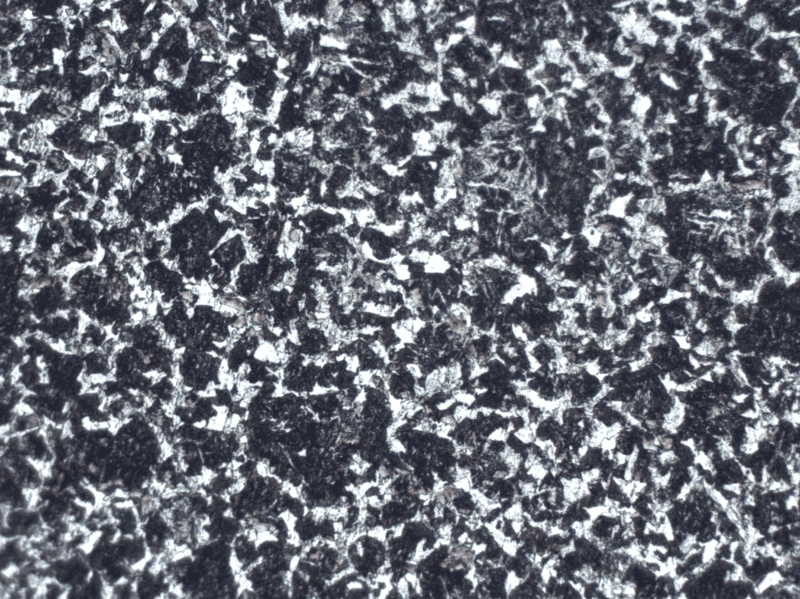
Attached are the two micrographs taken at the same magnification.
5318 A core 20x.png
4534 core 20x.png
 

Attachments

  • 5318 A core 20x.png
    5318 A core 20x.png
    256.5 KB · Views: 791
  • 4534 core 20x.png
    4534 core 20x.png
    223.9 KB · Views: 851
Engineering news on Phys.org
That was my first thought. The images show that the pearlite colonies are significantly larger in the first image, so I am lead to believe there is a difference in both cooling rate and carbon composition. Also, I must add that the micrographs were taken at the core of the bar.
 
Quentin_alex said:
the micrographs were taken at the core of the bar.
Different bar dimensions?
 
The first and second image are of 19 and 13 mm bars, respectively. The bars were not subject to a quenching process, but rather mostly air cooled. Taking the dimensions of the bar into account we might see a slightly finer structure in the center of the 13 mm bar. I think based on the images this is something we can suggest. However, my concern is the dramatic increase in pearlite of the 19 mm bar. I wonder if something else could be causing this.
 
Quentin_alex said:
The first and second image are of 19 and 13 mm bars, respectively.
Pearlite forms as the billet is worked and as the bar cools. The smaller bar needs to be worked for longer, so it has more deformation and time to develop pearlite before the microstructure reactions were frozen.

It is also possible that grain alignment due to stretching is affecting the view. It looks like both sections were cut from the same section orientation across the core of the bar. The section of each grain will be reduced as the crystals are stretched more to make the smaller bar.
 
  • Like
Likes   Reactions: Tom.G