What do the tick marks on closed contours indicate?

  • Thread starter Thread starter DaveC426913
  • Start date Start date
  • Tags Tags
    Map
Join the discussion
Registration is free. Ask a follow-up in this thread, or start your own.
13 replies · 4K views
DaveC426913
Gold Member
2025 Award
Messages
24,614
Reaction score
8,951
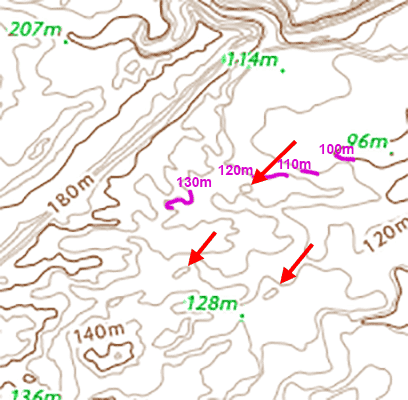
I'm trying to make a physical 3D map of this landscape.

These isolated curves (red) have no altitude on them, so it's up to me to interpret.

How do I know if these are hills or dips?

Can I gather from the rising landscape (marked in magenta) that these are probably hills?
Can I be sure?
test.png
 
Earth sciences news on Phys.org
Huh. I don't see how you COULD know. It certainly seems likely that they are above the surrounding territory, but that's not a given. It would be perfectly correct to draw the landscape that way if they were dips.
 
phinds said:
Interesting. What kind of tick marks? Can you show an example?
It's at the bottom of the page on his link.
 
But I don't think depth charts use the tick marks for bottom contours. It would probably make them too "busy" but I don't know that they differentiate them. They are color coded for shallows so its usually easy to tell.
Anybody know?
 
hutchphd said:
According to this source
http://geokov.com/Education/mountain-pass-cliff.aspxIf it is a depression it should have tick marks on the low side. I do remember seeing these on charts. The mountains have no tick marks.
Those cartographers are careful folks.
Thank the heck out of you! Of course!

(Alas, these are digital maps from Toporama. I'm not sure if they're actually showing that symbol. And it's very difficult to verify.)Now that I think about it, depressions are a comparatively rare artifact - especially if not water-filled or at least marshy. 99.9% of small, closed-contour land features are going to be bumps.
 
Last edited:
In the top left is a gully, cut into a scarp. It feeds an alluvial fan at the foot of the scarp, that fan has a gentle slope and covers the local bedrock. In the lower right, the distinctive lack of chevron patterns made by streams in valleys, makes it look like a karst landscape. I would expect sinkholes with such a geology, but those isolated and closed contours appear to be on steadily sloping ground, which suggests they are more likely to be raised limestone spires = hills.
I wonder, what is the local rainfall?
 
From this map, it appears to be treated the same way.
hutchphd said:
But I don't think depth charts use the tick marks for bottom contours. It would probably make them too "busy" but I don't know that they differentiate them. They are color coded for shallows so its usually easy to tell.
Anybody know?
I checked a chart online and it appears that depressions in the local topography are treated the same underwater. It's been a while since I did any cartography but think about it this way. If there was no water, where would you start creating tick marks? Certainly not at the 'shoreline' that doesn't exist.

https://www.mindat.org/glossary/depression_contour
A closed contour, inside of which the ground or geologic structure is at a lower elevation than that outside, and distinguished on a map from other contour lines by hachures marked on the downslope or downdip side.
 
A bit of clarifying colour banding helps clear it up.

test2.png


I'm glad I took the time to colour the whole thing. I would have been hopelessly lost pretty quickly if I hadn't.
 

Attachments

  • test3.png
    test3.png
    74.3 KB · Views: 576
  • Like
Likes   Reactions: hutchphd
Closed contours that represent depressions have tick marks on the downhill side. This is only true of closed contours. You can see such features on karst features such as sinkholes. Being a caver, I often peruse topo maps online for such features to find caves. You can find many such features on topo maps of N. Florida just south of Tallahassee where there are many sinks.
 
  • Skeptical
Likes   Reactions: davenn
DBO said:
Closed contours that represent depressions have tick marks on the downhill side. This is only true of closed contours.
Under what conditions are contours not closed? 😕
 
  • Like
Likes   Reactions: davenn, Bystander and phinds