- 8,943
- 2,955
If [itex]f(x)[/itex] is a square-integrable real-valued function on the reals, then we can define an auto-correlation function [itex]C(\theta)[/itex] via:
[itex]C(\theta) = \int dx f(x) f(x+\theta)[/itex]
I'm trying to get some insight on what
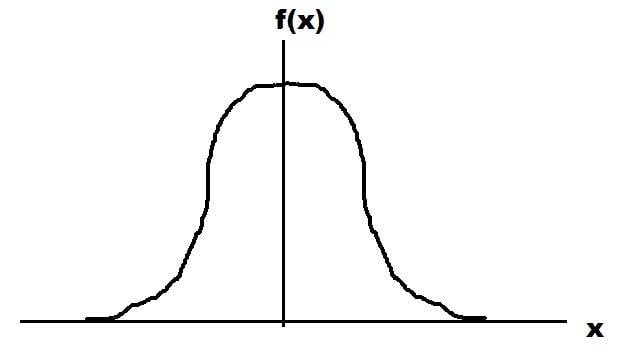
[itex]C(\theta)[/itex] is like, for small values of [itex]\theta[/itex] in the case in which [itex]f(x)[/itex] is highly peaked at [itex]x=0[/itex]; that is, [itex]f(x)[/itex] has a graph that looks roughly like this:
I don't actually have an analytic form for [itex]f(x)[/itex], so I can't explicitly do the integral, but I'm trying to get a qualitative feel for what the correlation function is like for such a function. I'm assuming that [itex]C(\theta)[/itex] can be approximated by a power series:
[itex]C(\theta) = A_0 + A_1 \theta + A_2 \theta^2 + \ldots[/itex]
The question is: is [itex]A_1[/itex] nonzero (and if so, what is its sign?)
I have two different approaches to get a qualitative answer that both seem reasonable, but they give different answers, and I'm wondering why.
First approach: Assume that you can take the derivative through the integral:
[itex]A_1 = \frac{d}{d \theta} C(\theta) |_{\theta = 0}<br /> = \int dx f(x) f'(x)[/itex]
where [itex]f'(x) = \frac{d}{d \theta} f(x+\theta) |_{\theta = 0}[/itex]
It's immediately obvious that [itex]A_1 = 0[/itex], because [itex]f(x)[/itex] is an even function (let's assume that it is, anyway), so [itex]f'(x)[/itex] is an odd function, so the product is an odd function, and the integral of an odd function gives 0. So the conclusion is that [itex]C(\theta)[/itex] has no linear term near [itex]\theta = 0[/itex]
Second approach: Approximate [itex]f(x)[/itex] by a step-function. That is, we approximate [itex]f(x)[/itex] by the function [itex]\tilde{f}(x)[/itex] defined by:
[itex]\tilde{f}(x) = 0[/itex] if [itex]|x| > \epsilon[/itex]
[itex]\tilde{f}(x) = K[/itex] if [itex]|x| < \epsilon[/itex]
The use of this function gives the following auto-correlation:
[itex]\int dx \tilde{f}(x) \tilde{f}(x+\theta) = K^2 (2 \epsilon - \theta)[/itex]
With this approximation for [itex]f(x)[/itex], we get [itex]A_1 = -K^2[/itex], which is nonzero.
So if I assume that [itex]f(x)[/itex] is analytic, I get [itex]A_1 = 0[/itex], and if I assume that [itex]f(x)[/itex] is a step-function, I get [itex]A_1[/itex] is negative. Those two statements are not really contradictions, because a step function is not analytic. However, it seems to me that you can approximate a step function by an analytic function arbitrarily closely, so it seems that using such an approximation, I should get an approximation for [itex]C(\theta)[/itex] that is similar to the exact result for a step function.
So which argument is correct?
[itex]C(\theta) = \int dx f(x) f(x+\theta)[/itex]
I'm trying to get some insight on what
[itex]C(\theta)[/itex] is like, for small values of [itex]\theta[/itex] in the case in which [itex]f(x)[/itex] is highly peaked at [itex]x=0[/itex]; that is, [itex]f(x)[/itex] has a graph that looks roughly like this:
I don't actually have an analytic form for [itex]f(x)[/itex], so I can't explicitly do the integral, but I'm trying to get a qualitative feel for what the correlation function is like for such a function. I'm assuming that [itex]C(\theta)[/itex] can be approximated by a power series:
[itex]C(\theta) = A_0 + A_1 \theta + A_2 \theta^2 + \ldots[/itex]
The question is: is [itex]A_1[/itex] nonzero (and if so, what is its sign?)
I have two different approaches to get a qualitative answer that both seem reasonable, but they give different answers, and I'm wondering why.
First approach: Assume that you can take the derivative through the integral:
[itex]A_1 = \frac{d}{d \theta} C(\theta) |_{\theta = 0}<br /> = \int dx f(x) f'(x)[/itex]
where [itex]f'(x) = \frac{d}{d \theta} f(x+\theta) |_{\theta = 0}[/itex]
It's immediately obvious that [itex]A_1 = 0[/itex], because [itex]f(x)[/itex] is an even function (let's assume that it is, anyway), so [itex]f'(x)[/itex] is an odd function, so the product is an odd function, and the integral of an odd function gives 0. So the conclusion is that [itex]C(\theta)[/itex] has no linear term near [itex]\theta = 0[/itex]
Second approach: Approximate [itex]f(x)[/itex] by a step-function. That is, we approximate [itex]f(x)[/itex] by the function [itex]\tilde{f}(x)[/itex] defined by:
[itex]\tilde{f}(x) = 0[/itex] if [itex]|x| > \epsilon[/itex]
[itex]\tilde{f}(x) = K[/itex] if [itex]|x| < \epsilon[/itex]
The use of this function gives the following auto-correlation:
[itex]\int dx \tilde{f}(x) \tilde{f}(x+\theta) = K^2 (2 \epsilon - \theta)[/itex]
With this approximation for [itex]f(x)[/itex], we get [itex]A_1 = -K^2[/itex], which is nonzero.
So if I assume that [itex]f(x)[/itex] is analytic, I get [itex]A_1 = 0[/itex], and if I assume that [itex]f(x)[/itex] is a step-function, I get [itex]A_1[/itex] is negative. Those two statements are not really contradictions, because a step function is not analytic. However, it seems to me that you can approximate a step function by an analytic function arbitrarily closely, so it seems that using such an approximation, I should get an approximation for [itex]C(\theta)[/itex] that is similar to the exact result for a step function.
So which argument is correct?