What Does Equation 5.7 in Introducing Einstein's Relativity Really Mean?

  • Context: Graduate 
  • Thread starter Thread starter Corbeau
  • Start date Start date
  • Tags Tags
    Push Stuck Tensors
Click For Summary

Discussion Overview

The discussion revolves around understanding Equation 5.7 from Ray D'Inverno's "Introducing Einstein's Relativity," specifically its implications in tensor transformation and the nature of the matrices involved. Participants explore the mathematical context, including Jacobians and coordinate transformations, while addressing difficulties in grasping the equation's meaning and application.

Discussion Character

  • Exploratory
  • Technical explanation
  • Conceptual clarification
  • Debate/contested
  • Mathematical reasoning

Main Points Raised

  • One participant expresses confusion about the meaning and derivation of Equation 5.7, noting the apparent discrepancy between the dimensions of the matrices involved.
  • Another participant clarifies that the notation is not lazy but indicates that the indices run over a range, suggesting both sides are indeed nxn matrices.
  • A different participant introduces the concept of the Jacobian matrix, relating it to the transformation of variables and suggesting working through specific examples, such as Cartesian to polar coordinates.
  • One participant emphasizes that the discussion is about transforming tensor components between coordinate systems, using vectors as an example.
  • Another participant shares a resource recommendation for learning linear algebra and tensors, highlighting the availability of free educational materials.

Areas of Agreement / Disagreement

Participants do not reach a consensus on the interpretation of Equation 5.7, as confusion and differing perspectives on the notation and application persist. Multiple viewpoints on the nature of the equation and its context are presented.

Contextual Notes

Some participants mention the need for foundational knowledge in multivariable calculus and linear algebra to fully understand the concepts discussed, indicating potential gaps in assumptions about participants' backgrounds.

Who May Find This Useful

This discussion may be useful for students and learners of relativity, linear algebra, and tensor calculus, particularly those encountering difficulties with tensor transformations and related mathematical concepts.

Corbeau
Messages
4
Reaction score
0
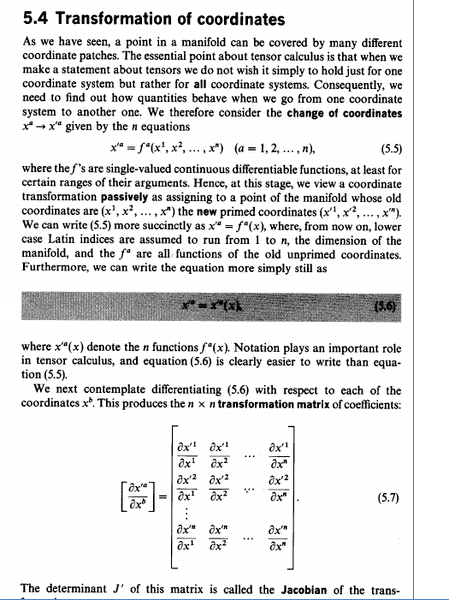
Hello. I'm going through Ray D'Inverno's "Introducing Einstein's Relativity" and I'm stuck at a certain point and can't move forward. It deals with tensors, I'm stuck at the transformation matrix and the problem is, I can't figure out what the key equation (5.7) actually means. There is a screenshot of the part of the page below, and I have no idea even how to start understanding it. What is it? What was it derived from? How do you actually use it? The left-hand side looks like a 1x1 matrix and the right-hand side looks like a n x n matrix and, of course, that wouldn't make any sense. If someone could write a few helpful sentences or point me in the direction of an Idiot's Guide to Tensor Differentiation, I would be most grateful. Thank you.

Screenshot:
tensors.png
 
Physics news on Phys.org
It's just some lazy notation. Note that the top x has an "a" superscript, and the bottom x has a "b". So they run over 1 to n. So it's just saying that the a index runs "down" in the matrix on the right side. And the b index runs "right."
 
Corbeau said:
I can't figure out what the key equation (5.7) actually means. There is a screenshot of the part of the page below, and I have no idea even how to start understanding it. What is it? What was it derived from? How do you actually use it? The left-hand side looks like a 1x1 matrix and the right-hand side looks like a n x n matrix and, of course, that wouldn't make any sense.

The left side is also nxn, as both indices a and b range independently from 1 to n.

Have you studied multivariable calculus? If so, wasn't the Jacobian covered?
 
Express one variable as a function of the other, i.e.,## f^:=(g_1(x_1,..,x_n), g_2(x_1,..,x_n),...,g_n(x_1,x_2,..,x_n))## then the matrix representing the Jacobian, i.e., the matrix M where ## (m_{ij}):= \frac {\partial g_i}{\partial x_j} ## is the matrix in 5.7. You may want to work out a specific example like , e.g., changing from Cartesians to Polars ( of course, this can only be done locally) and backwards.
 
WWGD said:
You may want to work out a specific example like , e.g., changing from Cartesians to Polars ( of course, this can only be done locally) and backwards.

Exercise 5.2 in the book from which Corbeau is studying asks for the Jacobian for Cartesian to spherical.
 
Wow, George, you seem to own a lot of books. Or, by George, you seem to own a lot of books.
 
This is not a tensor differentiation. This describes how you transform the components of a tensor from one coordinate system to another coordinate system.

A vector is a first order tensor. Suppose you know the components of the vector in Cartesian coordinates, and you want to find the components of the same vector is cylindrical coordinates. In other words, the original components are expressed with respect to the x, y, and z unit vectors, and you want to find the components expressed with respect the the r, θ, and z unit vectors. That's an example of what this is all about.

Chet
 
Warm thanks to everybody, I managed to push over this particular bump thanks to some advice here. The problem is I'm encountering stuff like that on every other page, but that's a different issue; I've finished my student era a while ago and now need additional time and effort to recall all the tools and tricks that are needed here. Well, thank gods for the internet and infinite sources :)
 
You should check out "Linear algebra done wrong" by Sergei Treil. It's free, it's the best book on linear algebra (based on the 60% of it that I've read so far, as well as other people's comments), and it contains a chapter on tensors (that I haven't read yet).

Another very good way to get introduced to tensors (and special relativity) is to read the first three chapters of "A first course in general relativity" by Schutz.
 

Similar threads

  • · Replies 2 ·
Replies
2
Views
2K
  • · Replies 5 ·
Replies
5
Views
1K
  • · Replies 12 ·
Replies
12
Views
3K
  • · Replies 10 ·
Replies
10
Views
4K
  • · Replies 1 ·
Replies
1
Views
2K
  • · Replies 3 ·
Replies
3
Views
3K
  • · Replies 6 ·
Replies
6
Views
2K
  • · Replies 6 ·
Replies
6
Views
3K
  • · Replies 2 ·
Replies
2
Views
1K
  • · Replies 3 ·
Replies
3
Views
2K