What does it mean to have an complex transmission angle?

Click For Summary
SUMMARY

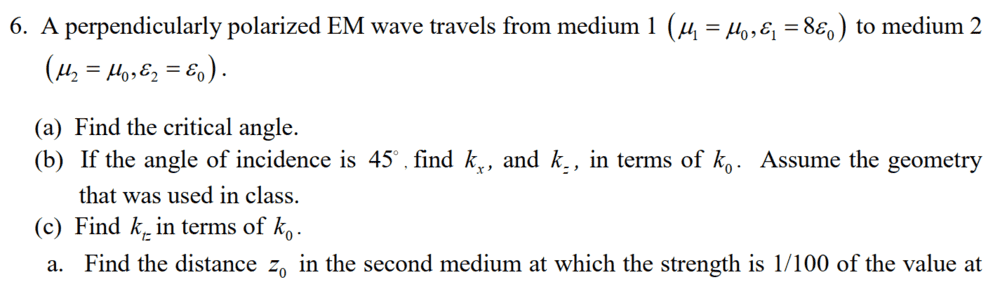
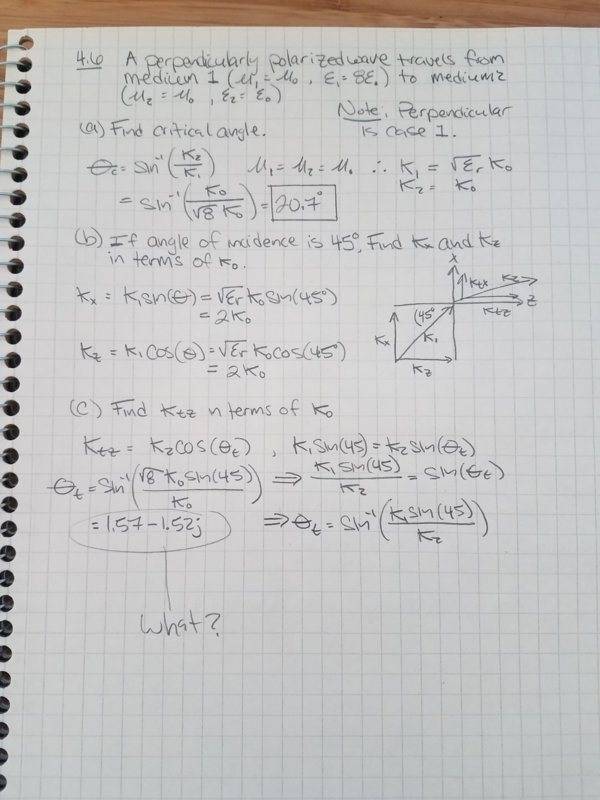
The discussion centers on the interpretation of a complex transmission angle encountered in wave propagation analysis. The user expresses confusion regarding the significance of obtaining a complex number for the transmission angle in part (c) of their problem. It is clarified that when a wave transitions between different media, it can produce a surface wave characterized by a guided wave along the interface, resulting in an elliptical E field vector. The user is advised to utilize the complex number in the cosine function and incorporate the wave number K0 for further calculations.

PREREQUISITES
  • Understanding of wave propagation principles
  • Familiarity with complex numbers in physics
  • Knowledge of surface waves and guided waves
  • Basic proficiency in trigonometric functions and their applications
NEXT STEPS
  • Research the properties of surface waves in different media
  • Learn about the mathematical representation of complex numbers in wave mechanics
  • Study the concept of E field vectors and their behavior during wave propagation
  • Explore the application of wave numbers, specifically K0, in wave analysis
USEFUL FOR

Students and professionals in physics, particularly those studying wave mechanics, as well as engineers working with wave propagation in various media.
thatsmessedup
Messages
27
Reaction score
0
I am getting a complex number for my transmission angle in part (c) but I do not know what that means. Am I even doing this correctly? Any help will be greatly appreciated. Thanks!

Capture.PNG

20191026_140532.jpg
 
Engineering news on Phys.org
thatsmessedup said:
I am getting a complex number for my transmission angle in part (c) but I do not know what that means. Am I even doing this correctly? Any help will be greatly appreciated. Thanks!

View attachment 251875
View attachment 251876
When a wave crosses between media, we can see a surface wave. This is a guided wave traveling along the interface, having a field component in the direction of propagation. This component is in quadrature to the main wave. In effect, the E field vector becomes an ellipse.
 
  • Like
Likes   Reactions: thatsmessedup
So to get my Ktz, I will plug the complex number into cos(), slap a K0 in front and call it a day?
 

Similar threads

Replies
8
Views
3K
  • · Replies 24 ·
Replies
24
Views
3K
  • · Replies 2 ·
Replies
2
Views
2K
  • · Replies 7 ·
Replies
7
Views
2K
  • · Replies 2 ·
Replies
2
Views
2K
  • · Replies 77 ·
3
Replies
77
Views
8K
  • · Replies 1 ·
Replies
1
Views
1K
  • · Replies 1 ·
Replies
1
Views
2K
  • · Replies 8 ·
Replies
8
Views
2K
  • · Replies 4 ·
Replies
4
Views
1K