What does this expression involving Partial Derivatives mean?

Join the discussion
Registration is free. Ask a follow-up in this thread, or start your own.
5 replies · 1K views
physicss
Messages
25
Reaction score
4
Homework Statement
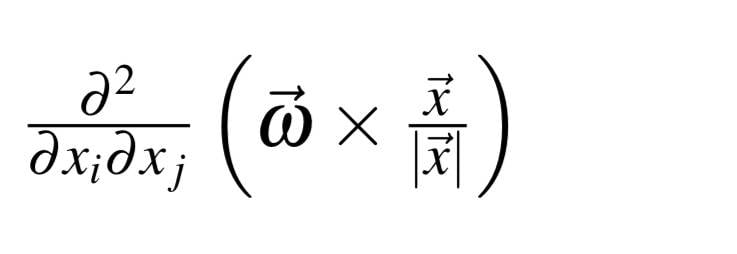
Hello, what does this expression mean?
Relevant Equations
(Picture)
I already solved w x x/|x|
For (w1,w2,w3) and (x1,x2,x3)
2E486A9A-524A-4515-AC6C-71F2B9313E92.jpeg
 
Physics news on Phys.org
haruspex said:
Then you just have to take the partial derivative wrt ##x_i## and again wrt ##x_j##.
Thanks for the answer. Would xi and xj be x1 and x2 in this case?
 
physicss said:
Thanks for the answer. Would xi and xj be x1 and x2 in this case?
No. Because the function is symmetric in the three parameters, you can replace them with ##x_i##, ##x_j##, ##x_k##, where it is understood that {i,j,k}={1,2,3}, but which is which is unspecified.
For example, suppose you had the function ##x_1x_2x_3## then its partial derivative wrt ##x_i## and ##x_j## would be ##x_k##.

Edit, you might also need to assume that i, j, k are in the same cyclic order as 1, 2, 3.

Edit 2: Just realised my posts may be off the mark. I need to solve it myself first.

Edit 3:
Rereading the question, I see it does not refer to indices 1, 2, 3. That is something you assumed. So my correct answer to your post #3 is:

Yes, they are using i, j, k as the indices, not 1, 2, 3.
 
haruspex said:
No. Because the function is symmetric in the three parameters, you can replace them with ##x_i##, ##x_j##, ##x_k##, where it is understood that {i,j,k}={1,2,3}, but which is which is unspecified.
For example, suppose you had the function ##x_1x_2x_3## then its partial derivative wrt ##x_i## and ##x_j## would be ##x_k##.

Edit, you might also need to assume that i, j, k are in the same cyclic order as 1, 2, 3.

Edit 2: Just realised my posts may be off the mark. I need to solve it myself first.

Edit 3:
Rereading the question, I see it does not refer to indices 1, 2, 3. That is something you assumed. So my correct answer to your post #3 is:

Yes, they are using i, j, k as the indices, not 1, 2, 3.
Thank you
 
Presumably ##\vec {\omega}## is constant and does not depend on the ##x_i##. I would try the brute force method which is always safe.
  1. Write ##\dfrac{\vec x}{|\vec x|}=\dfrac{x_1~\hat{x}_1+x_2~\hat{x}_2+x_3~\hat{x}_3}{\left[x_1^2+x_2^2+x_3^2 \right]^{1/2}}.##
  2. Find ##\dfrac{\partial^2}{\partial x_1\partial x_2}\left( \dfrac{x_1~\hat{x}_1+x_2~\hat{x}_2+x_3~\hat{x}_3}{\left[x_1^2+x_2^2+x_3^2 \right]^{1/2}} \right)##.
  3. Do a cyclic permutation of indices to find the other two terms.
  4. Take the cross product.
There might a simpler way to do this but I can't see what it is. I assume that in your original expression you have "off-diagonal" elements only, i.e. it is stipulated somewhere that ##i\neq j##.