What Factors Determine the Breaking Point of a Paddle Under Dynamic Forces?

  • Thread starter Thread starter meanswing
  • Start date Start date
  • Tags Tags
    Break
Click For Summary
SUMMARY

The breaking point of a paddle under dynamic forces is determined by the drag force from water and the force exerted by a pneumatic cylinder. The drag force is calculated using the formula F_w = C_d * rho * v^2 * A_p, while the force from the pneumatic piston is given by F_p = P * A_b. The paddle will fail when the combined forces exceed its yield strength, calculated as sigma = (F_w + F_p) / A_p. Proper analysis involves treating the paddle as a cantilever beam and calculating the bending moment and stress to ensure they remain within safe limits.

PREREQUISITES
  • Understanding of fluid dynamics, specifically drag force calculations.
  • Knowledge of pneumatic systems and pressure force calculations.
  • Familiarity with beam theory and bending stress analysis.
  • Basic principles of material strength, including yield strength and safety factors.
NEXT STEPS
  • Study the principles of fluid dynamics to better understand drag force calculations.
  • Learn about pneumatic systems and how to calculate forces from pressure and area.
  • Research beam theory, focusing on bending moments and stress calculations.
  • Explore material science concepts related to yield strength and factors of safety.
USEFUL FOR

Mechanical engineers, structural analysts, and anyone involved in the design and testing of dynamic systems, particularly those working with fluid dynamics and material strength in mechanical applications.

meanswing
Messages
10
Reaction score
0
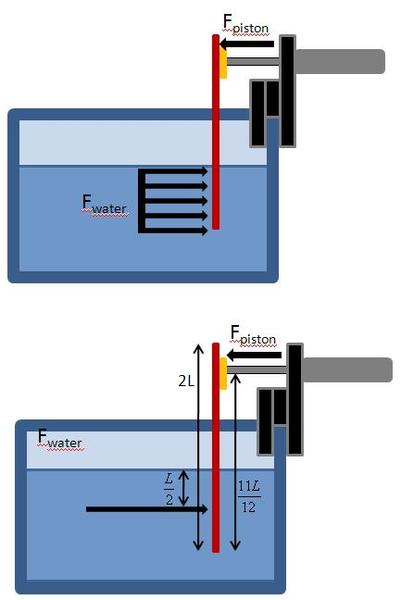
Hi Everyone. I am trying to find out when this paddle (in red) would break due to the force of the drag of the water and from the force of the pneumatic cylinder that is pushing it. I took intro to statics but as you can see with the figure the machine is not static. Can someone point me to the right direction.
______________________________________________________________________________
piston.JPG


Here is my attempt:

let the force of the water be the drag force of the water, F_w = C_d*rho*v^2*A_p , where C_d is the coefficient of drag of the paddle, rho is the density of water, v is the velocity of the paddel, and A_p is the cross sectional area of the paddle exposed to the water. The force of the pneumatic piston is, F_p = P*A_b = P*pi*d^2/4 , such that P is the pressure supplied to the cylinder and d is the diameter of the piston bore.

The paddle will break when the applied forces exceeds the paddles yield strength so. Let sigma be the yield strength resulting from the drag force and the force of the piston.

sigma = (F_w + F_p)/A_p
piston.jpg
 
Engineering news on Phys.org
Is the paddle fixed to the piston? There does not appear to be a pivot point. Does one consider the force of gravity, i.e., weight of paddle.

It is static in the sense that one is looking for the maximum force which would cause the maximum stress to exceed yield or critical shear stress if that is the criterion for failure. The force in the water occurs in conjunction with the force in the piston - but the two forces are not colinear, so there is a moment induced during motion of the paddle.
 
You can treat the problem as a beam. Consider the fixed end to be mounted and not moving. Then use the force of the water as you would a variably loaded cantilever beam. That should help you.
 
@ Astronuc , yes the paddle is fixed to the piston with a bracket (yellow) and the weight of the paddle is negligible compared to the forces applied to it. What do you mean there doesn't seem to be a pivot point?

@cstoos Shouldnt i consider the Force from the piston pushing the bracket. Wouldnt that increase maximum force being applied to the paddle?
 
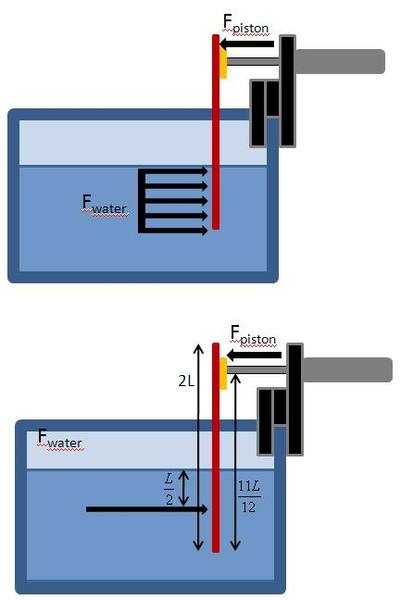
meanswing: The pivot point (or rather, the point about which the paddle would try to rotate, if it could) is the centerpoint of the yellow bracket. The maximum possible force on the paddle, Fw, is Fw = Fp. Therefore, you can use Fp to compute Fw, unless you already have velocity v. You don't include Fp hereafter in the moment summation, because Fp causes no moment about the pivot point. Don't worry too much about shear force. Instead, you need to compute bending moment, M, on the paddle, which is Fw in your second diagram multiplied by the distance from Fw to the yellow bracket. After you obtain M, compute bending stress, sigma = M*c/I. Ensure sigma does not exceed Sty/FSy, where Sty = tensile yield strength, and FSy = yield factor of safety, such as 1.50 or 2.0.
 
Bending Moment is Fw*(2L-11/12L-L/2)=Fw*7L/12, and in your case depend on the velocity.
 

Similar threads

  • · Replies 45 ·
2
Replies
45
Views
6K
  • · Replies 1 ·
Replies
1
Views
2K
  • · Replies 4 ·
Replies
4
Views
5K
  • · Replies 4 ·
Replies
4
Views
2K
  • · Replies 27 ·
Replies
27
Views
4K
  • · Replies 1 ·
Replies
1
Views
3K
Replies
5
Views
4K