What gauge wire to use? noob circuits

Click For Summary
For a setup with two sets of LED strips drawing 8.1A each, 16 AWG copper wire is recommended for runs of 6 to 10 feet due to its capacity to handle the current safely. For shorter runs of 10 to 15 cm carrying 1.35A, 24 AWG wire is suitable. The discussion clarifies that the wiring falls under chassis wiring, which is appropriate for this application. Ambient temperatures between 25-32C are expected, with a maximum of 40C, ensuring the wire can operate safely within these limits. Proper wire gauge selection is crucial for efficiency and safety in electrical circuits.
Sam_A
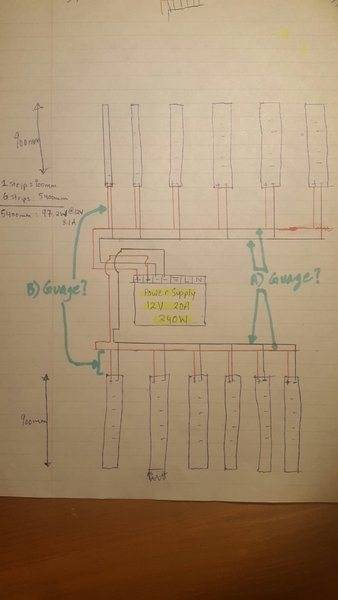
2 sets of 6x LED strips, each 12v 8.1a 97.2W, powered by a single cv 240W PSU, in parallel. The 2 sets are split at the PSU end, each set getting 120W separately. Schematic below,
2017-07-15 12.28.29.jpg


What I don't know is what gauge wire to use at points A and B? Can you please explain what should be used and why?

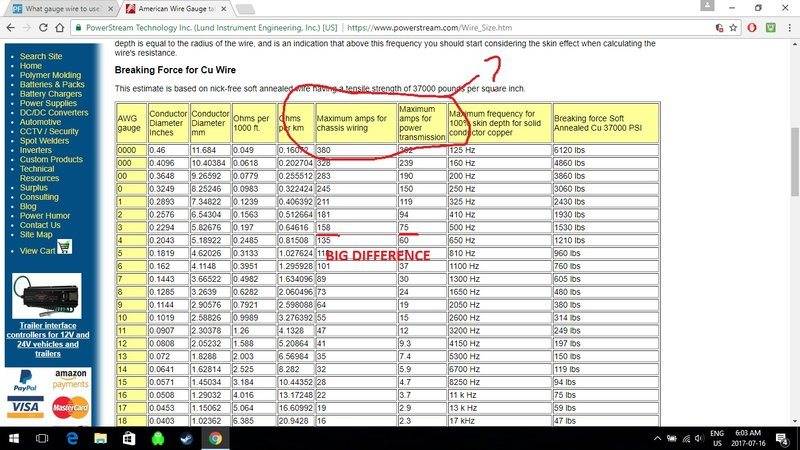
I looked at the AWG chart and I don't understand chassis wiring and power transmission wiring. What category do my wires fall under?
awgchart.jpg


Also, I haven't figured out yet how long exactly will my wires be at point A and B. I know length of the wire has some effect on the gauges, but don't know what effect. Can anybody please present a general guideline or pattern describing what happens as I increase or decrease my wire length?
Much appreciated!
 
Last edited by a moderator:
Engineering news on Phys.org
Sam_A said:
2 sets of 6x LED strips, each 12v 8.1a 97.2W, powered by a single cv 240W PSU, in parallel. The 2 sets are split at the PSU end, each set getting 120W separately. Schematic below,
View attachment 207259

What I don't know is what gauge wire to use at points A and B? Can you please explain what should be used and why?

I looked at the AWG chart and I don't understand chassis wiring and power transmission wiring. What category do my wires fall under?!
For what you are doing it would be considered chassis wiring. Power transmission wiring usually refers to the aluminum, or aluminum/copper clad wires used for high voltage transmission lines. I don't know what they are referring to in the above chart.

What is a wire?
  • Conductor material (copper, tinned copper, aluminum, nickel, silver, etc.).
  • # of strands (1 strand = solid, as in house wiring, or multiple strands of lighter gauge wire, i.,e. - 7x32 is 7 strands of 32 AWG)
  • Insulation material (cloth, rubber, plastic, mica, etc.), thickness, temperature and voltage limits.
What type of wire is appropriate depends on what it is used for. For instance, solid wire is fine for house wiring, but a very poor choice where a lot of flexing is involved. Spark plug wires have very thick insulation because they must operate at high voltage. Cloth covered, silicone rubber insulated copper wire is a good choice for motor leads, but TGGT or (Teflon-Glass-Glass-Teflon) or MG (Mica-Glass) nickel-alloy wire must be used inside industrial ovens, and other high temperature environments. A lot of it boils down to how hot the wire can be allowed to be. Ambient temperature matters, as does whether it is a single conductor in free air (good cooling), or multiple conductors enclosed within conduit.

For 8.1 amps, 16 AWG copper covers all the bases, but for short runs in open air at room temperature you can get away with wire as small as 20 AWG.

For each set of (6) 8.1A light bars, the wires to the power supply carry 48.6 amps.

What I don't understand is how a 20A, 240W power supply will work with 16 light bars at 8.1 amps each (1166W).
 
Last edited:
  • Like
Likes berkeman and Sam_A
Asymptotic said:
For 8.1 amps, 16 AWG copper covers all the bases, but for short runs in open air at room temperature you can get away with wire as small as 20 AWG.
What would you recommend for my setup? How short exactly is a short run?

To give some dimensions, the (A) 8.1a wire(s) will be 6-10 feet each, and the (B) 1.35a wires will be 10-15cm.

The ambient temperature I don't expect to rise past 40C. Mostly, I expect it in the 25-32C range.
 
Oh, I misunderstood.
If each light bar is 1.35A, their 10 to 15 cm runs can be 24 AWG.
16 AWG is still a good choice for 6 to 10 foot runs of the (A) wires.
 
I am trying to understand how transferring electric from the powerplant to my house is more effective using high voltage. The suggested explanation that the current is equal to the power supply divided by the voltage, and hence higher voltage leads to lower current and as a result to a lower power loss on the conductives is very confusing me. I know that the current is determined by the voltage and the resistance, and not by a power capability - which defines a limit to the allowable...

Similar threads

Replies
13
Views
3K
  • · Replies 28 ·
Replies
28
Views
16K
  • · Replies 7 ·
Replies
7
Views
3K
  • · Replies 3 ·
Replies
3
Views
2K
Replies
3
Views
5K
  • · Replies 9 ·
Replies
9
Views
2K
Replies
7
Views
7K
Replies
22
Views
5K
  • · Replies 5 ·
Replies
5
Views
6K
Replies
6
Views
2K