What is the basicity trend of organic compounds?

Click For Summary
SUMMARY

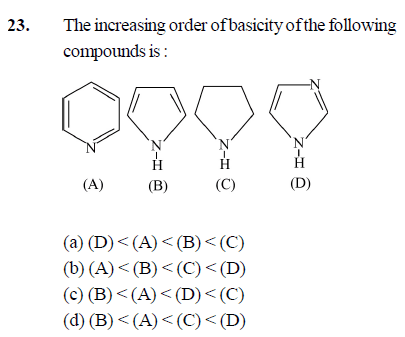
The basicity trend of organic compounds is established as C > D > A > B, with C (Pyrrolidine) exhibiting the highest basic strength due to its sp3 hybridization, resulting in lower electronegativity and easier lone pair donation. D (Imidazole) follows, as it contains two nitrogen atoms, one of which has a lone pair in conjugation, enhancing its basicity. A has one nitrogen atom with a lone pair not in conjugation, while B ranks lowest due to the involvement of its nitrogen's lone pair in aromaticity, hindering donation. The pKa values support this trend, with C at 11.3 and D at 6.95.

PREREQUISITES
  • Understanding of hybridization in organic compounds
  • Knowledge of basicity and pKa values
  • Familiarity with resonance and conjugation effects
  • Concept of aromaticity in organic chemistry
NEXT STEPS
  • Research the hybridization effects on basicity in organic compounds
  • Study the relationship between pKa values and basic strength
  • Explore resonance stabilization in nitrogen-containing compounds
  • Investigate the impact of aromaticity on the reactivity of amines
USEFUL FOR

Chemistry students, organic chemists, and anyone interested in understanding the basicity trends of nitrogen-containing organic compounds.

SpectraPhy09
Messages
23
Reaction score
3
Homework Statement
the increasing order of the basicity of the following
compounds : (Please check the image I have attached for the options )
Relevant Equations
I don't know any
I think the correct ans should be c (i.e C>D>A>B ) but its given d in my textbook( There can be a error also but I'm sure)
I think C should have the highest basic strength since Hybridisation of N in this is Sp3 so it has the least electronegativity so it can donate its lone pair easily
Then it should be D since there are two N atoms of which one's lone pair is in conjugation and one has a lone pair not in conjugation so it can donate that lone pair
Then A because it has only One N atom of whose lone pair is not in the conjugation. So it can donate it. And B last because the lone of N atom here is involved in the Aromaticity of the compound so it would be very difficult for it to donate that lone pair

Plz, can someone tell me if my reasoning is correct?
Amines_Tatva-ex-2(Q.23).png
 
Last edited by a moderator:
Physics news on Phys.org
I agree with your reasoning, and having looked it up I think you're right. Textbooks can make mistakes sometimes!
 
  • Like
Likes   Reactions: SpectraPhy09
Yes I think you could say that the neutral form of D (Imidazole) Is resonance stabilised, and the protonated form not. The pKa of its conjugate acid is 6.95 whereas that of C (Pyrrolidine, you could call it cyclic butylamine) is 11.3.

It's just a secondary amine, which made me think of comparing with diethylamine. pKa of c.a. 10.54. Then I thought, assuming the difference of that with pyrrolidine is significant enough to compare, how rationalise?At first I thought solvent accessibility but predicted the wrong way round, but then I thought no, the cyclic structure can't so easily form a hydrocarbon ball as the diethyl. These amine basicities have the property that you can always rationalise them.
 

Similar threads

  • · Replies 1 ·
Replies
1
Views
4K
  • · Replies 6 ·
Replies
6
Views
3K
Replies
3
Views
2K
  • · Replies 1 ·
Replies
1
Views
2K
  • · Replies 1 ·
Replies
1
Views
3K
  • · Replies 2 ·
Replies
2
Views
2K
Replies
3
Views
6K
  • · Replies 3 ·
Replies
3
Views
2K
  • · Replies 1 ·
Replies
1
Views
2K
  • · Replies 9 ·
Replies
9
Views
8K