What is the Center and Radius of a Circle?

Click For Summary
SUMMARY

The discussion focuses on determining the center and radius of a circle, as well as finding the y-coordinates of intersection points with the y-axis. The equation used is \(x^2 + (y + 1)^2 = 20\), confirming that if the circle intersects the y-axis, the x-coordinate is 0. The y-coordinates of intersection points are calculated as \(y = -1 \pm 2\sqrt{5}\), resulting in the points \((0, -1 + 2\sqrt{5})\) and \((0, -1 - 2\sqrt{5})\).

PREREQUISITES
  • Understanding of circle equations in the form \((x-h)^2 + (y-k)^2 = r^2
  • Knowledge of algebraic manipulation and solving equations
  • Familiarity with square roots and their properties
  • Basic coordinate geometry concepts
NEXT STEPS
  • Learn how to derive the center and radius from the standard form of a circle equation
  • Study the implications of circle intersections with coordinate axes
  • Explore the use of the quadratic formula in solving for y-coordinates
  • Investigate the geometric interpretations of circle equations and their graphs
USEFUL FOR

Students, educators, and anyone interested in mastering the concepts of circle geometry and algebraic equations related to conic sections.

mathdad
Messages
1,280
Reaction score
0
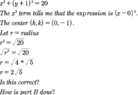
A. Determine the center and radius of circle.

B. Also, find the y-coordinates of the points (if any) where the circle intersects the y-axis.

View attachment 7462
 

Attachments

  • MathMagic171103_1.png
    MathMagic171103_1.png
    18.2 KB · Views: 135
Last edited by a moderator:
Mathematics news on Phys.org
If the circle were to intersect the y-axis, then what would x be?
 
Joppy said:
If the circle were to intersect the y-axis, then what would x be?

If the circle intersects the y-axis, the value of x is 0. True?
 
RTCNTC said:
If the circle intersects the y-axis, the value of x is 0. True?

No. If the circle intersects the y-axis, the value of x is 0 at the point(s) of intersection.

We must be absolutely clear.
 
Re: Center & Radius of Circle

Joppy said:
No. If the circle intersects the y-axis, the value of x is 0 at the point(s) of intersection.

We must be absolutely clear.

How is part B found?

- - - Updated - - -

Is my work for part A correct?
 
Yes, part A is correct.

Part B asks you to find the coordinates of the points where the circle intersects the y-axis. Joppy led you to the conclusion that those points must have x= 0. Now put x= 0 in the equation of the circle to determine what y is.
 
Part B

Let x = 0

x^2 + (y + 1)^2 = 20

(0)^2 + (y + 1)^2 = 20

(y + 1)^2 = 20

sqrt{(y + 1)^2} = sqrt{20}

y + 1 = 2•sqrt{5}

y = 2•sqrt{5} - 1

The y-coordinate is 2•sqrt{5} - 1.

Yes?

Is one the points of intersection for the circle
(0, 2•sqrt{5}-1)?
 
At the point:

$$(y+1)^2=20$$

Your next step should be:

$$y+1=\pm\sqrt{20}=\pm2\sqrt{5}$$

Hence:

$$y=-1\pm2\sqrt{5}$$

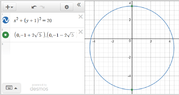
And so the points of intersection of the given circle and the $y$-axis are:

$$\left(0,-1+2\sqrt{5}\right),\,\left(0,-1-2\sqrt{5}\right)$$

View attachment 7485
 

Attachments

  • rtcntc_circle_2.png
    rtcntc_circle_2.png
    13.7 KB · Views: 134
We should be able to convince ourselves that given the circle:

$$(x-h)^2+(y-k)^2=r^2$$

We then know these points are on the circle:

$$(h+r,k),\,(h-r,k),\,(h,k+r),\,(h,k-r)$$
 
  • #10
MarkFL said:
We should be able to convince ourselves that given the circle:

$$(x-h)^2+(y-k)^2=r^2$$

We then know these points are on the circle:

$$(h+r,k),\,(h-r,k),\,(h,k+r),\,(h,k-r)$$

Cool notes. Check your PM.
 

Similar threads

  • · Replies 2 ·
Replies
2
Views
4K
  • · Replies 5 ·
Replies
5
Views
3K
  • · Replies 6 ·
Replies
6
Views
1K
  • · Replies 2 ·
Replies
2
Views
2K
  • · Replies 3 ·
Replies
3
Views
1K
  • · Replies 2 ·
Replies
2
Views
2K
Replies
4
Views
2K
  • · Replies 1 ·
Replies
1
Views
2K
  • · Replies 16 ·
Replies
16
Views
2K
  • · Replies 22 ·
Replies
22
Views
3K