What is the change in potential energy of two blocks in a physics problem?

Click For Summary

Homework Help Overview

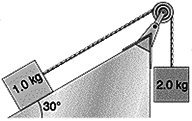
The discussion revolves around a physics problem involving two blocks connected by a cord over a massless, frictionless pulley. The original poster presents a scenario where one block is gaining potential energy while the other is losing it, and seeks clarification on the change in potential energy as the blocks move. The problem includes specific details about the masses and their speeds, prompting various interpretations and approaches to the energy calculations involved.

Discussion Character

  • Mixed

Approaches and Questions Raised

  • Participants explore the implications of the blocks moving at the same speed and question the correctness of the energy approach. Some suggest that the original poster may have omitted details regarding the masses of the blocks. Others discuss the relationship between kinetic energy and potential energy, raising concerns about the completeness of the original student's reasoning.

Discussion Status

The discussion is active, with participants offering various insights and questioning assumptions about the energy relationships in the system. Some guidance has been provided regarding the use of energy conservation principles, while others emphasize the need to consider non-conservative forces and the specific roles of the blocks' weights in the calculations.

Contextual Notes

There are indications that some participants believe the problem may lack sufficient detail, particularly regarding the masses of the blocks and their respective movements. The discussion also touches on the potential confusion between conservative and non-conservative forces in the context of energy calculations.

Physicscookie
Messages
3
Reaction score
1
Member warned to use the formatting template for homework posts.
I present the following problem to my AP and have received a variety of answers, being a new physics teacher I am not sure that my answer is correct. I would love to see the solution and justification.
Thanks
One attempt based on the inference that one block is gaining U (A) and the other (B) 1 is loosing it
1/2 mv2 b - 1/2 mv2a = 4.5 J

In the figure below, the pulley is massless, and both it and the inclined plane are frictionless. The masses are released from rest with the connecting cord taut. Some time later the 2.0 kg block has a speed of 3 m/s. What was the change in potential energy of both blocks?
upload_2015-12-23_9-47-49.png
 
  • Like
Likes   Reactions: NascentOxygen
Physics news on Phys.org
The string restricts the blocks to move at the same speed though so wouldn't 1/2 m(vb)^2 - 1/2 m(va)^2 = 0?
 
Alvise_Souta said:
The string restricts the blocks to move at the same speed though so wouldn't 1/2 m(vb)^2 - 1/2 m(va)^2 = 0?
The OP probably left out the subscripts in the mass terms. The two blocks have different masses.

I don't see anything wrong with the energy approach - it should give the correct answer. Is there any particular reason why you're doubtful about it?
 
Fightfish said:
The OP probably left out the subscripts in the mass terms. The two blocks have different masses.

I don't see anything wrong with the energy approach - it should give the correct answer. Is there any particular reason why you're doubtful about it?

If
Alvise_Souta said:
The string restricts the blocks to move at the same speed though so wouldn't 1/2 m(vb)^2 - 1/2 m(va)^2 = 0?

wouldn't that equate to them having the same kinetic energy? but since they are both moving at the same speed with different masses it can't equal zero?
 
Physicscookie said:
Ifwouldn't that equate to them having the same kinetic energy? but since they are both moving at the same speed with different masses it can't equal zero?
Yes indeed I overlooked the unequal masses
 
  • Like
Likes   Reactions: Physicscookie
Fightfish said:
The OP probably left out the subscripts in the mass terms. The two blocks have different masses.

I don't see anything wrong with the energy approach - it should give the correct answer. Is there any particular reason why you're doubtful about it?
One students argument in the change of U should be negative since in the end there is less potential energy...
Another approach was to calculate the total energy 1/2 ma+mbv2 which ends up being 13.5 and since

Emech =U + K U = -13.5
 
Last edited:
I think the problem here is the "approaches" you present are not exactly complete enough for us to comment on their correctness. The energy approach is the right way to go about it, although whether the students execute it correctly is another question altogether.
You just have to use
\Delta \mathrm{KE} = - \Delta U
and make use of the fact that the cord remains taut throughout.
 
  • Like
Likes   Reactions: Physicscookie
The problem with the student solution is that he is ignoring the fact that the weight force of the block "A" is doing negative work. So the relationship ΔKE=−ΔU is not complete, in this case. What we need is to decompose the Weight of block "A" in the x-direction:
WeightA = 9,81 N → Weight Ax = 9,81 × (sin 30°) = 4,905 N.
Okay, now we need to figure out what is the work made by that force, I did using the block "B":
WB = ΔKE = ½×2×(32) = 9J
By definition: Work = F×Δx, therefore:
ΔxB = 9J/19,62N ≅ 0,46 m
If we know how much "B" has moved, and we know the angle of the plane, we can discover the variation of space made by the block "A":
(Sin 30°) = ΔxB/ΔxA → ΔxA ≅ 0,91 m
Now the easy part, just put the values in the relationship:
ΔKE + Wother forces = -ΔU → ΔKE + Wweight of "A" = -ΔU → [½ × (1Kg +2Kg) × 32m/s] - (4,905N × 0,91m) = -ΔU = 13,5 - 4,5 = 9J
If the system is composed of two objects, the potential energy of the variation is 4,5J for each block , which is the response obtained by Physicscookie. I think that's the way that we can solve the problem. I hope I've helped, and sorry for bad English.
 
Last edited:
Pedro Delano said:
The problem with the student solution is that he is ignoring the fact that the weight force of the block "A" is doing negative work. So the relationship ΔKE=−ΔU is not complete, in this case.
I would be very disturbed if \Delta KE + \Delta U \neq 0 for a closed system.
Pedro Delano said:
If the system is composed of two objects, the potential energy of the variation is 4,5J for each block
No, the magnitude of the change in gravitational potential energy should be different for each block...

If you want to do a force analysis, you shouldn't mix it up with the energy approach, and you need to consider the tension in the rope as well.
 
  • #10
Fightfish said:
I would be very disturbed if \Delta KE + \Delta U \neq 0 for a closed system.
Well, if there is a non-conservative force acting on a system (like friction force, or, in this case, the weight in x-direction), the relationship ΔKE = -ΔU is incomplete, because you need to add the work made by the non-conservative forces. The relationship becomes ΔKE + Workadditional = -ΔU.
If you want to do a force analysis, you shouldn't mix it up with the energy approach, and you need to consider the tension in the rope as well.
I saw that type of solution (using the work of the weight in the x-direction) made by a book called "Physics I, 12ª Ed." by Young & Freedman, in the chapter 7, exercise number 73, it's a little different, cause involves elastic potencial energy, but the ideia is there.
Anyway, sorry if I made a mistake.
 
  • #11
Pedro Delano said:
Well, if there is a non-conservative force acting on a system (like friction force, or, in this case, the weight in x-direction), the relationship ΔKE = -ΔU is incomplete, because you need to add the work made by the non-conservative forces. The relationship becomes ΔKE + Workadditional = -ΔU.
"Weight", otherwise known as gravitational force, is conservative.
 
  • #12
Fightfish said:
"Weight", otherwise known as gravitational force, is conservative.
Yes, I tried to solve the problem that way because of that exercise on the book, I was confused when I saw the solution, but I tried to see that force similarly to a force of friction made by the block. It seems that the solution is wrong, sorry.
 
  • #13
If you calculate potential energy as work of acting forces you cannot calculate again as potential energy. There is double calculation.
$$ T = \frac{1}{2}(m_1+m_2)v^2 \,\,\,\, U = g(m_1h_1+m_2h_2) $$
Take the pulley as reference point we have by geometry:
$$ h_2 \to h \,\, and \,\, h_1 \to (l-h)\sin\phi \Rightarrow U(h) = gm_1(l-h)\sin\phi + gm_2h $$
Now we have:
$$ T = \frac{1}{2}(m_1+m_2)\left(\frac{dh}{dt}\right)^2 \,\,and\,\, U = m_1gl + (m_2-m_1\sin\phi)gh $$
 
  • Like
Likes   Reactions: Pedro Delano

Similar threads

Replies
9
Views
1K
  • · Replies 23 ·
Replies
23
Views
2K
  • · Replies 7 ·
Replies
7
Views
3K
Replies
1
Views
1K
  • · Replies 3 ·
Replies
3
Views
2K
Replies
24
Views
4K
  • · Replies 6 ·
Replies
6
Views
2K
  • · Replies 4 ·
Replies
4
Views
3K
  • · Replies 3 ·
Replies
3
Views
3K